Home
Class 12
MATHS
A vertical line passing through the poin...

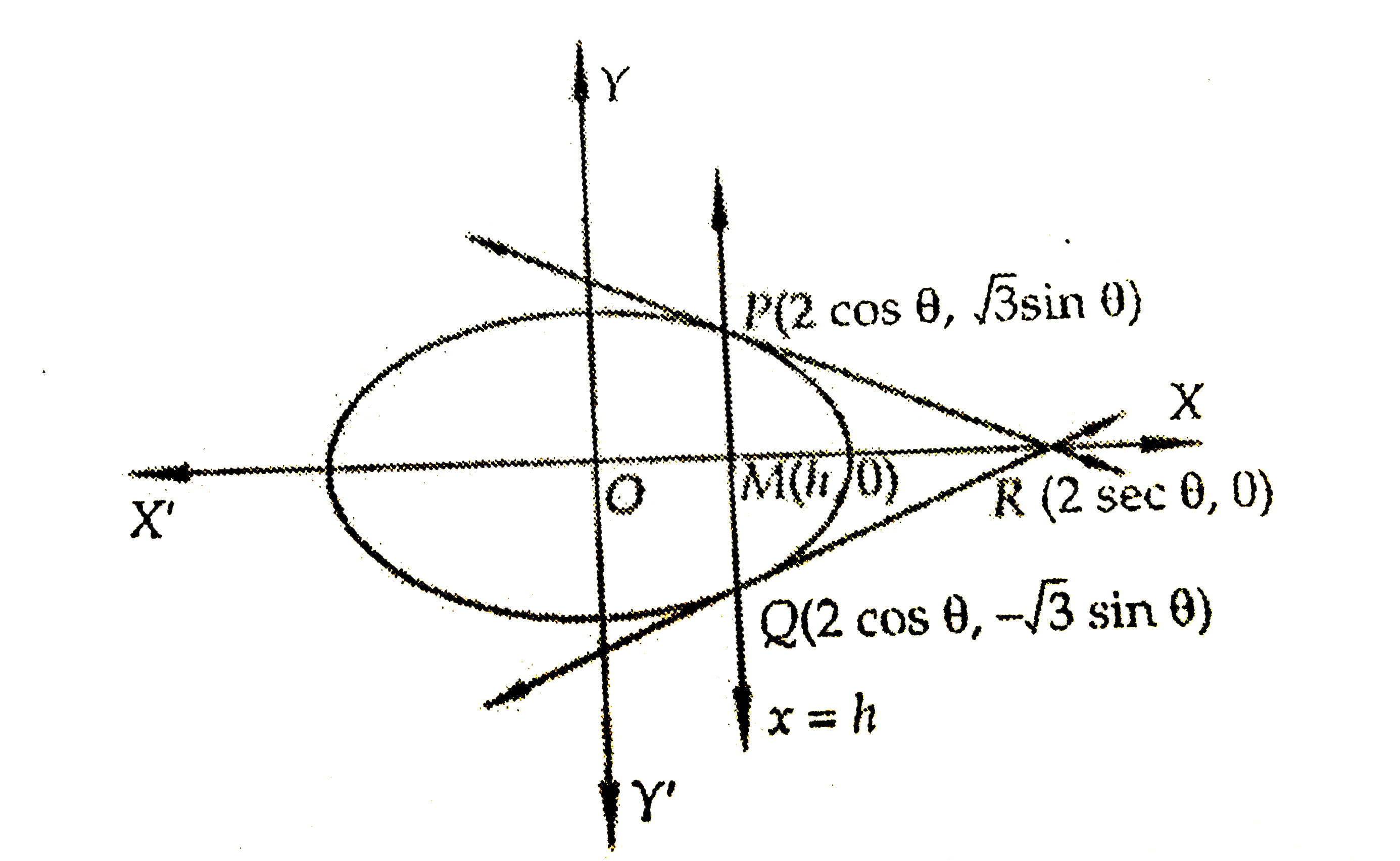
A vertical line passing through the point (h, 0) intersects the ellipse `(x^(2))/(4)+(y^(2))/(3)=1` at the point P and Q. Let the tangents to the ellipse at P and Q meet at the point R.
If `Delta(h)= " Area of the "DeltaPQR, Delta_(1)(h)=underset(1//2lehle1)max Delta(h)`
and `Delta_(2)(h)=underset(1//2lehle1)minDelta(h), then(8)/(sqrt5)Delta_(1)-8Delta_(2)=`

A

`(36)/(8)`

B

`(45sqrt5)/(8)`

C

9

D

8

Text Solution

Verified by Experts

The correct Answer is:
D

Let the coordinates of P be `(2costheta, sqrt3sintheta)`. Then, the coordinates of Q are `(2costheta, -sqrt3sintheta)`. Then `h = 2costheta`.
The equation of tangents at P and Q are `x//2 costheta+1sqrt3ysintheta=1 and, x//2costheta-y//sqrt3sintheta=1`. These two intersect at R `(2 sec theta, 0)`

`therefore Delta(h)=(1)/(2)(2sectheta-h)(2sqrt3sintheta)[thereforePQ=2sqrt3sinthetafand MR=(2sectheta-h)]`
`rArr Delta(h)=sqrt3(2sectheta-2costheta)sintheta`
`rArr Delta(h)=2sqrt3(sin^(3)theta)/(costheta)" "[thereforecostheta=(h)/(2)]`
`Delta(h)=(4sqrt3)/(h)(1-(h^(2))/(4))=(sqrt3)/(2)((4-h^(2))^(3//2))/(h)`
`(d)/(dh)(Delta(h))=(-sqrt3(2+h^(2))sqrt(4-h^(2)))/(h^(2))lt0 " for "hin(-2,2)`
`rArr Delta(h)` is a decreasing function of h on (-2, 2).
`Delta_(1)=underset(1//2lehle1)maxDelta(h)=Delta((1)/(2))=(45sqrt5)/(8)`
`Delta_(2)=underset(1//2lehle1)minDelta(h)=Delta(1)=(9)/(2)`
Hence, `(8)/sqrt5 Delta_(1)-8Delta_(2)=45-36=9`.
Promotional Banner

Topper's Solved these Questions

  • ELLIPSE

    OBJECTIVE RD SHARMA|Exercise Section II - Assertion Reason Type|7 Videos
  • ELLIPSE

    OBJECTIVE RD SHARMA|Exercise Exercise|82 Videos
  • ELLIPSE

    OBJECTIVE RD SHARMA|Exercise Chapter Test|30 Videos
  • DIFFERENTIATION

    OBJECTIVE RD SHARMA|Exercise Chapter Test|30 Videos
  • EXPONENTIAL AND LOGARITHMIC SERIES

    OBJECTIVE RD SHARMA|Exercise Chapter Test|20 Videos

Similar Questions

Explore conceptually related problems

A vertical line passing through the point (h,0) intersects the ellipse (x^(2))/(4)+(y^(2))/(3)=1 at the points P and Q. Let the tangents to the ellipse at P and Q meet at R. If delta(h) Area of triangle delta PQR, and delta_(1)max_((1)/(2)<=h<=1)delta(h) A further delta_(2)min_((1)/(2)<=h<=1)delta(h) Then (8)/(sqrt(5))delta_(1)-8 delta_(2)

The straight line (x)/(4)+(y)/(3)=1 intersects the ellipse (x^(2))/(16)+(y^(2))/(9)=1 at two points A and B such that area of Delta PAB is equal to 3, the number of such P's is/are

The straight line (x)/(4)+(y)/(3)=1 intersects the ellipse (x^(2))/(16)+(y^(2))/(9)=1 at two points A and B there is a point P on this ellipse such that the area of Delta PAB is equal to 6(sqrt(2)-1) .Then the number of such point (P) is/are

The line x+2y=1 cuts the ellipse x^(2)+4y^(2)=1 1 at two distinct points A and B. Point C is on the ellipse such that area of triangle ABC is maximum, then find point C.

The straight line (x)/(4)+(y)/(3)=1 intersects the ellipse (x^(2))/(16)+(y^(2))/(9)=1 at two points A and B there is a point P on this ellipse such that the area of Delta PAB is equal to 6(sqrt(2)-1) . Then the number of such point (P) is/are (A) 4 (B) 1 (C) 2 (D) 3

Let B the centre of the circle x^(2) + y^(2) - 2x + 4y + 1 = 0 . Let the tangents at two points P and Q on the circle intersect at the point A(3, 1). Then 8.(("area " Delta APQ)/("area " Delta BPQ)) is equal to ________.

P and Q are the points of intersection of the curves y^(2)=4x and x^(2)+y^(2)=12 . If Delta represents the area of the triangle OPQ, O being the origin, then Delta is equal to (sqrt(2)=1.41) .

Suppose S and S' are foci of the ellipse (x^(2))/(25)+(y^(2))/(16)=1 . If P is a variable point on the ellipse and if Delta is the area (in sq. units) of the triangle PSS' then the maximum value of Delta is double of

OBJECTIVE RD SHARMA-ELLIPSE-Section I - Solved Mcqs
  1. Find the locus of the foot of the perpendicular drawn from the cent...

    Text Solution

    |

  2. Let P(x1, y1) and Q(x2, y2), y1 < 0, y2 < 0, be the end points of the...

    Text Solution

    |

  3. The locus of the point of intersection of perpendicular tangents to x^...

    Text Solution

    |

  4. Let S=(3,4) and S'=(9,12) be two foci of an ellipse. If the coordinate...

    Text Solution

    |

  5. The tangent at a point P(acosvarphi,bsinvarphi) of the ellipse (x^2)/(...

    Text Solution

    |

  6. Let d1a n dd2 be the length of the perpendiculars drawn from the foci ...

    Text Solution

    |

  7. A bar of given length moves with its extremities on two fixed strai...

    Text Solution

    |

  8. The normal at a point P on the ellipse x^2+4y^2=16 meets the x-axis at...

    Text Solution

    |

  9. From a point P perpendicular tangents PQ and PR are drawn to ellipse x...

    Text Solution

    |

  10. Tangents are drawn from the point P(3, 4) to the ellipse x^2/9+y^2/4=1...

    Text Solution

    |

  11. Tangents are drawn from the point P(3,4) to the ellipse x^2/9+y^2/4=1...

    Text Solution

    |

  12. Tangents are drawn from the point P(3,4) to the ellipsex^2/9+y^2/4=...

    Text Solution

    |

  13. A vertical line passing through the point (h, 0) intersects the ellips...

    Text Solution

    |

  14. If the normal from the point P(h,1) on the ellipse x^2/6+y^2/3=1 is pe...

    Text Solution

    |

  15. the locus of the foot of perpendicular drawn from the centre of the el...

    Text Solution

    |

  16. Let E(1) and E(2) two ellipse whose centres are at the orgin. Then maj...

    Text Solution

    |

  17. Suppose that the foci of the ellipse (x^(2))/(9)+(y^(2))/(5)=1 are (f(...

    Text Solution

    |

  18. A line intesects the ellipse (x^(2))/(4a^(2))+(y^(2))/(a^(2))=1 at A a...

    Text Solution

    |

  19. Let F(1)(x(1),0)and F(2)(x(2),0)" for "x(1)lt0 and x(2)gt0 the foci of...

    Text Solution

    |

  20. If the tangents to the ellipse at M and N meet at R and the normal to ...

    Text Solution

    |

