Home
Class 11
PHYSICS
A block of ice at -10^@C is slowly heate...

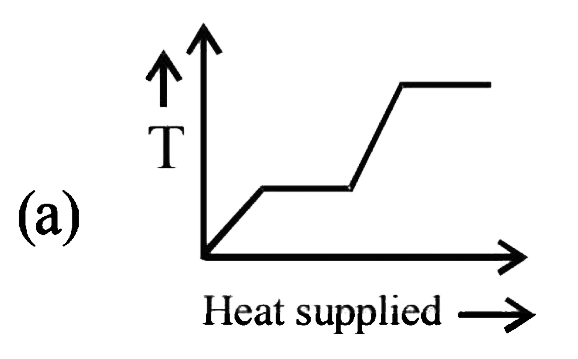
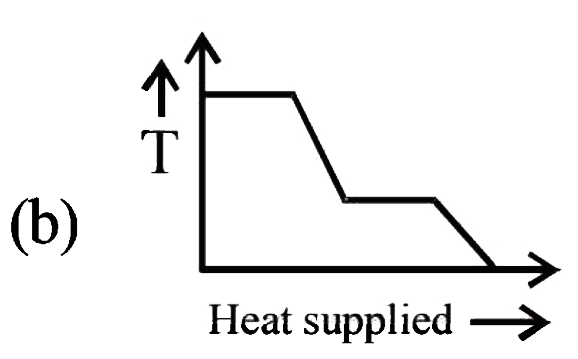
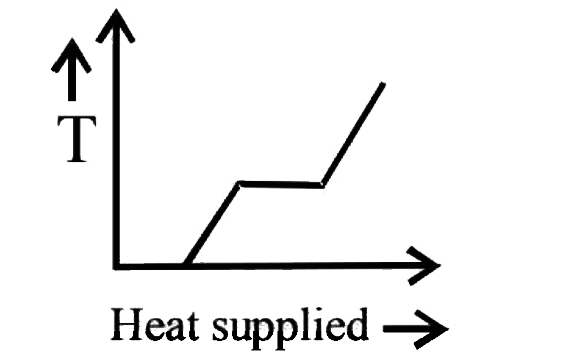
A block of ice at `-10^@C` is slowly heated and converted to steam at `100^@C.` Which of the following curves represents the phenomenon qualitatively?

A

B

C

D

\

Text Solution

AI Generated Solution

The correct Answer is:

To solve the problem of heating a block of ice at -10°C and converting it to steam at 100°C, we can break down the process into several steps, each corresponding to a phase change or temperature change. Here’s a step-by-step solution: ### Step 1: Heating the Ice from -10°C to 0°C - Initially, we have a block of ice at -10°C. We need to heat it to 0°C. - During this phase, the temperature of the ice increases linearly until it reaches 0°C. ### Step 2: Melting the Ice at 0°C - At 0°C, the ice begins to melt. This is a phase change from solid (ice) to liquid (water). - During this phase change, the temperature remains constant at 0°C while the ice absorbs heat and converts to water. ### Step 3: Heating the Water from 0°C to 100°C - Once all the ice has melted, we now have water at 0°C. We need to heat this water to 100°C. - Again, during this phase, the temperature of the water increases linearly until it reaches 100°C. ### Step 4: Boiling the Water at 100°C - At 100°C, the water begins to boil. This is another phase change from liquid (water) to gas (steam). - During this phase change, the temperature remains constant at 100°C while the water absorbs heat and converts to steam. ### Step 5: Heating the Steam Above 100°C - After all the water has turned to steam, if we continue to add heat, the temperature of the steam will increase above 100°C. - This phase will show a linear increase in temperature as we heat the steam. ### Summary of the Curve - The curve representing this process will have: - A linear increase in temperature from -10°C to 0°C (heating ice). - A flat line at 0°C (melting ice). - A linear increase in temperature from 0°C to 100°C (heating water). - A flat line at 100°C (boiling water). - A linear increase in temperature above 100°C (heating steam). ### Final Answer The qualitative representation of this phenomenon can be depicted as a curve with two flat sections (phase changes) and three linear sections (temperature changes). ---

To solve the problem of heating a block of ice at -10°C and converting it to steam at 100°C, we can break down the process into several steps, each corresponding to a phase change or temperature change. Here’s a step-by-step solution: ### Step 1: Heating the Ice from -10°C to 0°C - Initially, we have a block of ice at -10°C. We need to heat it to 0°C. - During this phase, the temperature of the ice increases linearly until it reaches 0°C. ### Step 2: Melting the Ice at 0°C - At 0°C, the ice begins to melt. This is a phase change from solid (ice) to liquid (water). ...
Promotional Banner

Topper's Solved these Questions

  • GRAVITATION

    SUNIL BATRA (41 YEARS IITJEE PHYSICS)|Exercise JEE Main And Advanced|54 Videos
  • LAWS OF MOTION

    SUNIL BATRA (41 YEARS IITJEE PHYSICS)|Exercise JEE Main And Advanced|79 Videos

Similar Questions

Explore conceptually related problems

A block of ice -10^(@)C is slowly heated and converted to steam at 100^(@)C . Which of the following curves represent the phenomenon qualitatively?

A block of ice at -12^(@)C is slowly heated and converted into steam at 100^(@)C . Which of the following curves best represents the event ?

A block of ice at -5^@C is slowly heated and converted to steam at 100^@C . The process can be qualitatively represented by the curve

The ice at 0^(@)C is converted into steam at 100^(@)C . State the isothermal changes in the process.

Ice at 0^(@)C is converted into steam at 100^(@)C . State the isothermal changes in this process?

1g of ice at 0^@ C is mixed 1 g of steam at 100^@ C . The mass of water formed is

SUNIL BATRA (41 YEARS IITJEE PHYSICS)-HEAT AND THERMODYNAMICS-JEE Main And Advanced
  1. The ratio of the speed of sound in nitrogen gas to that in helium gas,...

    Text Solution

    |

  2. A monatomic ideal gas, initially at temperature T1, is enclosed in a c...

    Text Solution

    |

  3. A block of ice at -10^@C is slowly heated and converted to steam at 10...

    Text Solution

    |

  4. An ideal gas is initially at temperature T and volume V. Its volume is...

    Text Solution

    |

  5. Starting with the same initial conditions, an ideal gas expands from v...

    Text Solution

    |

  6. The plots of intensity versus wavelength for three black bodies at tem...

    Text Solution

    |

  7. Three rods made of same material and having the same cross-section hav...

    Text Solution

    |

  8. In a given process on an ideal gas, dW=0 and dQlt0. Then for the gas

    Text Solution

    |

  9. P-V plots for two gases during adiabatic processes are shown in the fi...

    Text Solution

    |

  10. When a block of iron in mercury at 0^@C, fraction K1of its volume is s...

    Text Solution

    |

  11. An ideal gas is taken through the cycle AtoBtoCtoA, as shown in the fi...

    Text Solution

    |

  12. Which of the following graphs correctly represents the variation of be...

    Text Solution

    |

  13. An ideal Black-body at room temperature is thrown into a furnace. It i...

    Text Solution

    |

  14. The graph, shown in the adjacent diagram, represents the variation of ...

    Text Solution

    |

  15. Two rods, one of aluminium and the other made of steel, having initial...

    Text Solution

    |

  16. The PT diagram for an ideal gas is shown in the figure, where AC is an...

    Text Solution

    |

  17. 2kg of ice at 20^C@ is mixed with 5kg of water at 20^C@ in an insulati...

    Text Solution

    |

  18. Three discs A,B and C having radii 2,4 and 6 cm respectively are coate...

    Text Solution

    |

  19. If liquefied oxygen at 1 atmospheric pressure is heated from 50K to 30...

    Text Solution

    |

  20. Two identical rods are connected between two containers on of tehm is ...

    Text Solution

    |
