Home
Class 11
PHYSICS
If a piece of metal is heated to tempera...

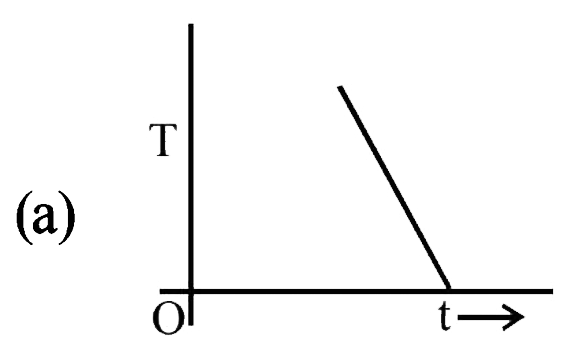
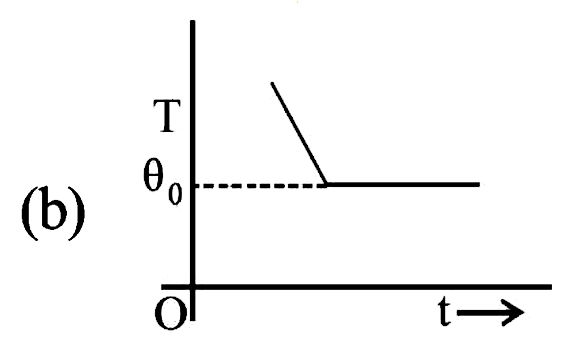
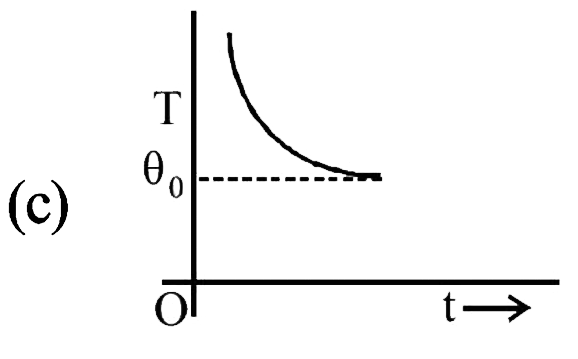
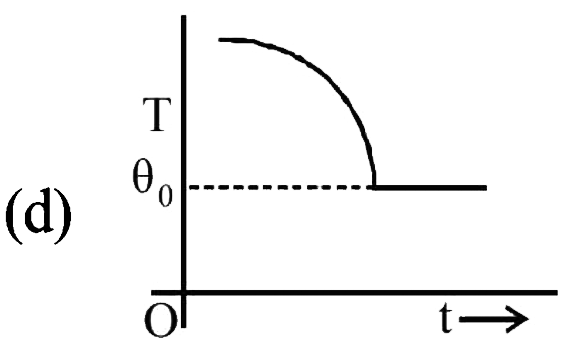
If a piece of metal is heated to temperature `theta` and the allowed to cool in a room which is at temperature `theta_0`, the graph between the temperature T of the metal and time t will be closet to

A

B

C

D

Text Solution

AI Generated Solution

The correct Answer is:

To solve the problem, we need to analyze the cooling of a heated piece of metal according to Newton's Law of Cooling. Let's break down the steps: ### Step-by-Step Solution: 1. **Understanding the Problem**: - We have a piece of metal heated to a temperature \( \theta \). - It is allowed to cool in a room at a constant temperature \( \theta_0 \). - We need to determine the relationship between the temperature \( T \) of the metal and time \( t \). 2. **Applying Newton's Law of Cooling**: - According to Newton's Law of Cooling, the rate of change of temperature of the object is proportional to the difference between its temperature and the ambient temperature. - Mathematically, this can be expressed as: \[ \frac{d\theta}{dt} = -k(\theta - \theta_0) \] where \( k \) is a positive constant. 3. **Rearranging the Equation**: - We can rearrange the equation to isolate the temperature terms: \[ \frac{d\theta}{\theta - \theta_0} = -k \, dt \] 4. **Integrating Both Sides**: - We integrate both sides: \[ \int \frac{d\theta}{\theta - \theta_0} = -k \int dt \] - This gives: \[ \ln|\theta - \theta_0| = -kt + C \] where \( C \) is the integration constant. 5. **Exponentiating to Solve for \( \theta \)**: - To eliminate the logarithm, we exponentiate both sides: \[ |\theta - \theta_0| = e^{-kt + C} = e^C e^{-kt} \] - Let \( A = e^C \), we can write: \[ \theta - \theta_0 = A e^{-kt} \] 6. **Expressing \( \theta \)**: - Thus, we can express the temperature \( \theta \) as: \[ \theta = \theta_0 + A e^{-kt} \] - Here, \( A \) is determined by the initial condition (the initial temperature of the metal). 7. **Identifying the Graph**: - As time \( t \) increases, the term \( A e^{-kt} \) decreases exponentially, meaning that the temperature \( \theta \) approaches \( \theta_0 \) asymptotically. - The graph of \( \theta \) versus \( t \) will show an exponential decay towards \( \theta_0 \). 8. **Conclusion**: - The graph will be a curve that starts at \( \theta \) and approaches \( \theta_0 \) over time, resembling an exponential decay function. - Therefore, the correct answer is option **C**, which represents an exponential decrease.

To solve the problem, we need to analyze the cooling of a heated piece of metal according to Newton's Law of Cooling. Let's break down the steps: ### Step-by-Step Solution: 1. **Understanding the Problem**: - We have a piece of metal heated to a temperature \( \theta \). - It is allowed to cool in a room at a constant temperature \( \theta_0 \). - We need to determine the relationship between the temperature \( T \) of the metal and time \( t \). ...
Promotional Banner

Topper's Solved these Questions

  • GRAVITATION

    SUNIL BATRA (41 YEARS IITJEE PHYSICS)|Exercise JEE Main And Advanced|54 Videos
  • LAWS OF MOTION

    SUNIL BATRA (41 YEARS IITJEE PHYSICS)|Exercise JEE Main And Advanced|79 Videos

Similar Questions

Explore conceptually related problems

Which metal is a liquid at room temperature ?

The specific heat of metals at low temperature is

A sphere of radius r, density, rho and specific heat s is heated to temperature theta and then cooled in an enclosure at temperature theta_(0) . How , the rate of fall of temperature is related with r, rho and s?

The graph between the (velocity^(2)) and temperature T of a gas is

A non-metal which is gas at room temperature

The graph between surface tension and temperature T is

A piece of glass is heated to a high temperature and then allowed to cool. If it cracks, a probable reason for this is the following property of glass

SUNIL BATRA (41 YEARS IITJEE PHYSICS)-HEAT AND THERMODYNAMICS-JEE Main And Advanced
  1. A themallly insulated vessel contains an ideal gas of molecular mass M...

    Text Solution

    |

  2. Three perfect gases at absolute temperature T1,T2, and T3 are mixed. T...

    Text Solution

    |

  3. A Carnot engine operating between temperature T1 and T2 has efficiency...

    Text Solution

    |

  4. 100g of water is heated from 30^@C to 50^@C. Ignoring the slight expan...

    Text Solution

    |

  5. A wooden wheel of radius R is made of two semicircular part . The two ...

    Text Solution

    |

  6. Helium gas goes through a cycle ABCDA (consisting of two isochoric and...

    Text Solution

    |

  7. A liquid in a beaker has temperature theta(t) at time t and theta0 is ...

    Text Solution

    |

  8. A Carnot engine, whose efficiency is 40%, takes in heat from a source ...

    Text Solution

    |

  9. The above p-v diagram represents the thermodymic cycle of an engine, o...

    Text Solution

    |

  10. If a piece of metal is heated to temperature theta and the allowed to ...

    Text Solution

    |

  11. The pressure that has to be applied to the ends of a steel wire of len...

    Text Solution

    |

  12. There is a circular tube in a vertical plane. Two liquids which do not...

    Text Solution

    |

  13. Three rods of Copper, Brass and Steel are welded together to from a Y ...

    Text Solution

    |

  14. One mole of a diatomic ideal gas undergoes a cyclic process ABC as sho...

    Text Solution

    |

  15. A solid body of constant heat capacity 1J//^@C is being heated by keep...

    Text Solution

    |

  16. Consider a spherical shell of radius R at temperature T. The black bod...

    Text Solution

    |

  17. Consider an ideal gas confined in an isolated closed chamber. As the g...

    Text Solution

    |

  18. n' moles of an ideal gas undergoes a process AtoB as shown in the figu...

    Text Solution

    |

  19. A pendulam clock loses 12s a day if the temperature is 40^@C and gains...

    Text Solution

    |

  20. An ideal gas under goes a quasi static, reversible process in whichh i...

    Text Solution

    |
