Home
Class 11
PHYSICS
In the adjoining figure, block A is of m...

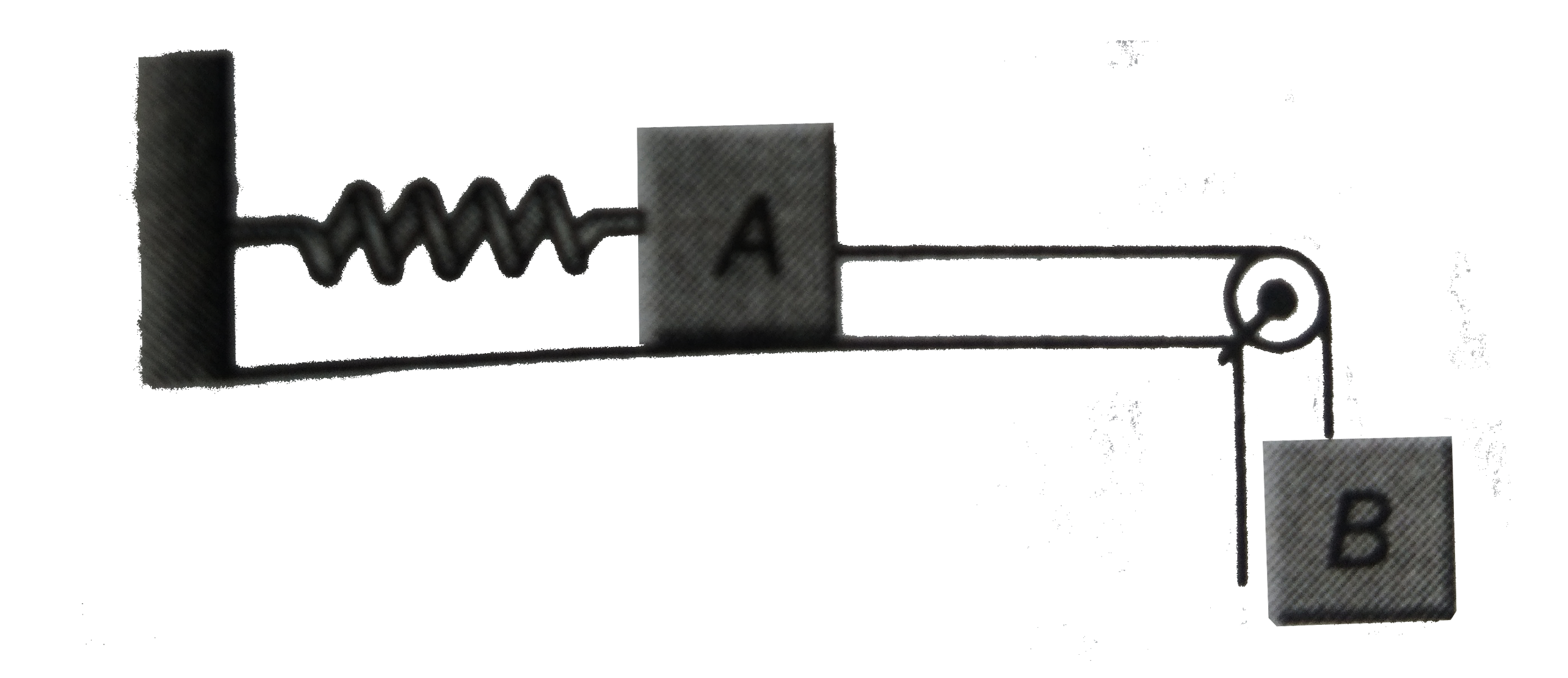
In the adjoining figure, block A is of mass (m) and block B is of mass 2m. The spring has force constant k. All the surfaces are smooth and the system is released form rest with spring unstreched.
.

Text Solution

Verified by Experts

The correct Answer is:
A, B, C, D

(a) At maximum extension in the spring
`v_(A) = v_(B) =0` Therefore, appluing conservation of mechanical energy:
(momentarilt)
Therefore, appluing conservation of mechanical energy:
decreasing in gravitational energy of block B = incrasing in elastic potential
enerrgy of spring .
or `m_(B)gx_(M) =1/2Kx_(m)^(2)`
or `2mgx_(m) =1/2Kx_(m)^(2)`
:. `x_(m) =(4mg)/K`
(b) At `x=x_(m)/2 =(2mg)/K`
Let `v_(A) =v_(B) =v(say)`
The decrase in gravitational potential energy of block (B) =increase in elastic potential energy of spring + increase in kinetic inergy of both the blocks.
`:. m_(B) gx =1/2Kx^(2) +1/2(m_(A) + m_(B)) v^(2)`
or `(2m) (g) ((2mg)/k) = 1/2K ((2mg)/K)^(2) + 1/2(m+2m)v_(2)`
`:. v = 2gsqrtm/(2K)`
(c) At `x=x_(m/4)=(mg)/K`
.
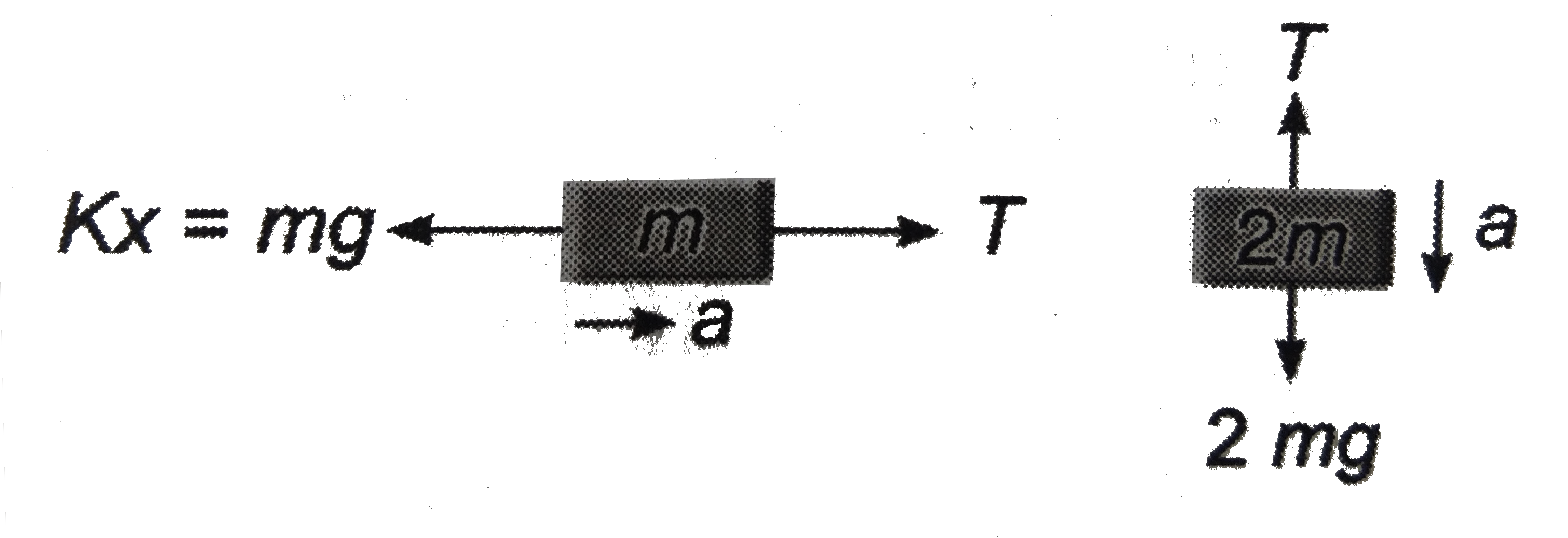
or `Kx=mg`
`a=(Net pulling force)/(Total mass) =(2mg-mg)/3m`
` =g/3`(downwards).
Promotional Banner

Topper's Solved these Questions

  • WORK, ENERGY & POWER

    DC PANDEY|Exercise TYPE2|1 Videos
  • WORK, ENERGY & POWER

    DC PANDEY|Exercise Miscellaneous Example|6 Videos
  • WORK, ENERGY & POWER

    DC PANDEY|Exercise Level 2 Comprehension Based|2 Videos
  • WAVE MOTION

    DC PANDEY|Exercise Integer Type Question|11 Videos
  • WORK, ENERGY AND POWER

    DC PANDEY|Exercise MEDICAL ENTRACES GALLERY|33 Videos

Similar Questions

Explore conceptually related problems

In the adjoining figure, block A is of mass (m) and block B is of mass2 m. The spring has force constant k. All the surfaces are smooth and the system is released form rest with spring unstretched. .

Consider the situation shown in figure. Mass of block A is m and that of blcok B is 2m. The force constant of string is k. Friction is absent everywhere. System is released from rest with the spring unstretched. Find (a) The maximum extension of the spring x_(m) (b) The speed of block A when the extension in the springt is x=(x_(m))/(2) (c ) The net acceleration of block B when extension in the spring is x=(x_(m))/(4).

In the shown diagram mass of A is m and that of B is 2 m. All the surfaces are smooth. System is released from rest with spring unstretched. Then, the maximum extension (x_(m)) in spring will be:

A block of mass m is placed at rest on a smooth wedge of mass M placed at rest on a smooth horizontal surface. As the system is released

A block of mass m is connected to another block of mass M by a spring (massless) of spring constant k. The block are kept on a smooth horizontal plane. Initially the blocks are at rest and the spring is unstretched. Then a constant force F starts acting on the block of mass M to pull it. Find the force of the block of mass M.

A block of mass m is connect to another block of mass M by a massless spring of spring constant k. The blocks are kept on a smooth horizontal plane. Initially the blocks are at rest and the spring is unsrtretched when a constnt force F starts acting on the block of mass M to pull it. Find the maximum extension of the spring.

A block of mass m attached in the lower and vertical spring The spring is hung from a calling and force constant value k The mass is released from rfest with the spring velocity unstrached The maximum value praduced in the length of the spring will be

A block of mass m initially at rest is dropped from a height h on to a spring of force constant k . the maximum compression in the spring is x then

