Home
Class 11
PHYSICS
. In the figure shown, AB = BC = 2m. F...

.
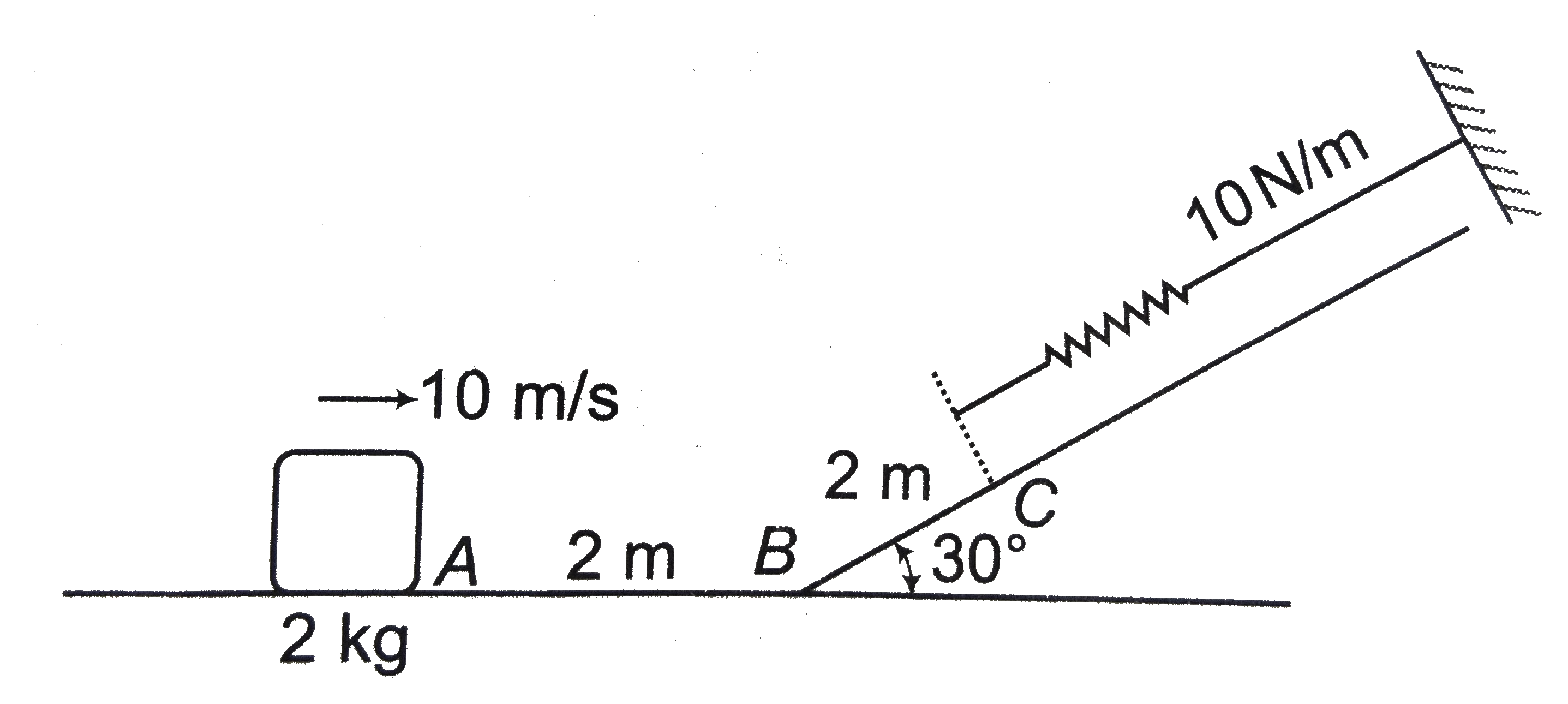
In the figure shown, `AB = BC = 2m`. Friction coefficient everywhere is `mu=0.2.` Find the maximum compression of the spring.

A

`1.48m`

B

`3.45m`

C

`4.75m`

D

`2.45m`

Text Solution

Verified by Experts

The correct Answer is:
D

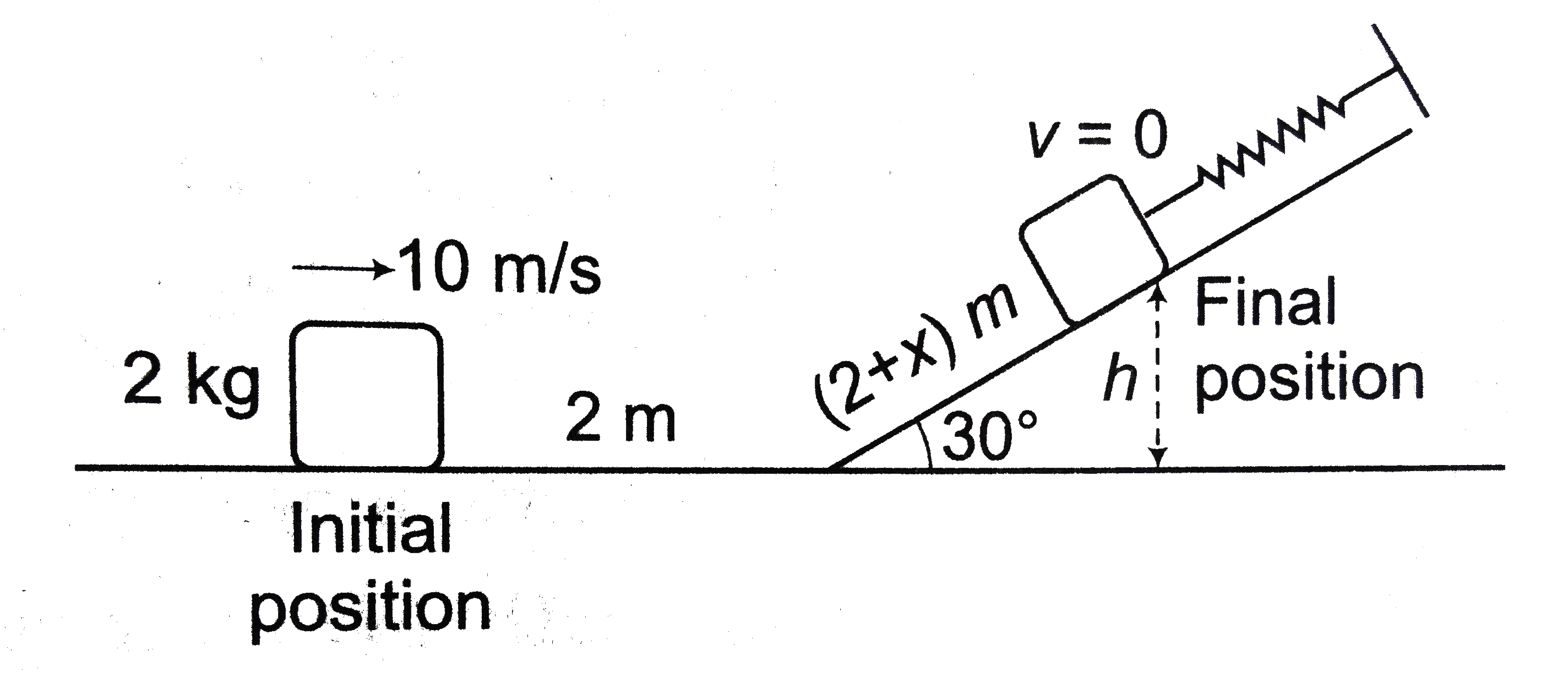
Let x be the maximum extension.
.
`h = (2+x) sin 30^(@) = (1+0.5x)m`
The block has traveled `d_(1) =2m` on rough horizontal ground and `d_(2)=(2+x)m` on rough inclined ground . In the initial position block has only kinetic energy and in the final position spring and gravitational potential energy. so, applying the equation.
`E_(i)-E_(f) =` work done against friction
`rArr ((1)/(2)mv^(2))-((1)/(2)kx^(2) + mgh) = mu mg d_(1) + (mu mg cos theta) d_(2)`
`rArr 1/2 xx 2 xx (10)^(2)-1/2 xx x^(2) -2xx10xx(1+0.5x) = 0.2xx2xx10xx2 + (0.2xx2xx10xxcos 30^@)(2+x)`
Solving this equation we get,
`x=2.45m`.
Promotional Banner

Topper's Solved these Questions

  • WORK, ENERGY & POWER

    DC PANDEY|Exercise TYPE2|1 Videos
  • WORK, ENERGY & POWER

    DC PANDEY|Exercise Miscellaneous Example|6 Videos
  • WORK, ENERGY & POWER

    DC PANDEY|Exercise Level 2 Comprehension Based|2 Videos
  • WAVE MOTION

    DC PANDEY|Exercise Integer Type Question|11 Videos
  • WORK, ENERGY AND POWER

    DC PANDEY|Exercise MEDICAL ENTRACES GALLERY|33 Videos

Similar Questions

Explore conceptually related problems

In the figure shown, the frictional coefficient between the table and the block is 0.2. Find the ratio of tensions in the right and the left strings.

A block of mass m is moving with a speed v on a horizontal rought surface and collides with a horizontal monted spring of spring constant k as shown in the figure .The coefficient of friction between the block and the floor is mu The maximum cobnpression of the spring is

The spring constant of the spring shown in the figure is 250Nm^(-1) . Find the maximum compression of the spring?

Find maximum compression is the spring from the given figure.

The arrangement shown in figure is at rest. An ideal spring of natural length l_0 having spring constant k=220Nm^-1 , is connected to block A. Blocks A and B are connected by an ideal string passing through a friction less pulley. The mass of each block A and B is equal to m=2kg when the spring was in natural length, the whole system is given an acceleration veca as shown. If coefficient of friction of both surfaces is mu=0.25 , then find the maximum extension in 10(m) of the spring. (g=10ms^-2) .

For the arrangement shown in figure, the spring is initially compressed by 3 cm . When the spring is released the block collides with the wall and rebounds to compress the spring again. (a) If the coefficient of restitution is (1)/sqrt(2) , find the maximum compression in the spring after collision. (b) If the time starts at the instant when spring is released, find the minimum time after which the block becomes stationary.

There are two block as shown in the figure of masses 1kg and 4kg . Friction coefficient between any two surfaces are 0.2 then find maximum value of horizontal force F so that both blocks moves together.

A block of mass m is placed on a smooth block of mass M = m with the help of a spring as shown in the figure. A velocity v_(0) is given to upper block when spring is in natural length. Find maximum compression in the spring.

Each of the blocks shown in figure has mass 1 kg. The rear block moves with a speed of 2 m/s towards the front block kept at rest. The spring attached to the front block islight and has a spring constant 50 N/m. find the maximum compression of the spring.

