Home
Class 11
PHYSICS
A disc of mass 3 m and a dise of mass m ...

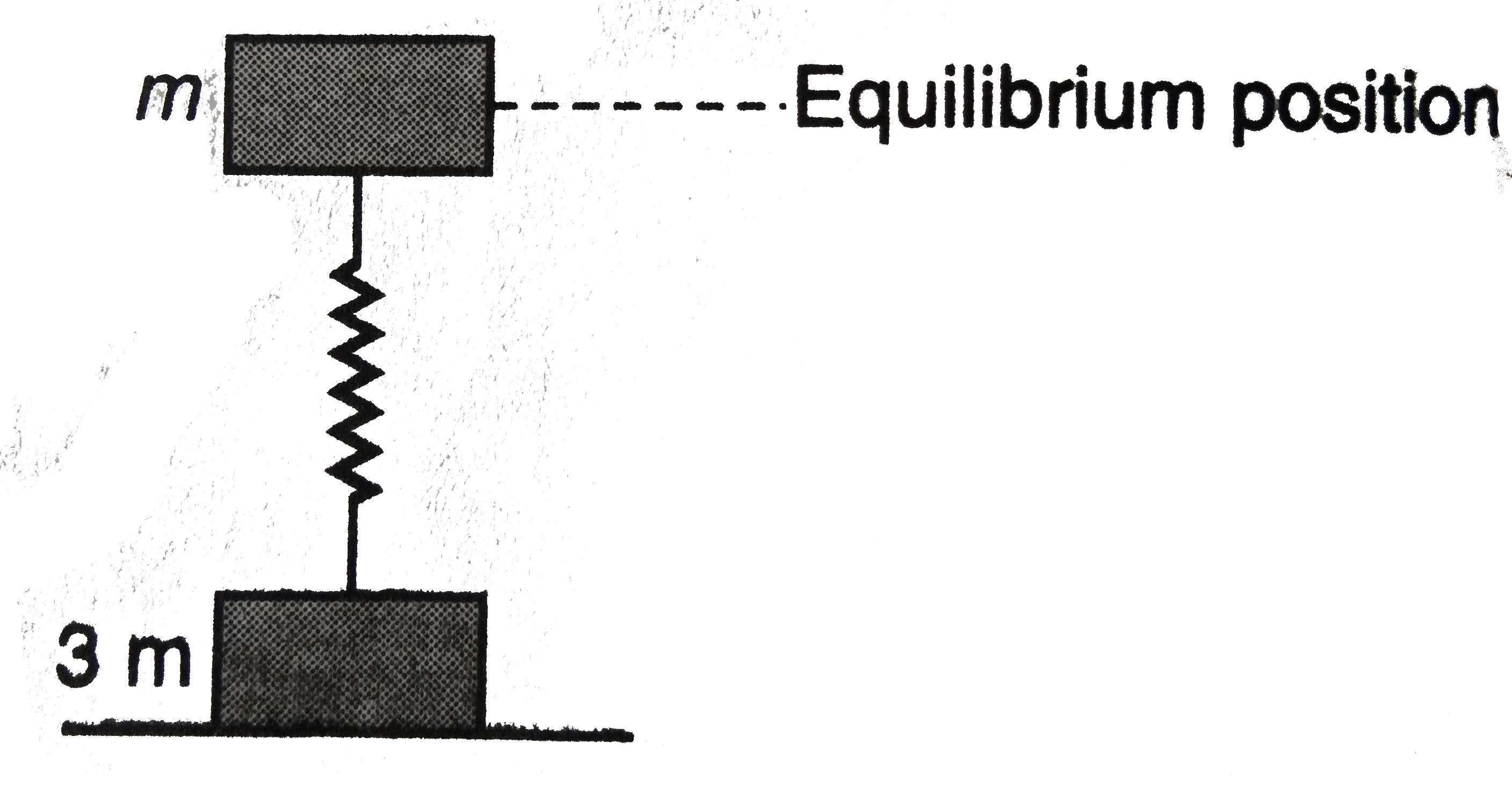
A disc of mass 3 m and a dise of mass m are connected by a massless sping of stiffness k. The heavier is disc placed on the ground with the spring vertical and lighter disc on top from its equilibrium position the upper disc is pushed down by a distance `delta` and released. Then.

A

if `deltagt(3mg)/k` the lower desc will bounce up.

B

if `delta=(2 mg)/k` maximum normal reaction fron on lower disc = 6mg .

C

if `delta=(2 mg)/k` maximum normal reaction from ground on lower disc = 4 mg.

D

if `delta gt (4 mg)/k`, the lower disc will bounce up

Text Solution

Verified by Experts

The correct Answer is:
B, D

At equilirium
.
`kdelta_(0) =mg`
or `delta_(0) =(mg)/k`
where, `delta_(0) ="compression"`
(b) `delta_("Total") =delta + delta_(0) =(3mg)/k`
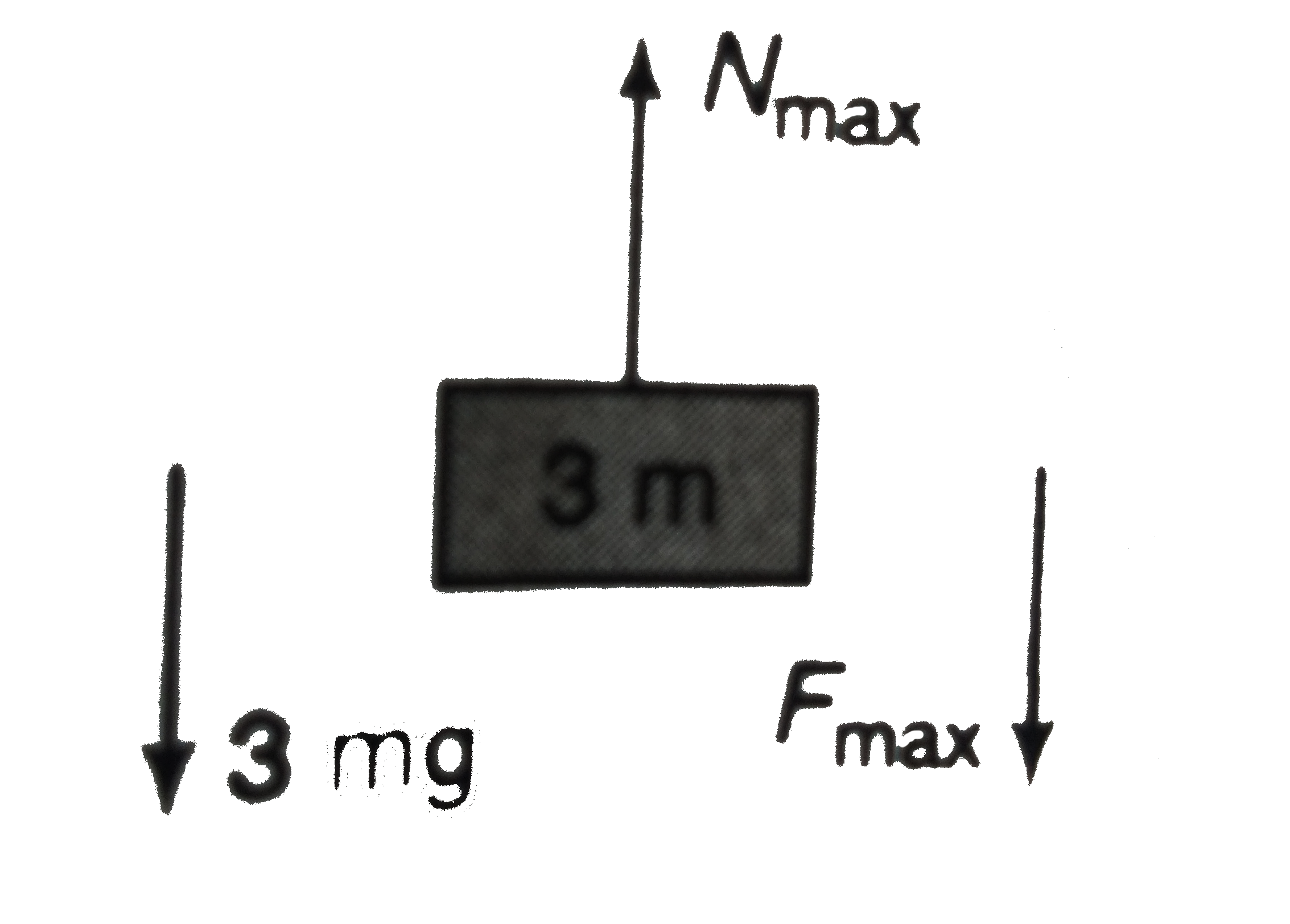
`F_(max) =kdelta_(max) =k((3mg)/k) =3mg ("downward")`

`:. N_(max) =3mg + F_(max) =6mg`
(d) If `deltagt(4mg)/k`, the upper block will move a distance `xgt(4mg)/k-delta_(0)` or `xgt(3mg)/k` from natural length.
Hence in this case, extension
`xgt(3mg)/k`
or `F =kxgt3mg` (upward on lower block)
So lower block will bounce up.
Promotional Banner

Topper's Solved these Questions

  • WORK, ENERGY & POWER

    DC PANDEY|Exercise Level 2 Subjective|15 Videos
  • WORK, ENERGY & POWER

    DC PANDEY|Exercise Level 2 Comprehension Based|2 Videos
  • WORK, ENERGY & POWER

    DC PANDEY|Exercise Level 2 objective|30 Videos
  • WAVE MOTION

    DC PANDEY|Exercise Integer Type Question|11 Videos
  • WORK, ENERGY AND POWER

    DC PANDEY|Exercise MEDICAL ENTRACES GALLERY|33 Videos

Similar Questions

Explore conceptually related problems

Figure shows two discs of same mass m. They are rigidy attached to a spring of stiffness k. The system is in equlibrium. From this equilibrium position, the upper disc is pressed down slowly by a distance x and released. Find the minimum vlue of x, if the lower disc is just lifted off the ground.

A disc of mass m is connected with an ideal spring of stiffness k . If it is released from rest, it rolls without sliding on an inclination plane. The maximum elongation of the spring is:

A uniform circular disc of mass 'm' and radius 'R' is placed on a rough horizontal surface and connected to the two ideal non-deformed spring of stiffness k and 2k at the centre 'C' and point 'A' as shown . The centre of the disc is slighty displaced horizontally from equilibrium positon and then released, then the time period of small oscillation of the disc is (there is no slipping between the disc and the surface).

In the figure shown the spring constant is K the mass of the upper disc is m and that of the lower disc is 3m the upper block is depressed down from its equilibrium position by a distance delta=5mg//k and released at t=0 find the velocity of m when normal reaction on 3m is mg

A disc of mass m and radius R is placed over a plank of same mass m. There is sufficient friction between disc and plank to prevent slipping. A force F is applied at the centre of the disc. Force of friction between the disc and the plank is

A disc of mass m and radius R is placed over a plank of same mass m. There is sufficient friction between disc and plank to prevent slipping. A force F is applied at the centre of the disc. Acceleration of the plank is

A disc of mass m_(2) is placed on a table. A stiff spring is attached to it and is vertical. The other end of the spring is attached to a disc of mass m_(1) What minimum force should be applied to the upper disc to press the spring such that the lower disc is lifted off the table when the external force is suddenly removed?

A uniform disc of mass m and radius R is pivoted smoothly at its centre of mass. A light spring of stiffness k is attached with the dics tangentially as shown in the Fig. Find the angular frequency in (rad)/(s) of torsional oscillation of the disc. (Take m=5kg and K=10(N)/(m) .)