Home
Class 11
PHYSICS
Five particles each of mass 'm' are kept...

Five particles each of mass 'm' are kept at five verties of a regular pentagon . A sixth particles of mass 'M' is kept at center of the pentagon 'O'.Distance between'M' and is 'm' is 'a'. Find
(a) net force on 'M'
(b) magnitude of net force on 'M' if any one particle is removed from one of the verties.

Text Solution

Verified by Experts

The correct Answer is:
A, B

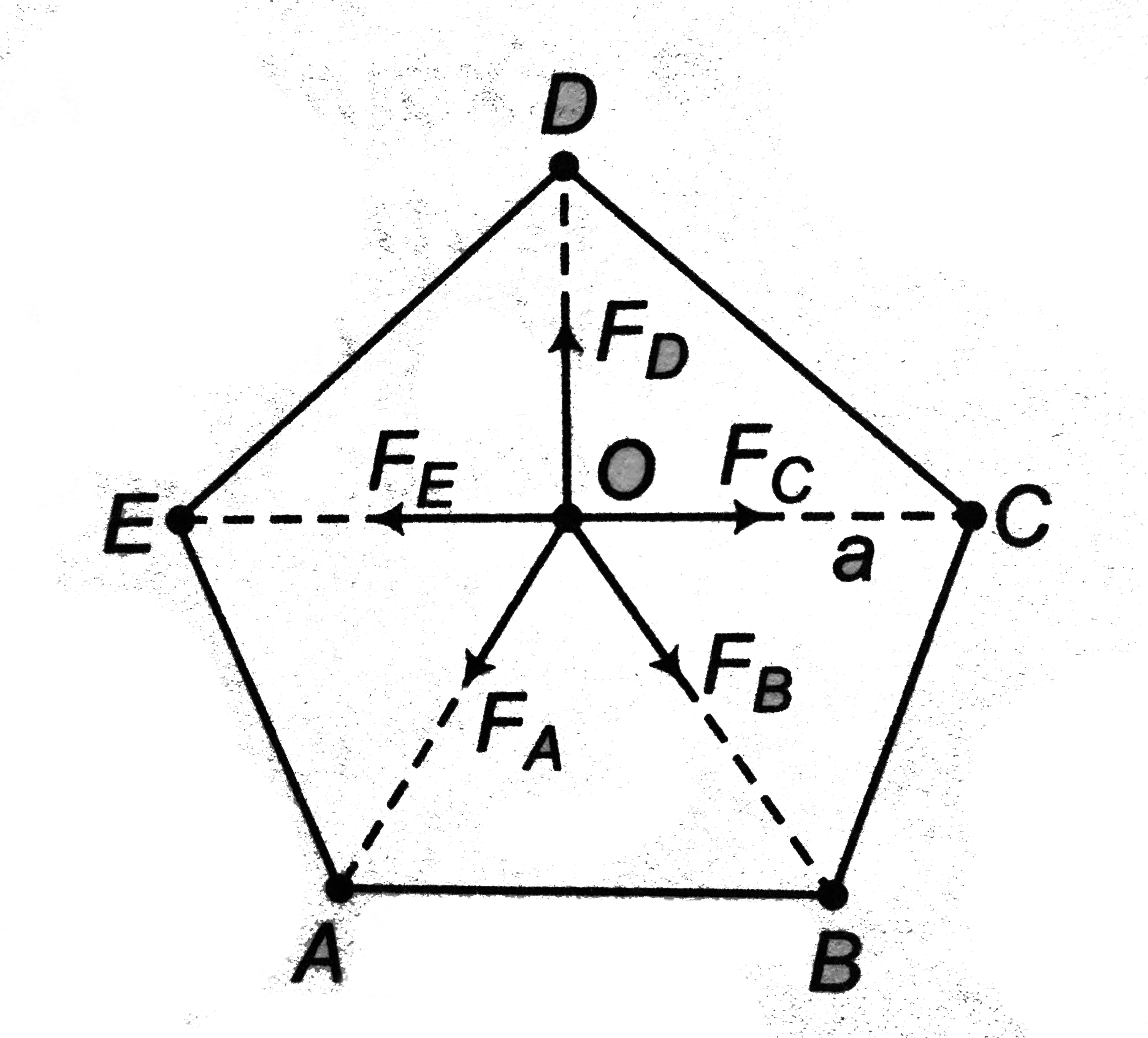
(a)`F_A = F_B = F_C = F_D = F_E = (GMm)/(a^(2))=F`(say)
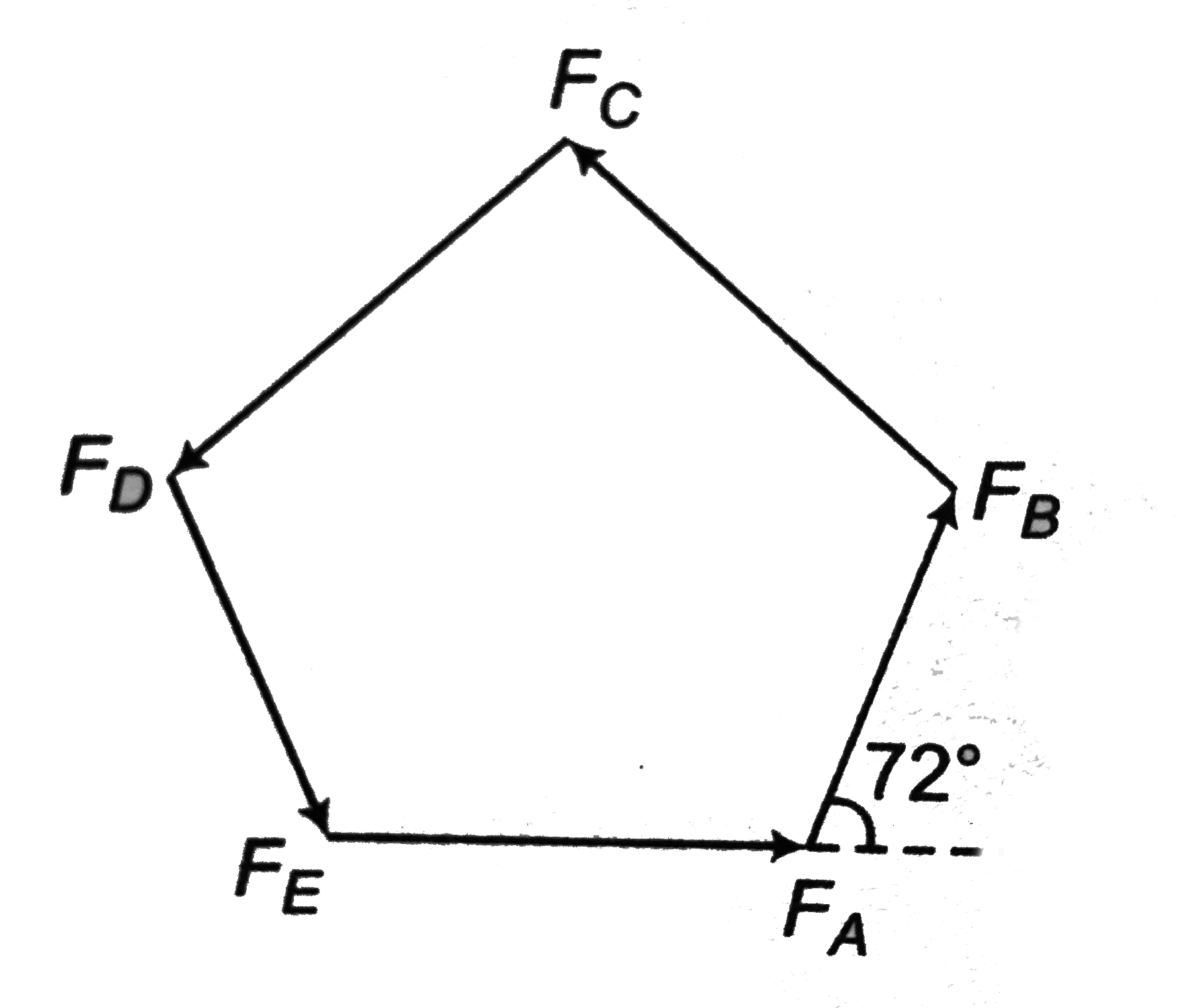
Angle between two successive force vectors is `theta = (360^(@))/(5)=72^(@)`.
When these five force vectors are added as per polygon law of vector addition we get another closed regular polygon as shown below.


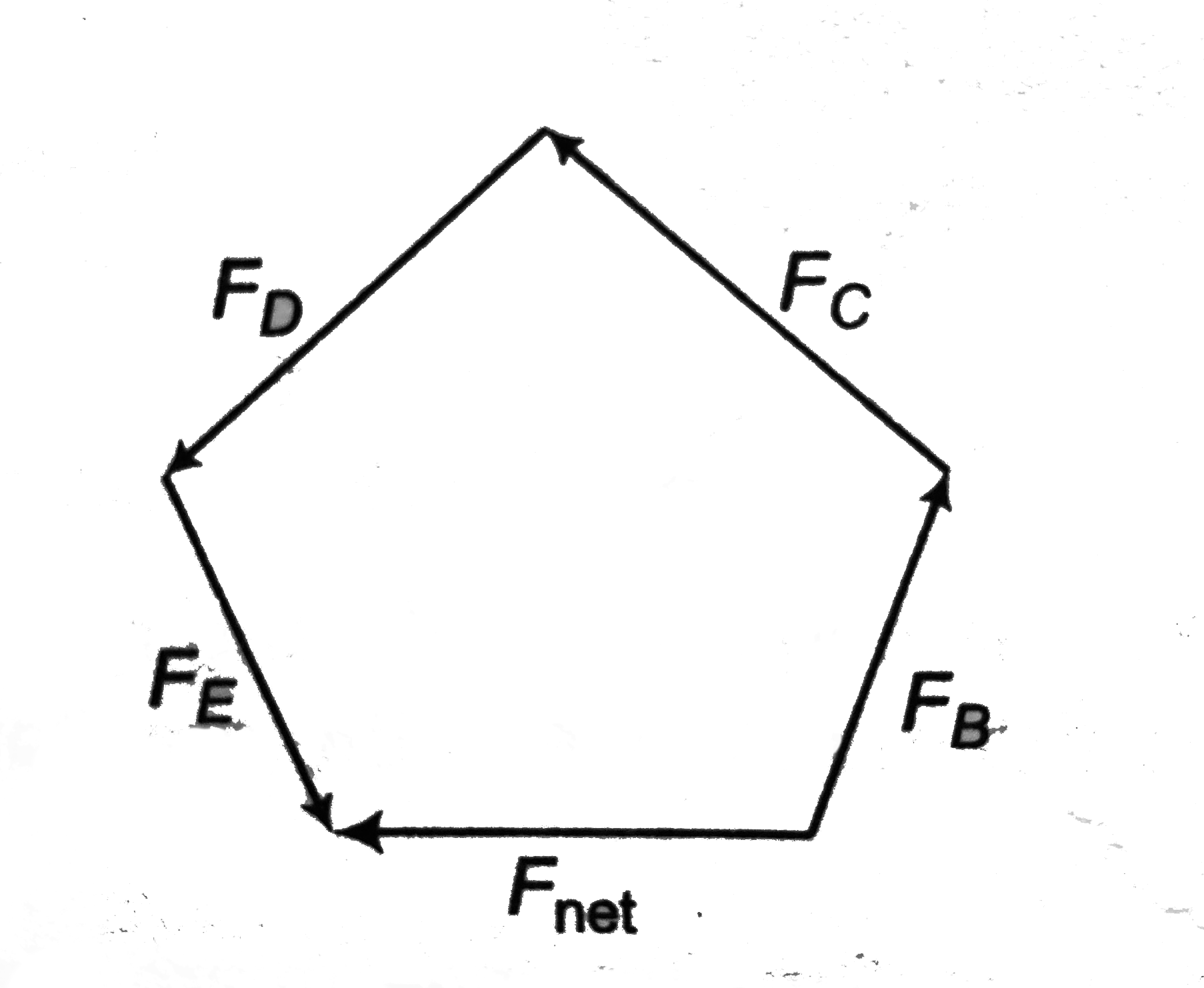
Therefore, net resultant force on 'M' is zero. (b) When particle at A is removed, then `F_(A)` will be removed. So, magnitude of net force will be `F` as shown below:
`:.F_("net") = F =(GMm)/(a^(2))`
Promotional Banner

Topper's Solved these Questions

  • GRAVITATION

    DC PANDEY|Exercise Solved Examples|16 Videos
  • GRAVITATION

    DC PANDEY|Exercise Miscellaneous Examples|8 Videos
  • GENERAL PHYSICS

    DC PANDEY|Exercise INTEGER_TYPE|2 Videos
  • KINEMATICS

    DC PANDEY|Exercise INTEGER_TYPE|11 Videos

Similar Questions

Explore conceptually related problems

Six particles each of mass 'm' are placed at six verties A,B,C,D,Eand F of a regular hexagon of side 'a'. A seventh particle of mass 'M' is kept at center 'O' of the hexagon. (a)Find net force on 'M'. (b)Find net force on 'M' if particles at A is removed. (c) Find net force on 'M' if particles at A and C are removed .

Three particles each of mass m are kept at vertices of an equilateral triangle of side L. The gravitational field at centre due to these particle is

Three particles each of mass m are kept at the vertices of an euilateral triangle of side L . The gravitational field at the centre due to these particle is

Four particles each of mass m are kept at the four vertices of a square of side 'a' . Find graitational potential energy of this system.

Four particles each of mass 'm' are placed at the four vertices of a square 'a' .Find net force on any one the particle.

Six particles each of mass m are placed at the corners of a regular hexagon of edge length a . If a point mass m_0 is placed at the centre of the hexagon, then the net gravitational force on the point mass is

Five point masses m each are kept at five vertices of a regular pentagon. Distance of centre of pentagon from any one of the verticle is 'a'. Find gravitational potential and filed strength at centre.

A heavy nucleous of masss M kept at rest in laboratory rejects a light particle of mass m .

Three particles each of mass m are placed at the three corners of an equilateral triangle of side L. A particle of mass M is kept at the midpoint of any one side. What is the force acting on M, due to this system of 3 particles ?

Eight particles of mass 'm' each are placed at the verties of a cube of side 'a' . Find gravitational potential energy of this system . .

DC PANDEY-GRAVITATION-(C) Chapter Exercises
  1. Five particles each of mass 'm' are kept at five verties of a regular ...

    Text Solution

    |

  2. Starting from the centre of the earth having radius R, the variation o...

    Text Solution

    |

  3. A satellite of mass m is orbiting the earth (of radius R) at a height ...

    Text Solution

    |

  4. At what height from the surface of earth the gravitation potential and...

    Text Solution

    |

  5. The ratio of escape velocity at earth (v(e)) to the escape velocity at...

    Text Solution

    |

  6. Kepler's third law states that square of period revolution (T) of a pl...

    Text Solution

    |

  7. The reading of a spring balance corresponds to 100 N while situated at...

    Text Solution

    |

  8. The gravitational field due to an uniform solid sphere of mass M and r...

    Text Solution

    |

  9. What would be the value of acceleration due to gravity at a point 5 km...

    Text Solution

    |

  10. Two particles of equal mass (m) each move in a circle of radius (r) un...

    Text Solution

    |

  11. What would be the escape velocity from the moon, it the mass of the mo...

    Text Solution

    |

  12. Two spheres of masses 16 kg and 4 kg are separated by a distance 30 m ...

    Text Solution

    |

  13. Orbital velocity of an artificial satellite does not depend upon

    Text Solution

    |

  14. Gravitational potential energy of body of mass m at a height of h abov...

    Text Solution

    |

  15. According to Kepler's law of planetary motion, if T represents time pe...

    Text Solution

    |

  16. If mass of a body is M on the earth surface, then the mass of the same...

    Text Solution

    |

  17. Two spherical bodies of masses m and 5m and radii R and 2R respectivel...

    Text Solution

    |

  18. The force of gravitation is

    Text Solution

    |

  19. Dependence of intensity of gravitational field (E) of earth with dista...

    Text Solution

    |

  20. Keeping the mass of the earth as constant, if its radius is reduced to...

    Text Solution

    |

  21. A body of mass m is raised to a height 10 R from the surface of the ea...

    Text Solution

    |