Home
Class 11
PHYSICS
In the figure masses 400 kg and 100 kg a...

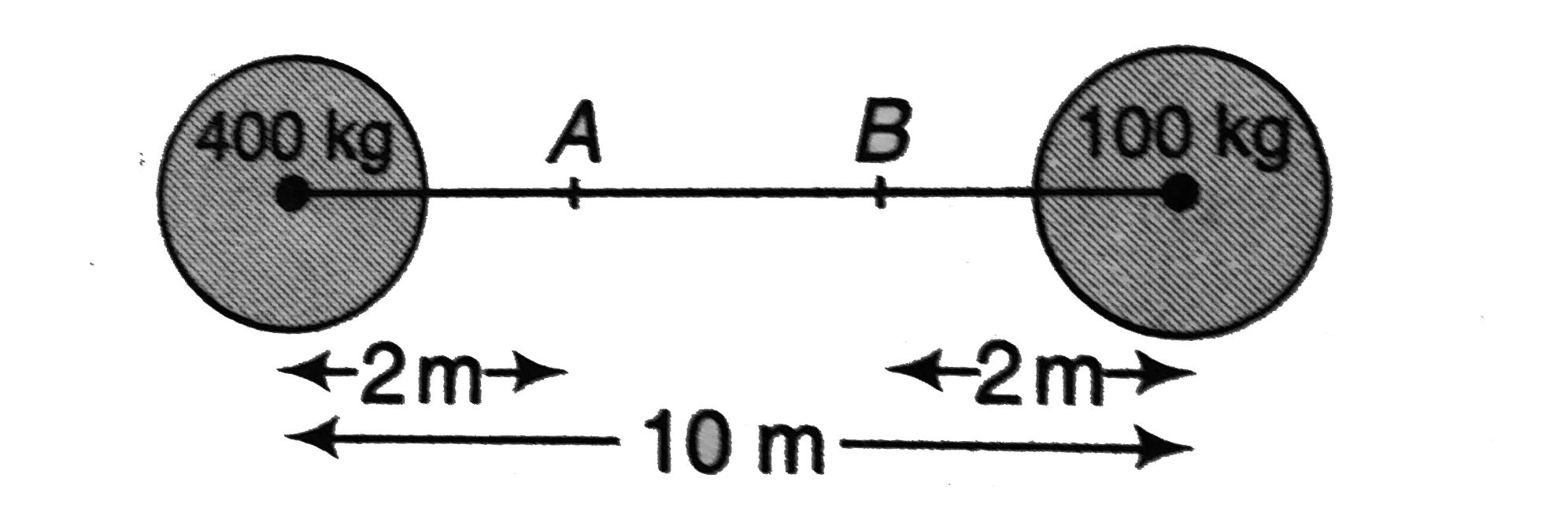
In the figure masses `400 kg` and `100 kg` are fixed.

(a) How much work must be done to move a `1 kg` mass from point `A` to point `B`?
(b) What is the minimum kinetic with which the `1 kg` mass must be projected from `A` to the right to reach the point `B`?

Text Solution

Verified by Experts

The correct Answer is:

A, B

`W = U_(f) - U_(i) = U_(B) - U_(A)`
`= mV_(B) - mV_(A)` (`V =` gravitational potential)
`= m(V_(B) - V_(A))`
`= (1) [-(100)/(2) - (400)/(8) + (100)/(8) + (400)/(2)] (6.67 xx 10^(-11))`
`= 7.5 xx 10^(-9) J`
(b) First let us find the point (say) `c` between `A` and `B` where field strength due to `400 kg` and `100 kg` masses is zero. Let its distance from `400 kg` is `r`.
Then, `(G(400))/(r^(2)) = (G(100))/((10 - r)^(2))`
`r = (20)/(3) m` and `(10 - r) = (10)/(3) m`
So, we have to move the body only from `A` to `C`. After that `100 kg` mass will pull `1 kg` mass by its own.
`:.` Minimum kinetic energy `= Delta U = U_(C) - U_(A)`
`= m(V_(C) - V_(A))`
`= (1) [-(400)/(20//3) - (100)/(10//3) + (100)/(8) + (400)/(2)] (6.67 xx 10^(-11))`
`= 8.17 xx 10^(-9)J`
Promotional Banner

Topper's Solved these Questions

  • GRAVITATION

    DC PANDEY|Exercise Level 2 Single Correct|22 Videos
  • GRAVITATION

    DC PANDEY|Exercise Level 2 More Than One Correct|10 Videos
  • GRAVITATION

    DC PANDEY|Exercise Level 1 Single Correct|27 Videos
  • GENERAL PHYSICS

    DC PANDEY|Exercise INTEGER_TYPE|2 Videos
  • KINEMATICS

    DC PANDEY|Exercise INTEGER_TYPE|11 Videos

Similar Questions

Explore conceptually related problems

A point mass of 10 kg is placed at the centre of earth. The weight of the point mass is

There is a shell of mass M and density of shell is uniform. The work done to take a point mass from point A to B is (AB = r)

A 4 kg mass and 1 kg mass are moving with equal linear momenta.The ratio of their kinetic energies is

Masses 8 kg and 2 kg are 18 cm apart. The point where the gravitational field due to the masses is zero is

Two masses A and B of mass 15kg and 6kg are connected by a string passing over a friction pulley fixed at the corner of a table as shown in The coefficient of friction between A and table is 0.3 the minimum mass (in kg) of that must be placed on A to prevent it from moving is .

Two masses, 800 kg and 600 kg are at a distance 0.25 m apart. The magnitude of total force experienced by a body of mass 1 kg placed at a point distance 0.2 m from the 800 kg mass 0.15 m from the 600 kg mass :

In the given figure mass of string AB is 2kg . Find tension at A,B and C , where C is the mid point of string.

A ball of mass 1 kg carrying a charge 10^(-8)C moves from a point A at potential 600 V to a point B at zero potential. The change in its kinetic energy is

DC PANDEY-GRAVITATION-Level 1 Subjective
  1. A particle of mass 1 kg is kept on the surface of a uniform sphere of ...

    Text Solution

    |

  2. What is the fractional decrease in the value of free-fall acceleration...

    Text Solution

    |

  3. Two masses m(1) and m(2) at an infinite distance from each other are i...

    Text Solution

    |

  4. If a satellites is revolving close to a planet of density rho with per...

    Text Solution

    |

  5. A satellite is revolving around a planet in a circular orbit. What wil...

    Text Solution

    |

  6. If the radius of the earth contracts to half of its present value with...

    Text Solution

    |

  7. Two concentric spherical shells have masses m(1), m(2) and radit R(1),...

    Text Solution

    |

  8. A semicircular wire hs a length L and mass M. A paricle of mass m is p...

    Text Solution

    |

  9. A rocket is accelerated to speed upsilon = 2sqrt(gR) near the earth's ...

    Text Solution

    |

  10. Two spheres one of mass M has radius R. Another sphere has mass 4M and...

    Text Solution

    |

  11. A uniform solid sphere of mass M and radius a is surrounded symmetrica...

    Text Solution

    |

  12. The density inside a solid sphere of radius a is given by rho=rho0/r, ...

    Text Solution

    |

  13. Two neutron stars are separated by a distance of 10^(10) m. They each ...

    Text Solution

    |

  14. A mass m is taken to a height R from the surface of the earth and then...

    Text Solution

    |

  15. In the figure masses 400 kg and 100 kg are fixed. (a) How much wo...

    Text Solution

    |

  16. Two identical stars of mass M orbit around their centre of mass. Each ...

    Text Solution

    |

  17. Consider two satellites A and B of equal mass, moving in the same circ...

    Text Solution

    |

  18. In a certain binary star system, each star has the same mass as our su...

    Text Solution

    |

  19. (a) Does it take more energy to get a satellite upto 1500 km above ear...

    Text Solution

    |
