Home
Class 11
PHYSICS
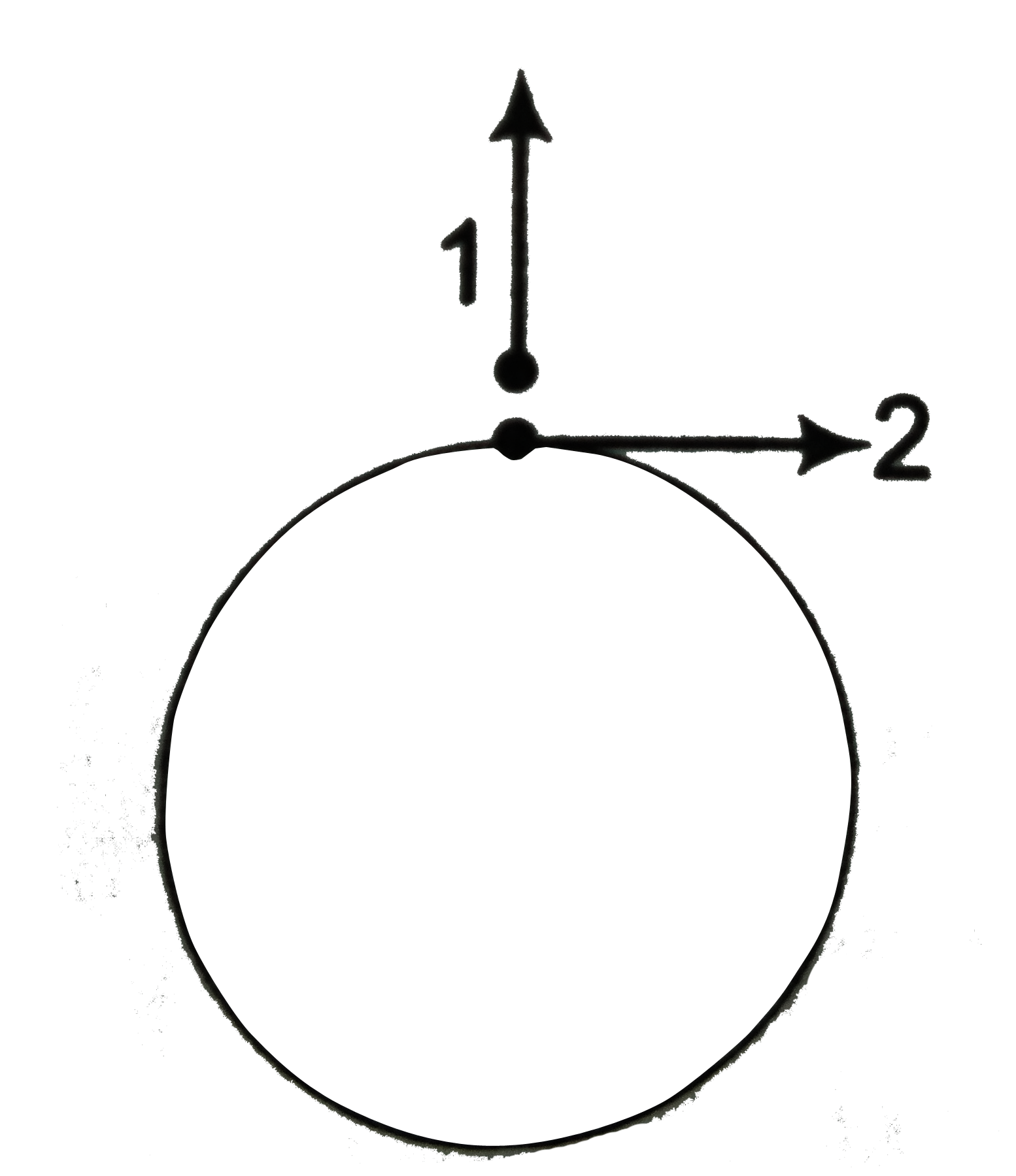
Two identical particles 1 and 2 are proj...

Two identical particles `1` and `2` are projected from surface of earth with same velocities in the directions shows in figure.

A

Both the particles will stop momentarily (before striking with ground)at different times

B

Particle `-1` will rise upto lesser height compared to particle`-2`

C

Minimum speed of particle`- 2` is more than that of particle`-1`

D

Particle `-1` will strike the ground earlier

Text Solution

Verified by Experts

The correct Answer is:

B, C, D

At heighest point velocity of particle-1 will becomes zero. But velocity of particle-2 is non zero.
Promotional Banner

Topper's Solved these Questions

  • GRAVITATION

    DC PANDEY|Exercise Level 2 Subjective|14 Videos
  • GRAVITATION

    DC PANDEY|Exercise Check Point 10.1|20 Videos
  • GRAVITATION

    DC PANDEY|Exercise Level 2 Single Correct|22 Videos
  • GENERAL PHYSICS

    DC PANDEY|Exercise INTEGER_TYPE|2 Videos
  • KINEMATICS

    DC PANDEY|Exercise INTEGER_TYPE|11 Videos

Similar Questions

Explore conceptually related problems

Two particles A and B are projected from the same point with the same velocity of projection but at different angles alpha and beta of projection, such that the maximum height of A is two-third of the horizontal range of B. then which of the following relations are true?

A number of particles are projected from a given point with equal velocities in different directions in the same vertical plane. At any instant they will lie on

When a particle is projected from the surface of earth its mechanical energy and angular momentum about center of earth at all time are constant. Q. A particle of mass m is projected from the surface of earth with velocity v_(0) at angle 0 with horizontal suppose h be the maximum height of particle from surface of earth and v its speed at that point then v is v_(0)cos0

Two particles A and B are projected from the same point in different direction in such a manner that their velocity vectors are shown in the diagram :- .

Two particles are projected vertically upwards from the surface of the earth with velocities upsilon_(1) = sqrt((2gR)/3) and upsilon_(2) = sqrt((4gR)/(3)) respectively. If the maximum heights attained by the two particles are h_(1) and h_(2) respectively, then calculate the ratio (h_1)/(h_2) .

A particle of mass m is projected upwards from the surface of the earth with a velocity equal to half the escape velocity. (R is radius of earth and M is mass of earth)Calculate the potential energy of the particle at its maximum. Write the kinetic energy of the particle when it was at half the maximum height.

Two particles A and B are projected from the same point in different directions in such a manner that vertical components of their initial velocities are same (Fig. 5.8). Find the ratio of range. .

Two particles A and B are projected simultaneously in the direction shown in the figure with velocities V_(A)=20m//s and V_(B)=10m//s respectively. If they collide in air after 1/2 sec. then

Three particles are projected vertically upward from a point on the surface of the earth with velocities sqrt(2gR//3) surface of the earth. The maximum heights attained are respectively h_(1),h_(2),h_(3) .
