Home
Class 11
PHYSICS
Three simple harmonic motion of equal am...

Three simple harmonic motion of equal amplitudes `A` and equal time periods in the same direction combine. The phase of the second motion is `60^(@)` ahead of the first and the phase of the third motion is `60^(@)` ahead of the second. Find the amplitude of the resultant motion.

Text Solution

Verified by Experts

The correct Answer is:
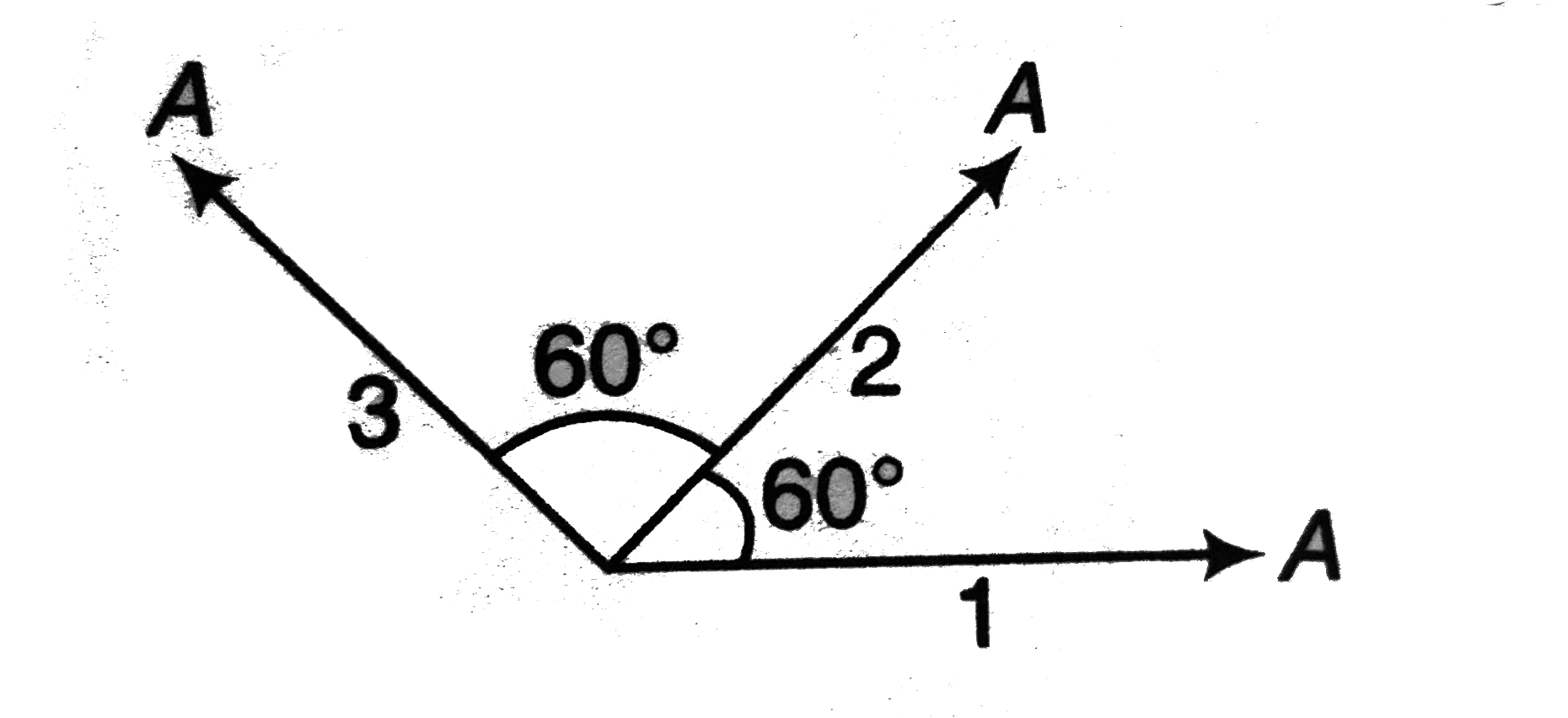
A, B

Resultant of `1` and `3` is also `A` in the direction of `2`.

`:. A_(R) = 2A`.
Promotional Banner

Topper's Solved these Questions

  • SIMPLE HARMONIC MOTION

    DC PANDEY|Exercise Only one question is correct|48 Videos
  • SIMPLE HARMONIC MOTION

    DC PANDEY|Exercise JEE Advanced|34 Videos
  • SIMPLE HARMONIC MOTION

    DC PANDEY|Exercise Exercise 14.3|7 Videos
  • SEMICONDUCTORS AND ELECTRONIC DEVICES

    DC PANDEY|Exercise More than One Option is Correct|3 Videos
  • SOLVD PAPERS 2017 NEET, AIIMS & JIPMER

    DC PANDEY|Exercise Solved paper 2018(JIPMER)|38 Videos

Similar Questions

Explore conceptually related problems

(a) A particle is subjected to two SHMs of same time period in the same direction. If A_1=6cm , A_2=8cm , find the resultant amplitude if the phase difference between the motions is (a) 0^@ , (b) 60^@ , (c) 90^@ and (d) 120^@ . (b) In the previous problem if A_1=A_2=a and resultant amplitude is also a, find phase difference between them. (c) Three SHMs of equal amplitude A and equal time periods in the same direction combine. The phase of the second motion is 120^@ ahead of first and the phase of the third motion is 120^@ ahead of the second. Find the amplitude of the resultant motion.

A particle is subjected to three SHM's in same direction simultaneously each having amplitude a and equal time period. The phase of the second motion is 30^(0) ahead of the first and the phase of the third motion is 30^(0) ahead of the second. Find the amplitude of the resultant motion.

Time S.H.M. of equal amplitude a and equal time period in the same direction combine. The first is 60^(@) ahead of the second and second is 60^(@) ahead of the third S.H.M . The amplitude of the resultant oscillation is:

Three SHO's of equal amplitude A and equal time period combine in the same direction. The difference in phase between successive SHO's os 60^(@) ahead of the other. The amplitude of the resultant oscillation is

A simple harmonic motion has an amplitude A and time period T. What is the time taken to travel from x=A to x=A//2 ?

A simple harmonic motion of amplitude A has a time period T. The acceleration of the oscillator when its displacement is half the amplitude is

For a particle executing simple harmonic motion, the amplitude is A and time period is T. The maximum speed will be

Three simple harmonic motions in the same direction having the same amplitude and same period are superposed. If each differ in phase from the next by 45^(@) , then

A particle is subjected to two simple harmonic motions of sae time period in the same direction. The amplitude of the first motion is 3.0 cm and that of the second is 4.0 cm. Find the resultant amplitude if the phase difference between the motion is a. 0^@, b. 60^@, c. 90^@

