Home
Class 11
PHYSICS
The heights of mercury surfaces in the t...

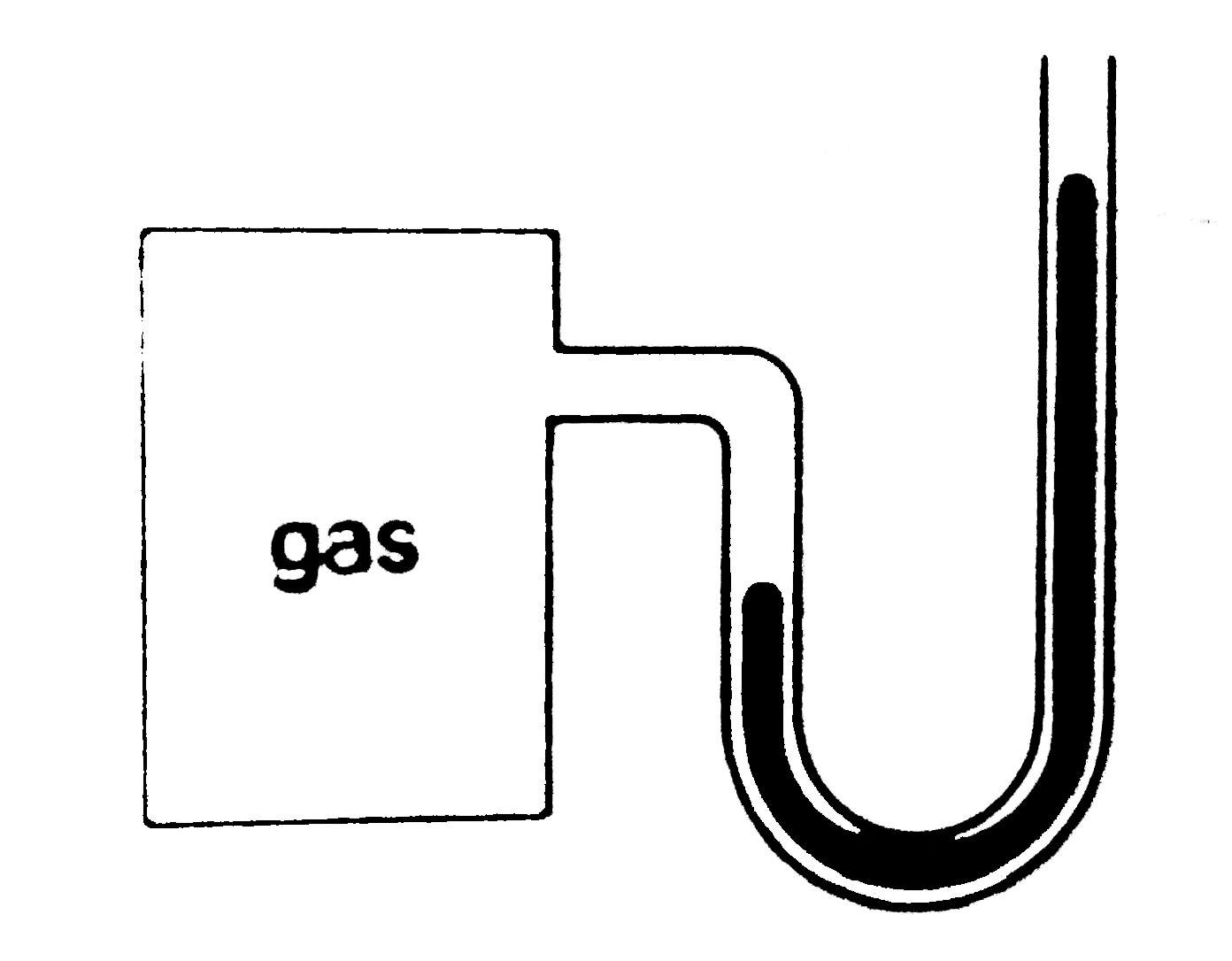
The heights of mercury surfaces in the tow arms of the manometer shown in figure are 2 cm and 8cm. Atmospheric pressure `=1.01xx10^5Nm^-2` . Find a. the pressure of the gas in the cylinder and b. the pressure of mercury at the bottom of the U tube.

Text Solution

Verified by Experts

The correct Answer is:

A, B

(a) `p=p_(0)+rho_(Hg) g Delta h`
(b) `p = p_(0) +rho_(Hg) gh_(RHS)`
Here, `Delta h=(8-2)=6cm=6xx 10^(-2)m`
and `h_(RHS)=8 cm =8xx10^(-2)m`.
Promotional Banner

Topper's Solved these Questions

  • FLUID MECHANICS

    DC PANDEY|Exercise Introductory Exercise|1 Videos
  • FLUID MECHANICS

    DC PANDEY|Exercise Exercise16.2|2 Videos
  • FLUID MECHANICS

    DC PANDEY|Exercise Miscellaneous Examples|10 Videos
  • EXPERIMENTS

    DC PANDEY|Exercise Subjective|15 Videos
  • GENERAL PHYSICS

    DC PANDEY|Exercise INTEGER_TYPE|2 Videos

Similar Questions

Explore conceptually related problems

The manometer has a water column difference of 50 cm . If the atmospheric pressure is 10^(5) Pa, find the pressure of the gas in the container .

A cylinder contains He at 2 atmosphere pressure and hydrogen at 1.5 atmosphere pressure. What is the pressure of the mixture of gases in the cylinder ?

In the given figure, atmospheric pressure p_0 = 1 atm and mercury column length is 9 cm. Pressure p of the gas enclosed in the tube is

The height of mercury barometer is h when the atmospheic pressure is 10^(5)Pa . The pressure at x in the shown diagram is

What is the pressure on a swimmer 10m below the surface of lake? g=10ms^(-2) , atmospheric pressure = 1.01 xx 10^(5)Pa

The U-tube acts as a water siphon. The bend in the tube is 1m above the water surface. The tube outlet is 7m below the water surface. The water issues from the bottom of the siphon as a free jet at atmospheric pressure. Determine the speed of the free jet and the minimum absolute pressure of the water in the bend. Given atmospheric pressure =1.01xx 10^(5)N//m^(2),g=9.8 m//s^(2) and density of water =10^(3)kg//m^(3) .

A manometer reads the pressure of a gas in an enclosure as shown in the figure. The absolute and gauge pressure of the gas in cm of mercury is (take atmospheric pressure =76 cm of mercury)

A manometer reads the pressure of a gas in a enclosure as shown in figure(a) When some of the gas is removed by a pump, the manometer reads as in (b). The liquid used in the manometers is mercury and the atmospheric pressure is 76 cm of mercury. (i) Give the absolute and gauge pressure of the gas in the enclosure for cases (a) and (b) in units of cm of mercury . (ii) How would the level change in case (b) if 13.6 cm of water are poured into the right limb of the manometer?

Suppose the pressure at the surface of mercury in as barometer tube is P_1 and the pressure at the surface of mercury in the cup is P_2 .
