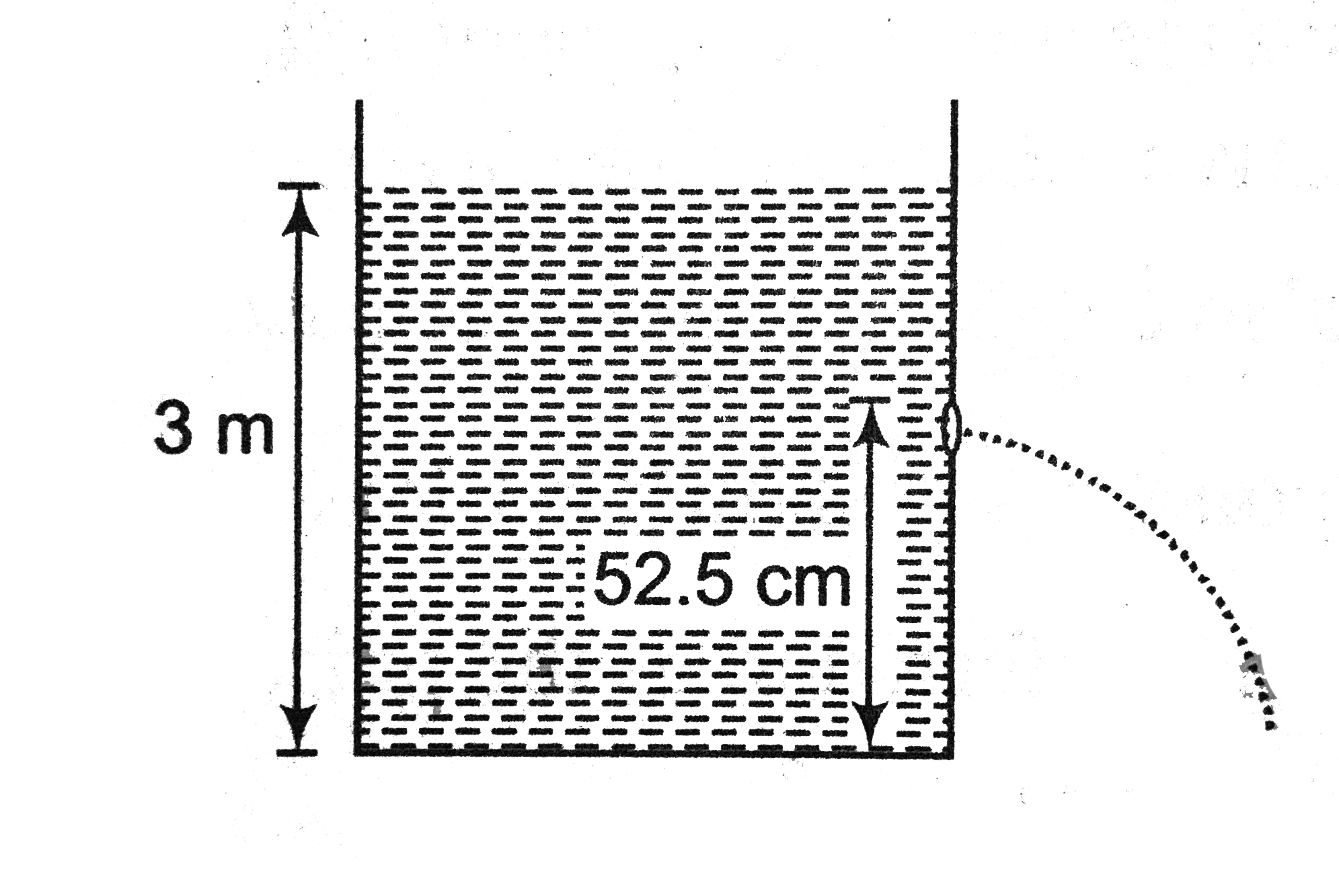
Water is filled in a cylindrical container to a height of `3m`. The ratio of the cross-sectional area of the orifice and the beaker is `0.1`. The square of the speed of the liquid coming out from the orifice is `(g=10m//s^(2))`.
A
`50 m^(2)//s^(2)`
B
`50.5m^(2)//s^(2)`
C
`51m^(2)//s^(2)`
D
`52 m^(2)//s^(2)`
Text Solution
Verified by Experts
The correct Answer is:
A
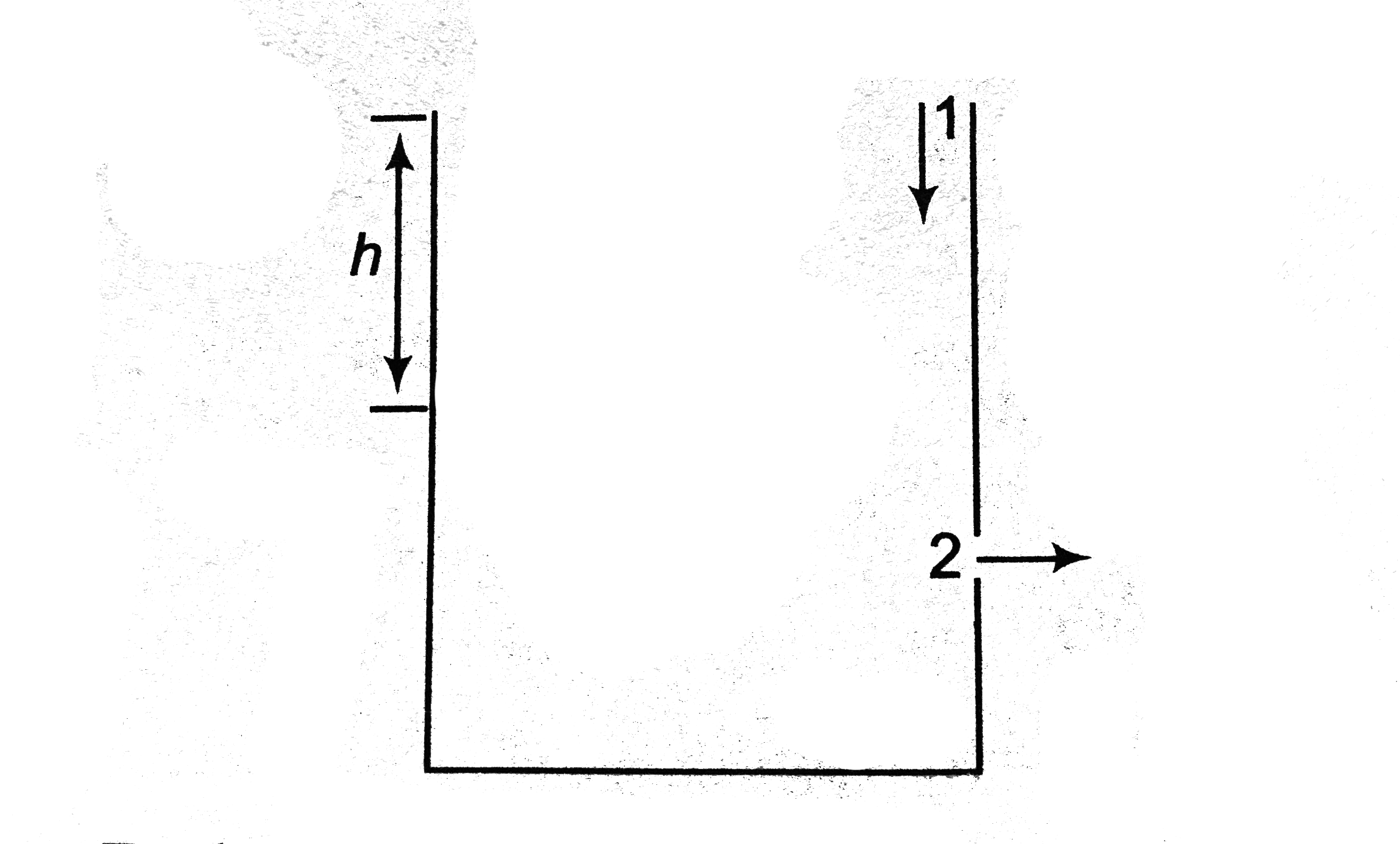
Applying continuity equation at 1 and 2, we have `A_(1)v_(1)=A_(2)v_(2)`...(i) Further applying Bernoulli's equation at these two points, we have `p_(0)+rho gh +(1)/(2) rho v_(1)^(2)=p_(0)+0+(1)/(2) rho v_(2)^(2)`...(ii) Solving Eqs. (i) and (ii), we have `v_(2)^(2)=(2gh)/(I-(A_(2)^(2))/(A_(1)^(2)))` Substituting the values, we have `v_(2)^(2)=(2xx10xx2.475)/(1-(0.1)^(2))=50m^(2)//s^(2)`.
Topper's Solved these Questions
FLUID MECHANICS
DC PANDEY|Exercise Exercise16.6|4 Videos
FLUID MECHANICS
DC PANDEY|Exercise Exercise16.7|4 Videos
FLUID MECHANICS
DC PANDEY|Exercise Exercise16.4|4 Videos
EXPERIMENTS
DC PANDEY|Exercise Subjective|15 Videos
GENERAL PHYSICS
DC PANDEY|Exercise INTEGER_TYPE|2 Videos
Similar Questions
Explore conceptually related problems
What is filled in a cylindrical container to a height of 3 m . The ratio of the cross-sectional area of the orifice and the beaker is 0.1 . The square of the speed of the liquid coming out from the orifice is (g = 10 m//s^2) .
A cylindrical tank is filled with water to a level of 3m. A hole is opened at a height of 52.5 cm from bottom. The ratio of the area of the hole to that of cross-sectional area of the cylinder is 0.1. The square of the speed with which water is coming out from the orifice is (Take g= 10 m//s^(2) )
A cylindrical vessel is filled with water upto a height of 1m. The cross-sectional area of the orifice at the bottom is (1//400) that of the vessel. (a) What is the tiome required to empty the tank through the orifice at the bottom? (b) What is the time required for the same amount of water to flow out if the water level in tank is maintained always at a height of 1m from orifice?
A cylindrical tank is filled with water to a level of 4 m. A hole is opened at a height of 60 cm from bottom. The ratio of the area of the hole to that at cross-sectinal area at cylinder is 0.2. Then the velocity with which water is coming out is (g = 10m//s^(2))
At the mount of the tap area of cross-section is 2.0cm^(2) and the speed of water is 3m//s . The area of cross-section of the water column 80 cm below the tap is (use g=10m//s^(2))
A liquid of density rho is filled in a vessel up to height H and a hole of cross section area A is made at a depth h below the free surface of liquid. The speed of liquid coming out of the hole is independent of
Water is filled in a container upto height 3m. A small hole of area 'a' is punched in the wall of the container at a height 52.5 cm from the bottom. The cross sectional area of the container is A. If a//A=0.1 then v^2 is (where v is the velocity of water coming out of the hole)
Oil is filled in a cylindrical container up to height 4m. A small hole of area 'p' is punched in the wall of the container at a height 1.52m from the bottom. The cross sectional area of the container is Q. If p/q = 0.1 then v is (where vis the velocity of oil coming out of the hole)
An ideal liquid of density rho is filled in a horizontally fixed syringe fitted with a piston. There is no friction between the piston and the inner surface of the syringe. Cross-sectional area of the syringe is A. At one end of the syringe, an orifice is made. When the piston is pushed into the syringe, the liquid comes out of the orifice and then following a parabolic path falls on the ground. With what velocity does the liquid come out of the orifice?