Home
Class 11
PHYSICS
A capillary tube is dipped in a liquid. ...

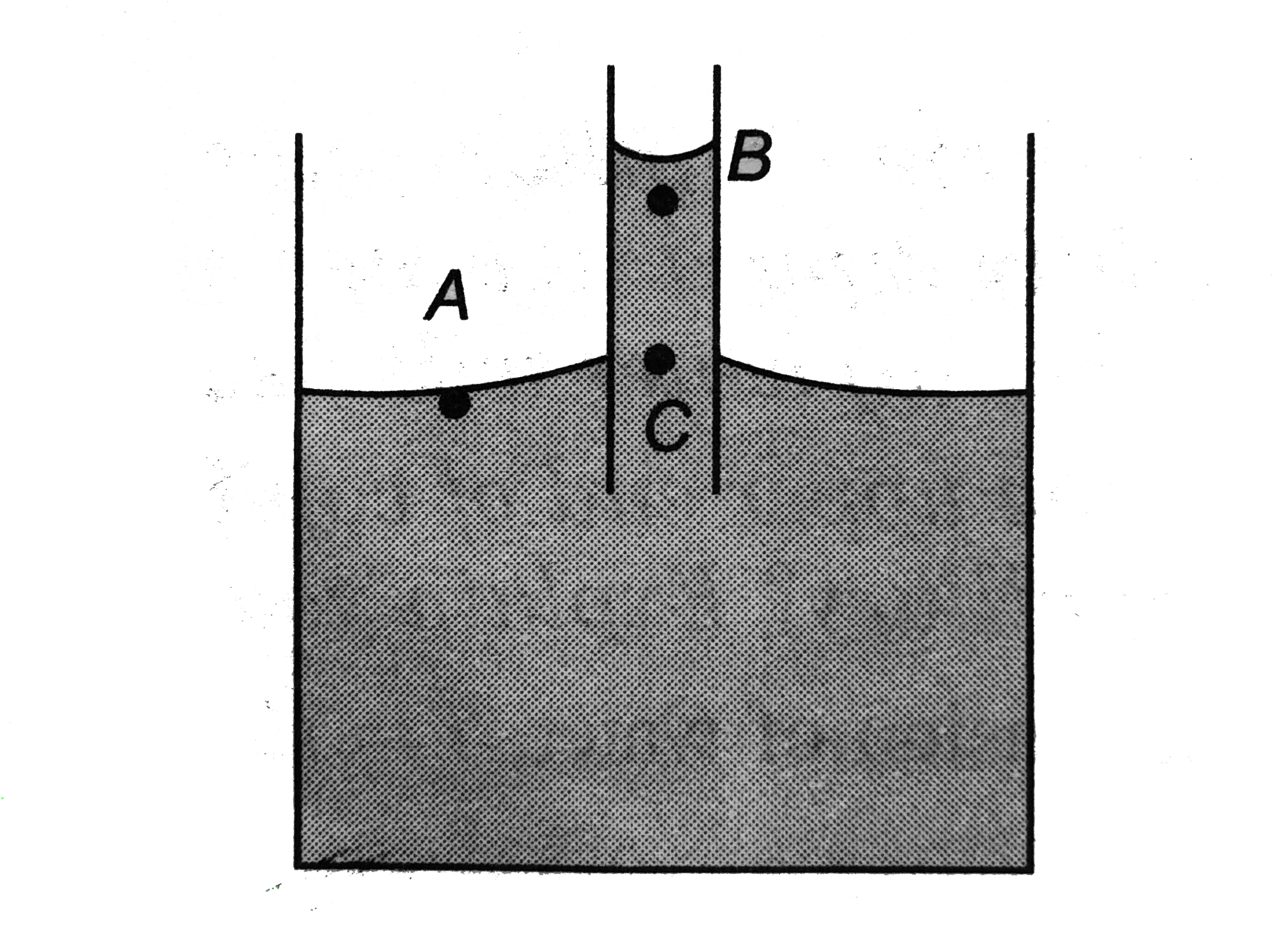
A capillary tube is dipped in a liquid. Let pressure at point `A,B` and `C` be `p_(A)p_(B)` and `p_(C)` respectively, then

A

`p_(A) =p_(B) =p_(C)`

B

`p_(A) = p_(B) lt p_(C)`

C

`p_(A) = p_(C) lt p_(B)`

D

`p_(A) = p_(C) gt p_(B)`

Text Solution

Verified by Experts

The correct Answer is:

D

`p_(A)=p_(C)=(p_(B)+rho gh)`.
Promotional Banner

Topper's Solved these Questions

  • FLUID MECHANICS

    DC PANDEY|Exercise Level 1 Assertion And Reason|10 Videos
  • FLUID MECHANICS

    DC PANDEY|Exercise Assertion and Reason|1 Videos
  • FLUID MECHANICS

    DC PANDEY|Exercise Exercise16.7|4 Videos
  • EXPERIMENTS

    DC PANDEY|Exercise Subjective|15 Videos
  • GENERAL PHYSICS

    DC PANDEY|Exercise INTEGER_TYPE|2 Videos

Similar Questions

Explore conceptually related problems

An object of uniform density is allowed to float in water kept in a beaker. The object has triangular cross-section as shown in the figure. If the water pressure measured at the three points A, B and C below the object are P_(A), P_(B) " and " P_(C ) respectively. Then

Figure shows a capillary tube C dipped in a liquid that wets it. The liquid rises to a point A . If we blow air through the horizontal tube H , what will happen to the liquid column in the capillary tube?

A horizontal tube has different cross sections at points A and B . The areas of cross section are a_(1) and a_(2) respectively, and pressures at these points are p_(1)=rhogh_(1) and p_(2)=rhogh_(2) where rho is the density of liquid flowing in the tube and h_(1) and h_(2) are heights of liquid columns in vertical tubes connected at A and B . If h_(1)-h_(2)=h , then the flow rate of the liquid in the horizontal tube is

Capillary tubes of length l and 2l are connected in series, their radii are r and 2r respectively. If stream line flow is maintained and pressure difference across first and second capillary tubes are P_(1) and P_(2) respectively then find the ratio (P_(1))/(P_(2)) .

A cylindrical container filled with a liquid is being rotated about its central axis at a constant angular velocity omega . Four points A, B, C and D are chosen in the same plane such that ABCD is a square of side length a and AB is horizontal while BC is vertical. A and D lie on the axis of rotation. Let the pressure at A, B, C and D be denoted by P_(A), P_(B), P_(C ) and P_(D) . Which of these options is correct ?
