Home
Class 11
PHYSICS
For a wave described by y = A sin (omega...

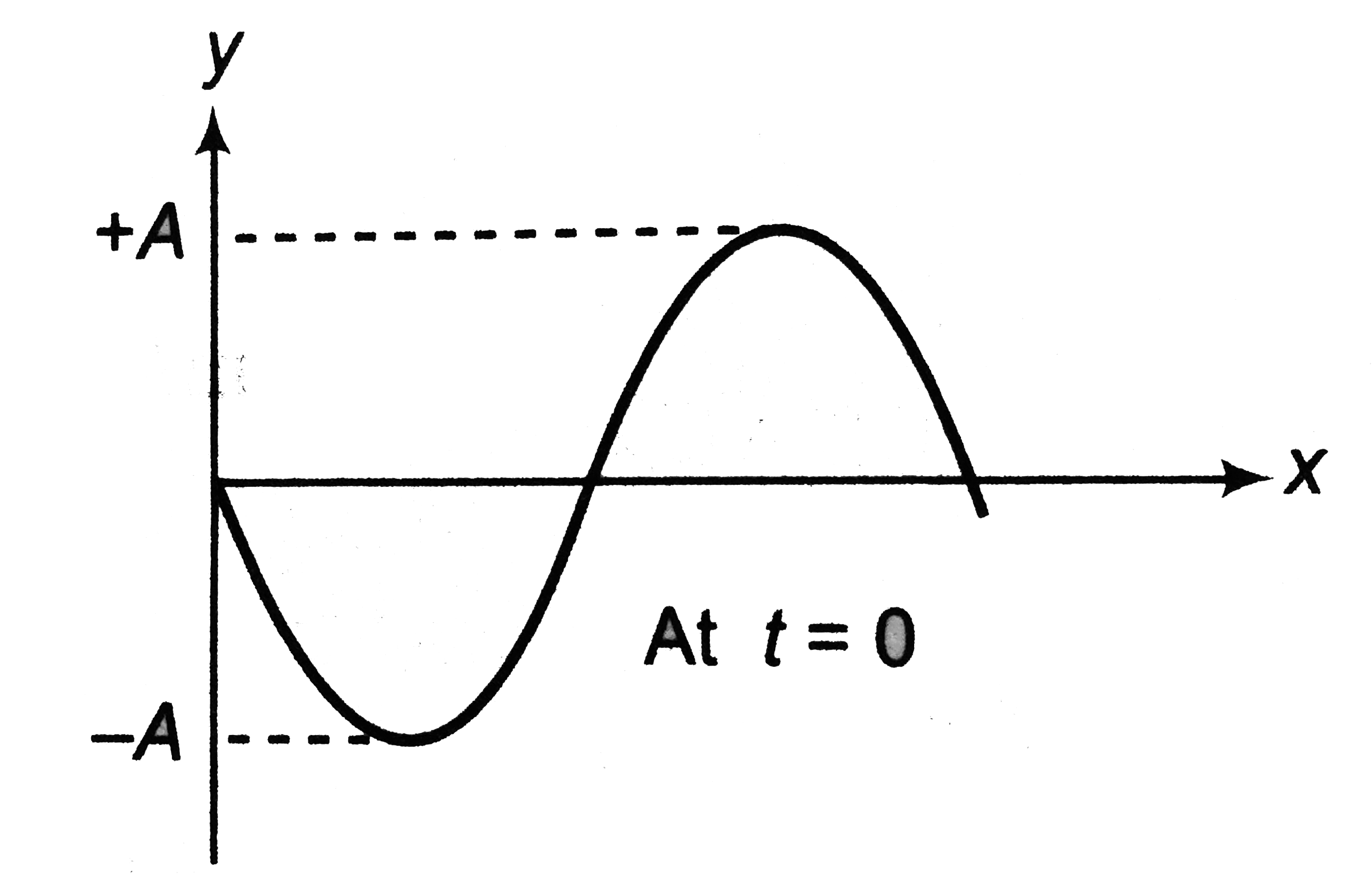
For a wave described by `y = A sin (omegat - kx)`, consider the following or not and in what direction and describe whether the particle is speeding up, slowing sown or instantanteously not accelerating?

Text Solution

Verified by Experts

`y =A sin (omegat - kx)`
Particle velocity `v_p (x, t)=(dely)/(delt) =omegaA cos (omegat - kx)` and particle acceleration
`a_p (x, t)=(del^(2)y)/(delt) = -omega^(2)A sin(omegat - kx)`
(a) `t =0 , x= 0: v_p =+ omegaA` and `a_(p) =0`
i.e. particle is moving upward but its acceleration is zero.
(b) `t =0`, `x = (pi)/(4k)` ` x=(pi)/(4k)`
`:. kx=(pi)/(4)`
`v_(p) =omegaA cos (-(pi)/(4)) = + (omegaA)/(sqrt(2)`
and ` a_(p)= -omega^(2)A sin (-(pi)/(4)) = + (omega^(2)A)/sqrt(2)`
Velocity of particle is positive, i.e. the particle is moving upward (along positive y- direction). Further `(v_(P))` and `(a_(p)) are in the same direction (both are positive). Hence, the particle is speeding up.
(C) `t =0 , x =(pi)/(2k) , x=(pi)/(2k) :. kx = (pi)/(2)`
`v_(p) =omegaA cos(-pi//2) = 0`
`a_(p) = -omega^(2) A sin (-pi//2) =omega^(2) A`
i.e. particle is stationary or at its exterme position `(y = - A)`. So, it is speeding up at this instant.
(d) `t =0 , x= (3pi)/(4k) , x = (3pi)/(4k) :. kx = (3pi)/(4)`
`:. v_(p) = omegaA cos (-(3pi)/(4)) = -(omegaA)/(sqrt(2))`
`a_(p) = -omega^(2)A sin(-(3pi)/(4)) = + -(0megaA)/sqrt(2)`
`a_(p) = - omega^(2) A sin (-(3pi)/(4))= + (omega^(2)A )/sqrt(2)`
Velocity of particle is negative, i.e. the particle is moving downwards. Further `v_(p)` and `(a_(P))` are in opposite direction , i.e. the particle is slowing down.
Promotional Banner

Topper's Solved these Questions

  • WAVE MOTION

    DC PANDEY|Exercise Exercise 17.1|4 Videos
  • WAVE MOTION

    DC PANDEY|Exercise Exercise 17.2|2 Videos
  • WAVE MOTION

    DC PANDEY|Exercise Example Type 5|1 Videos
  • VECTORS

    DC PANDEY|Exercise Medical enrances gallery|9 Videos
  • WORK, ENERGY & POWER

    DC PANDEY|Exercise Level 2 Comprehension Based|2 Videos

Similar Questions

Explore conceptually related problems

A wave on a string is described by y(x,t)=A cos (kx-omegat) . (a) Graph y,v_(y) , and a_(y) as function of x for time t=0. (b) consider the following points on the string: (i) x=0,(ii) x=pi//4k, (iii) x=pi//2k, (iv)x=3pi//4k, (v)x=pi//k, (vi)x=5pi//4k, (vii) x=3pi//2k, (viii) x=7pi//4k . For a particle at each of these points at t=0, describes in words whether the particle is moving and in what direction, and whether the particle is speeding up, slowing down, or instantaneously not acceleraring.

A wave is described by y=Asin(omega-kx) . The speeds of which of the following particles in the medium are increasing at time t=0?

In a wave motion y = a sin (kx - omegat) , y can represent

In a stationary wave represented by y = a sin omegat cos kx , amplitude of the component progerssive wave is

In a stationary wave represented by y = a sin omegat cos kx , amplitude of the component progerssive wave is

A wave y = a sin (omegat - kx) on a string meets with another wave producing a node at x = 0 . Then the equation of the unknown wave is

The wave described by y = 0.25 sin ( 10 pix -2pi nt ) where x and y are in meters and t in seconds , is a wave travelling along the
