Home
Class 11
PHYSICS
A copper rod 2 m long has a circular cro...

A copper rod 2 m long has a circular cross-section of radius 1 cm. One end is kept at `100^@C` and the other at `0^@C`. The surface is insulated so that negligible heat is lost through the surface. In steady state, find
(a) the thermal resistance of the bar
(b) the thermal current H
(c) the temperature gradient `(dT)/(dx)` and
(d) the temperature at a distance 25 cm from the hot end.
Thermal conductivity of copper is 401 `W//m-K.`

Text Solution

Verified by Experts

The correct Answer is:
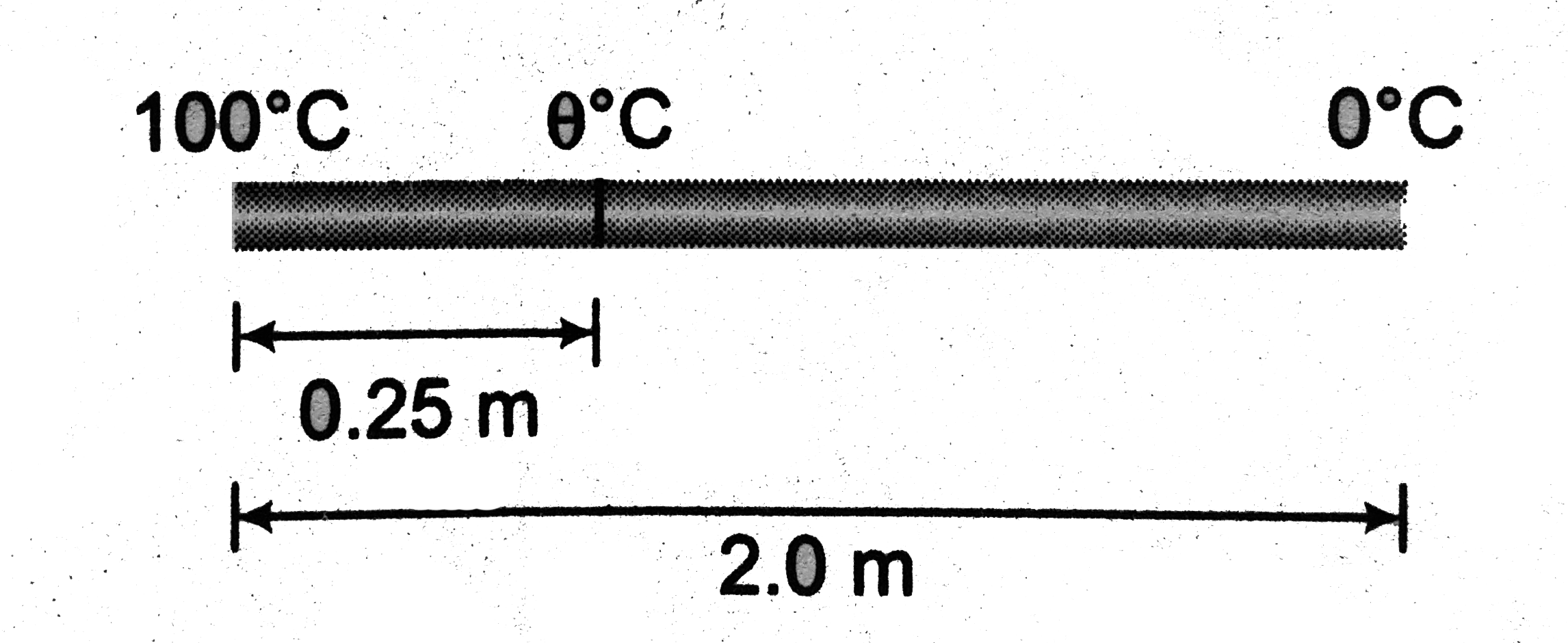
A, B, C, D

(a) Thermal resistance, `R = l/(KA) = l/(K(pir^2))`
or `R=((2)/((401)(pi)(10^-2)^2))`
`= 15.9 K//W`
(b) Thermal current, `H = (DeltaT)/R = (Deltatheta)/R = (100)/(15.9)`
or `H=6.3 W`
(c) Temperature gradient
`=(0-100)/2 = -50K//m`
`=-50^@C//m`
(d) Let `theta` be the temperature at 25 cm from the hot end, then

`(theta -100) = ("temperature gradient") xx ("distance")`
or `theta- 100 = (-50)(0.25)`
or `theta = 87.5^@C` .
Promotional Banner

Topper's Solved these Questions

  • CALORIMETRY & HEAT TRANSFER

    DC PANDEY|Exercise Example Type 1|4 Videos
  • CALORIMETRY & HEAT TRANSFER

    DC PANDEY|Exercise Example Type 2|2 Videos
  • BASIC MATHEMATICS

    DC PANDEY|Exercise Exercise|13 Videos
  • CALORIMETRY AND HEAT TRANSFER

    DC PANDEY|Exercise Medical entrance s gallery|38 Videos

Similar Questions

Explore conceptually related problems

The ends of a copper rod of length 1m and area of cross-section 1cm^2 are maintained at 0^@C and 100^@C . At the centre of the rod there is a source of heat of power 25 W. Calculate the temperature gradient in the two halves of the rod in steady state. Thermal conductivity of copper is 400 Wm^-1 K^-1 .

The ends of copper rod of length 1m and area of cross section 1cm^(2) are maintained at 0^(@)C and 100^(@)C . At the centre of rod, there is a source of heat of 32W . The thermal conductivity of copper is 400W//mK

Find the thermal resistance of an aluminium rod of length 20cm and area of cross section 1cm^(2) . The heat current is along the length of the rod. Thermal conductivity of aluminium =200Wm^(-1)K^(-1) .

In a steady state of heat conduction the temperature of the ends A and B of a rod 100cm long per 0^(@)C and 100^(@)C The temperature of the rod at a point 60cm distant from the end A is .

The temperature gradient in a rod of 1m long is '100^@' C/m if the temperature of hotter end is '30^@' C, then the temperature of colder end is

A rod AB is 1m long. The temperature of its one end A is maintained at 100^(@) C and other end B at 10^(@) C, the temperature at a distance of 60 cm from point B is

The temperature of hot and cold end of a 20 cm long rod in thermal steady state are at 100^(@)C and 20^(@)C respectively. Temperature at the centre of the rod is

In a steady state of thermal conduction, temperature of the ends A and B of a 20 cm long rod are 100^(@)C and 0^(@)C respectively. What will be the temperature of the rod at a point at a distance of 6 cm from the end A of the rod

A bar of copper of length 75 cm and a bar of steel of length 125 cm are joined together end to end . Both are of circular cross - section with diameter 2 cm . The free ends of the copper and steel bars are maintained at 100^(@)C and 0^(@)C respectively . The surface of the bars are thermally insulted . What is the temperature of the copper - steel junction ? What is the heat transmitted per unit time across the junction ? Thermal conductivty of copper 9.2 xx 10^(-2) k cal m^(-1) ""^(@)C^(-1)s^(-1) and that of steel is 1.1 xx 10^(-2)k cal m^(-1)s^(-1) (@)C^(-1) .

A bar of copper of length 75cm and a abr of steel of length 125cm are joined together end to end. Both are of circular cross section with diameter 2cm. The free ends of the copper and the steel bors are maintained at 100^(@)C and 0^(@)C respectively. The curved surface of the bors. are thermally insulated. What is the temperature of the coppe-steel junction? What is the amount of heat transmitted per unit time across the junction? Thermal conductivity of copper is 386Js^(-1)m^(-1) ^(@)C^(-1) and that of steel is 46Js^(-1)m^(-1) (@)C^(-1)

