Home
Class 11
PHYSICS
In the above example, if temperature of ...

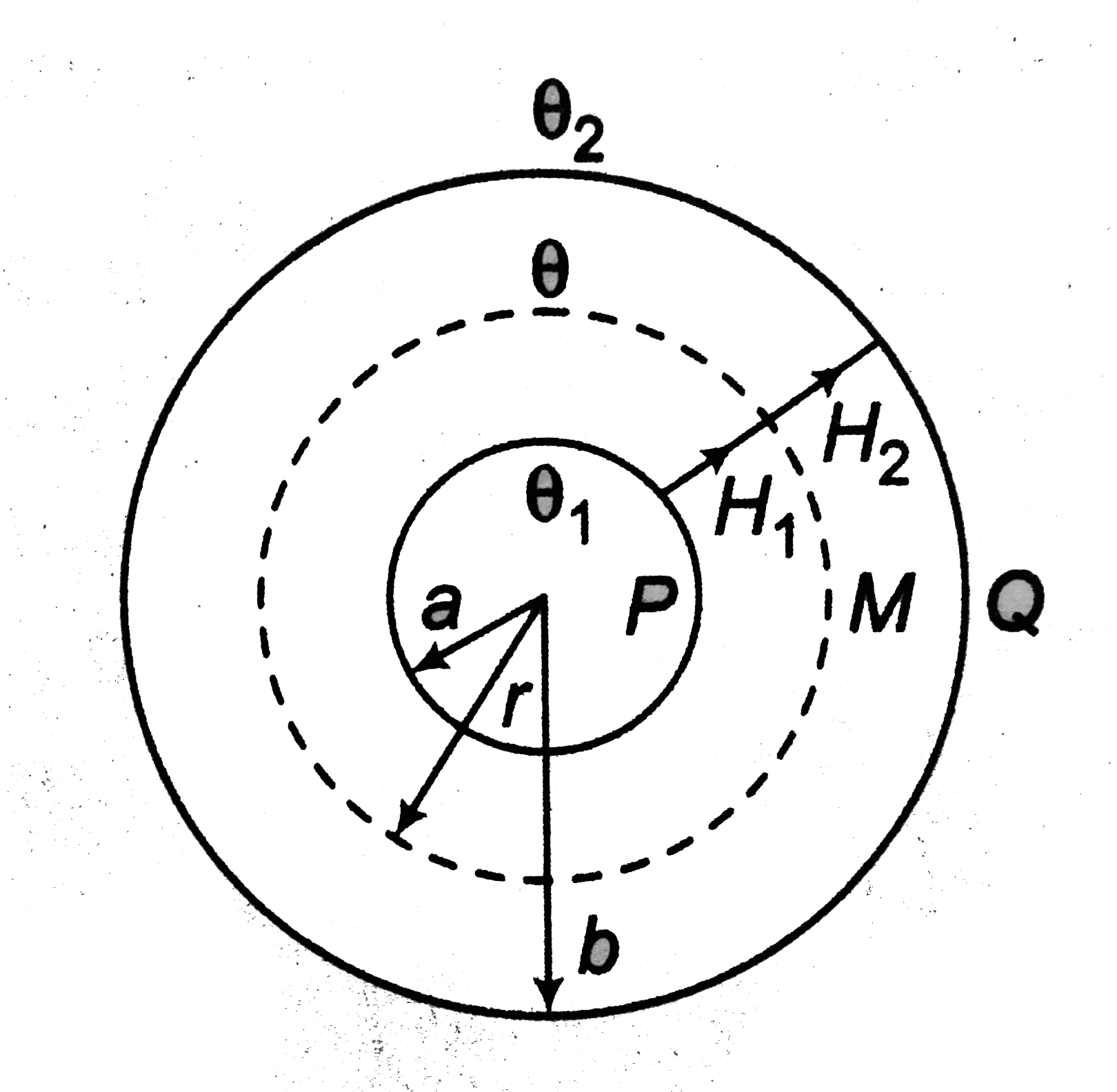
In the above example, if temperature of inner surface P is kept constant at `theta_1` and of the outer surface Q at `theta_2(lttheta_1)`. Then,
Find.
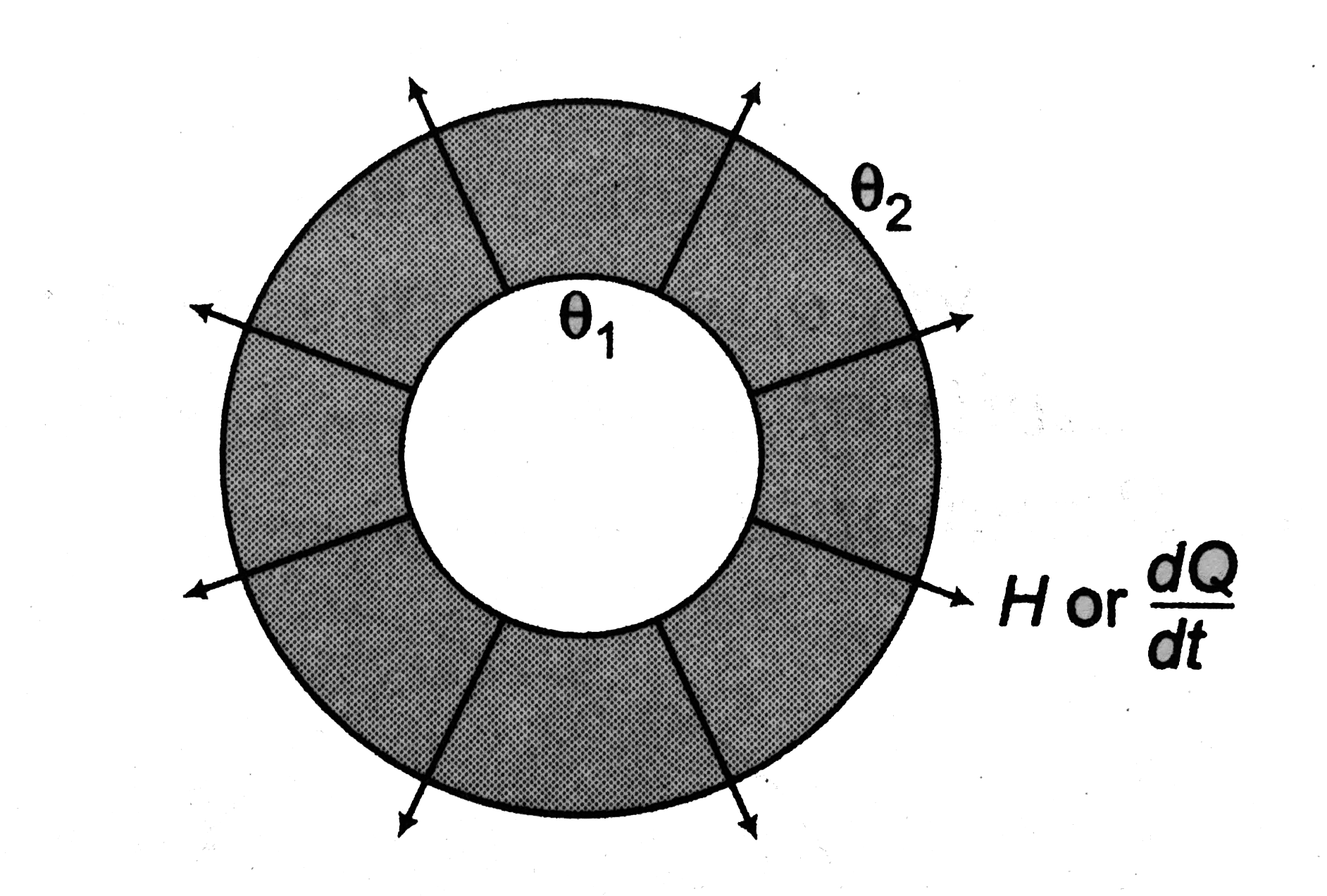
(a) rate of heat flow or heat current from inner surface to outer surface.
(b) temperature `theta` at a distance `r (altrltb)` from centre.

Text Solution

Verified by Experts

The correct Answer is:
A, B, D

(a)
`H or (dQ)/(dt) = ("Temperature difference")/("Thermal resistance")`
`= ((theta_1 - theta_2)(4piK))/(1/a-1/b)`
`= ((theta_1-theta_2)(ab)(4piK))/(b-a)`
(b)
In the figure, we can see that
Heat current `H_1` = Heat current `H_2`
`:. ((TD)_(PM)/R_(PM)) = ((TD)_(MQ)/R_(MQ))` ..........(i)
Using the result obtained in Example-3 of thermal resistance, we can find
` R_(PM) = 1/(4piK) (1/a-1/r)`
and `R_(MQ) = 1/(4piK) (1/r - 1/b)`
Substituting the values in Eq. (i), we have
`((theta_1-theta)/((1/(4piK)) (1/a-1/r))) = (theta - theta_2)/((1/4piK)(1/r-1/b))`
Solving this equation we can find `theta`.
Promotional Banner

Topper's Solved these Questions

  • CALORIMETRY & HEAT TRANSFER

    DC PANDEY|Exercise Example Type 2|2 Videos
  • CALORIMETRY & HEAT TRANSFER

    DC PANDEY|Exercise Example Type 3|1 Videos
  • CALORIMETRY & HEAT TRANSFER

    DC PANDEY|Exercise Level 2 Subjective|14 Videos
  • BASIC MATHEMATICS

    DC PANDEY|Exercise Exercise|13 Videos
  • CALORIMETRY AND HEAT TRANSFER

    DC PANDEY|Exercise Medical entrance s gallery|38 Videos

Similar Questions

Explore conceptually related problems

The ends of a metal rod are kept at temperatures theta_1 and theta_2 with theta_2gttheta_1 . The rate of flow of heat along the rod is directly proportional to

If charge q is induced on outer surface of sphere of radius R, then intensity at a point P at a distance S from its centre is

The ends of a metal rod are kept at temperature theta_(1) and theta_(2) with theta_(2) gt theta_(1) . At steady state the rate of flow of heat along the rod is directly proportional to

Inner and outer surfaces of a cylinder are maintained at temperature 4T and T respectively. Heat flows radially from inner surface of radius R to outer surface of radius 4R. Radial distance from the center where temperature is 2T.

Inner surfaec of a cylindrical shell of length l and of material of thermal conductivity k is kept at constant temperature T_(1) and outer surface of the cylinder is kept at constant temperature T_(2) such that (T_(1)gtT_(2)) as shown in figure. heat flows from inner surface to outer surface radially outward. inner and outer radii of the shell are R and 2R resspectively. Due to lack of space this cylinder has to be replaced by a smaller cylinder of length (l)/(2) inner and outer radii (R)/(4) and R respectively and thermal conductivity of material nk. if rate of radially outward heat flow remains same for same temperatures of inner and outer surface i.e., T_(1) and T_(2) then find the value of n.

A charge Q is placed at the centre of an uncharged, hollow metallic sphere of radius of rasius alpha. (a) Find the surface charge density on the inner surface and on the outer surface. (b) If a charge q is pur on the sphege, what would be the surface charge dendities on the inner and the outer surface? (c) Find the electric field inside the sphere at a distance x from the centre in the situations (a) and (b).

A hollow spherical conductor of radius r potential of 100 V at its outer surface. The potential inside the hollow at a distance of (r )/(2) from its centre is

A composite spherical shell is made up to two materials having thermal conductivities k and 2k respectively as shown in the diagram . The temperature at the innermost surface is maintained at T whereas the temperature at the outermost surface is maintained at 10 T . A, B, C and D are four points in the outer material such that AB = BC = CD. The effective thermal resistance between the inner surface of the shell and the outer surface of the shell for the radial heat flow is