Home
Class 12
CHEMISTRY
A compound formed by elements X and Y ha...

A compound formed by elements `X` and `Y` has a cubic structure in which `X` atoms are at the corner of the cube and also at the face centers. `Y` atoms are present at the body centre and at the edge centre of the cube.
a. Celculate (i) `Z_(eff')` (ii) total number of atoms in the cube, and (iii) formula of the compound.
b. If all the atoms are removed from one of the body diagonals of the cube, calculate (i) `Z_(eff')` (ii) total number of atoms in the cube, and (iii) formula of the compound.
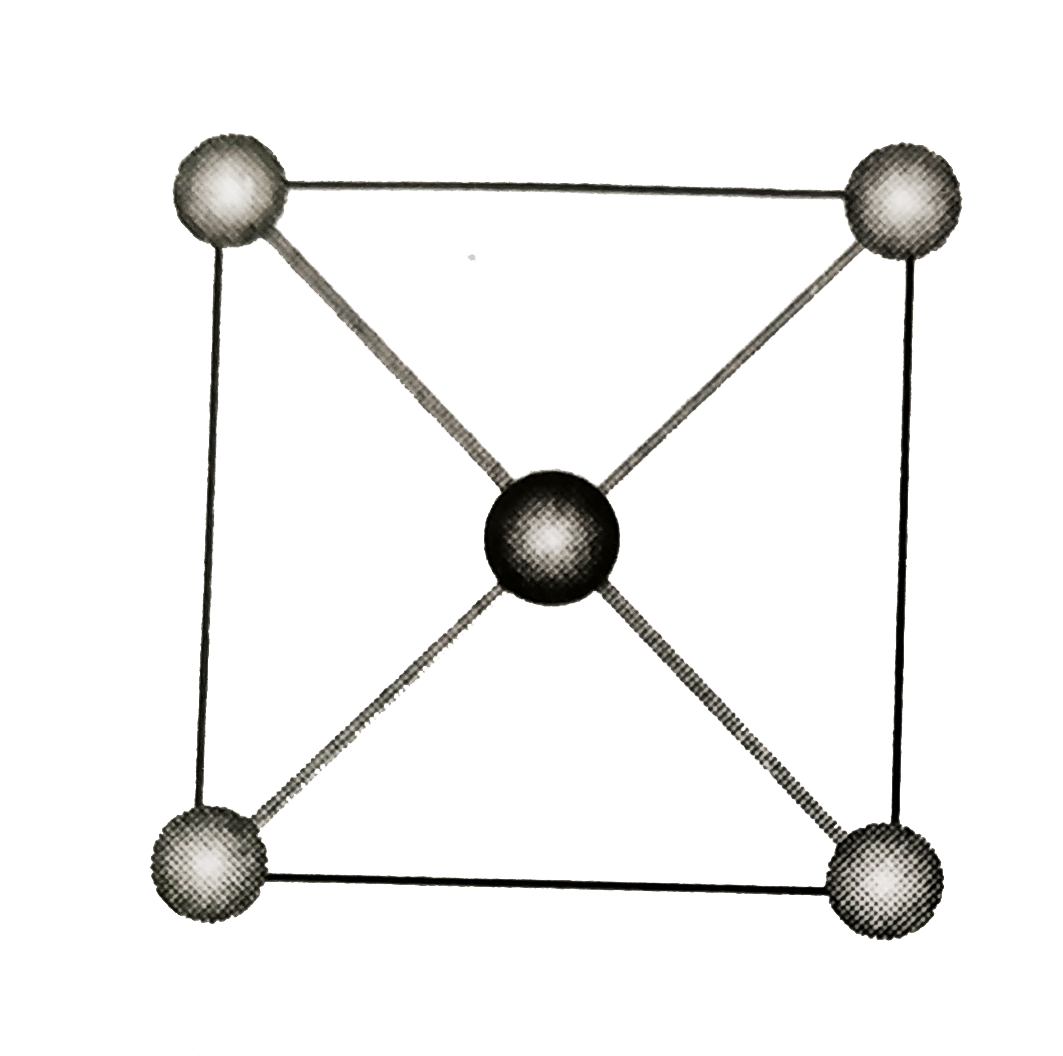
c. If all the atoms from the diagonals of the one of the face of the cube are removed, calculate (i) `Z_(eff')` (ii) total number of atoms in the cube, and (iii) formula of the compound.
d. If all the atoms are removed from one of the plane passing through the middle of t he cube, calculate (i) `Z_(eff')` (ii) total number of atoms in the cube, and (iii) formula of the compound.
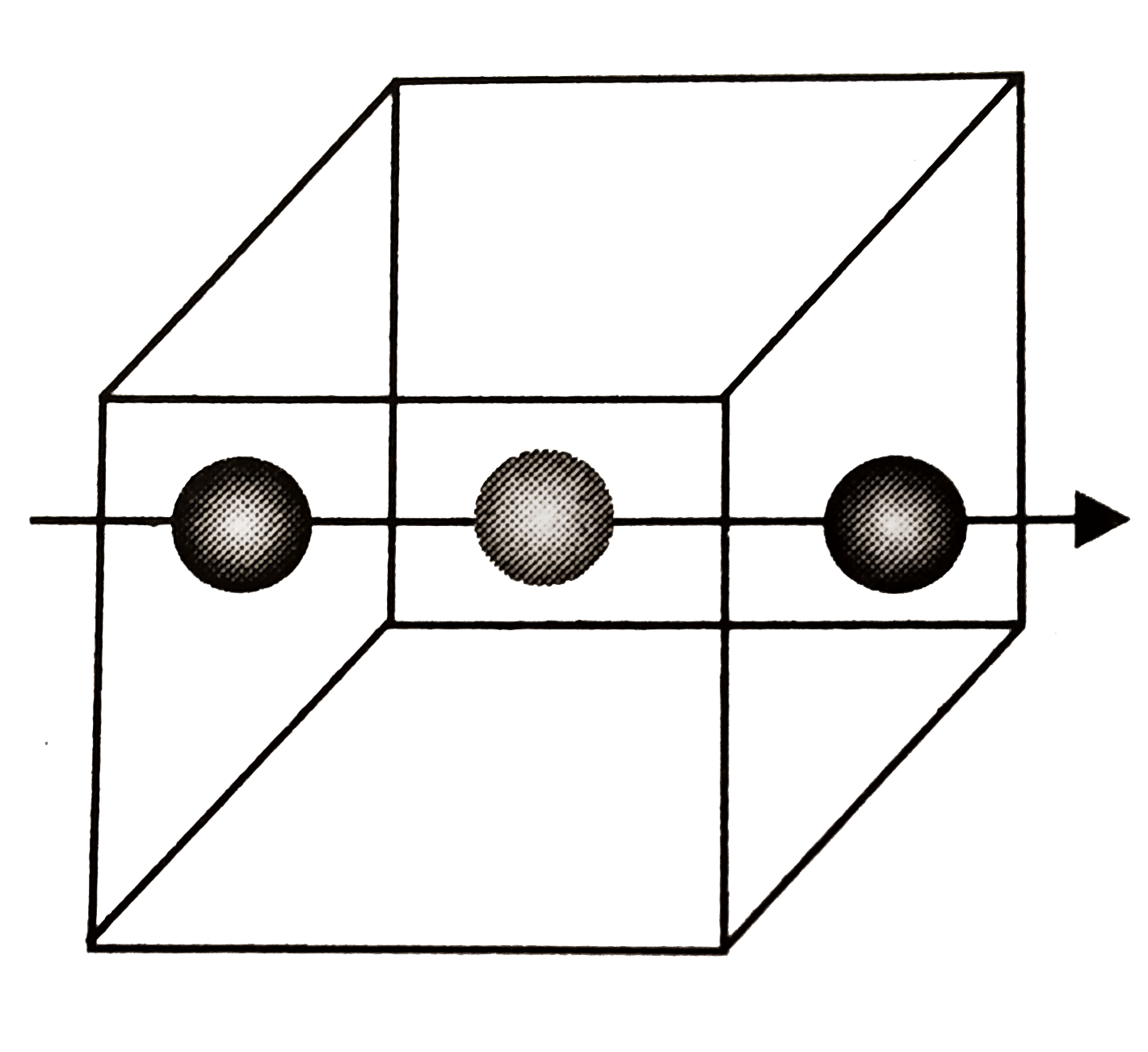
e. If all the atoms are removed from one of the axes passing through one of the face centres of the cube, calculate (i) `Z_(eff')` (ii) total number of atoms in the cube, and (iii) formula of the compound.

Text Solution

Verified by Experts
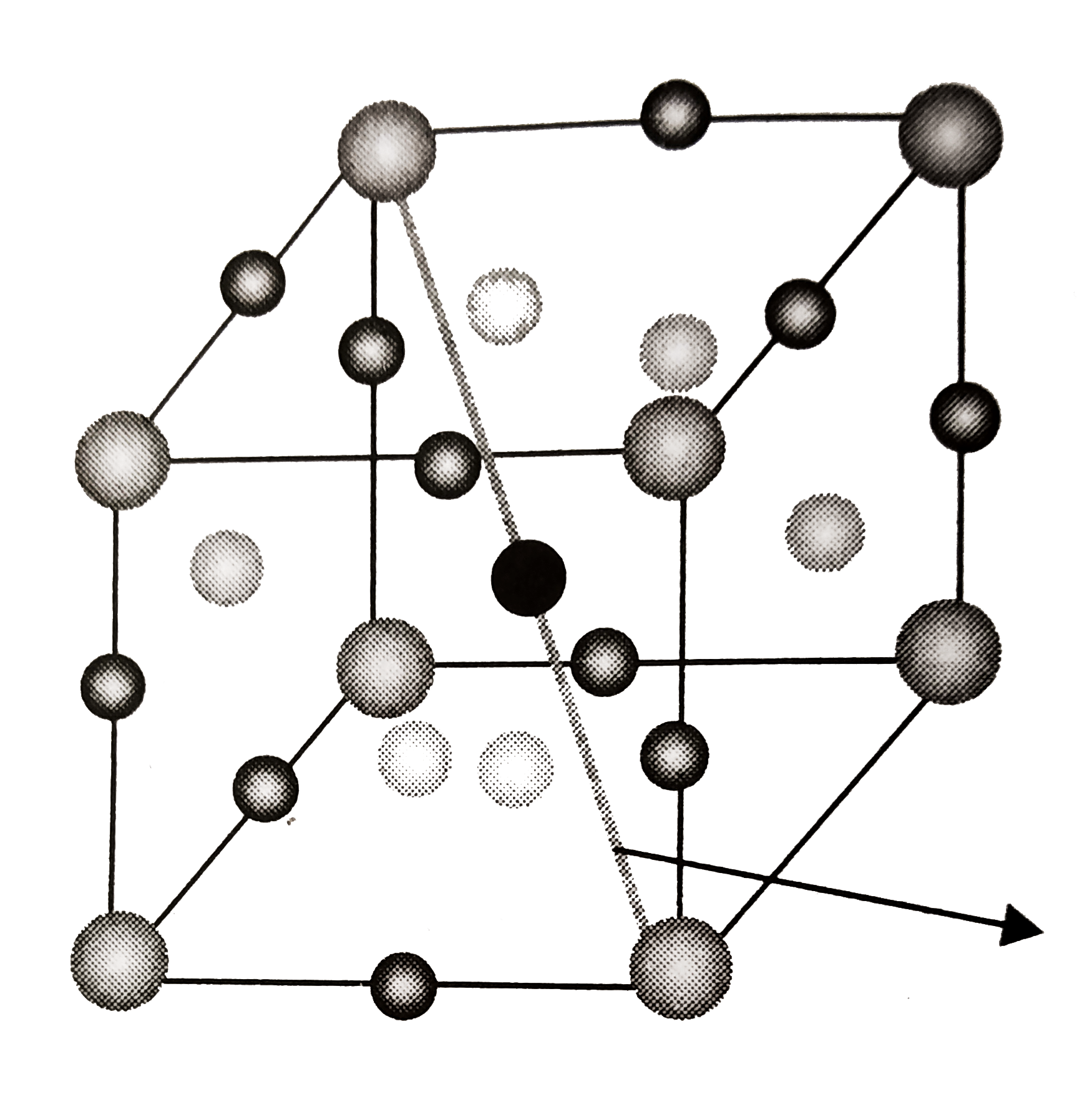
a. `Z_(eff(X)) = (n_(c))/(8) + (n_(f))/(2) = (8)/(8) + (6)/(2) = 1 + 3 = 4`
`Z_(eff(Y)) = (n_(b))/(8) + (n_(e))/(4) = (1)/(1) + (12)/(4) = 1 + 3 = 4`.
`Z_(eff(X + Y)) = 4 + 4 = 8`
ii. Total number of atoms in the cube
ii. `= 8` (corners) `+ 6 ("face centre") + 1` (body centre)
`+ 12` (edge centre)
`= 27` atoms/units cube
(iii). Formula: `Z_(eff(X)) = 4, Z_(eff(Y)) = 4`
implies `X_(4) Y_(4) = 4XY`
b. i.

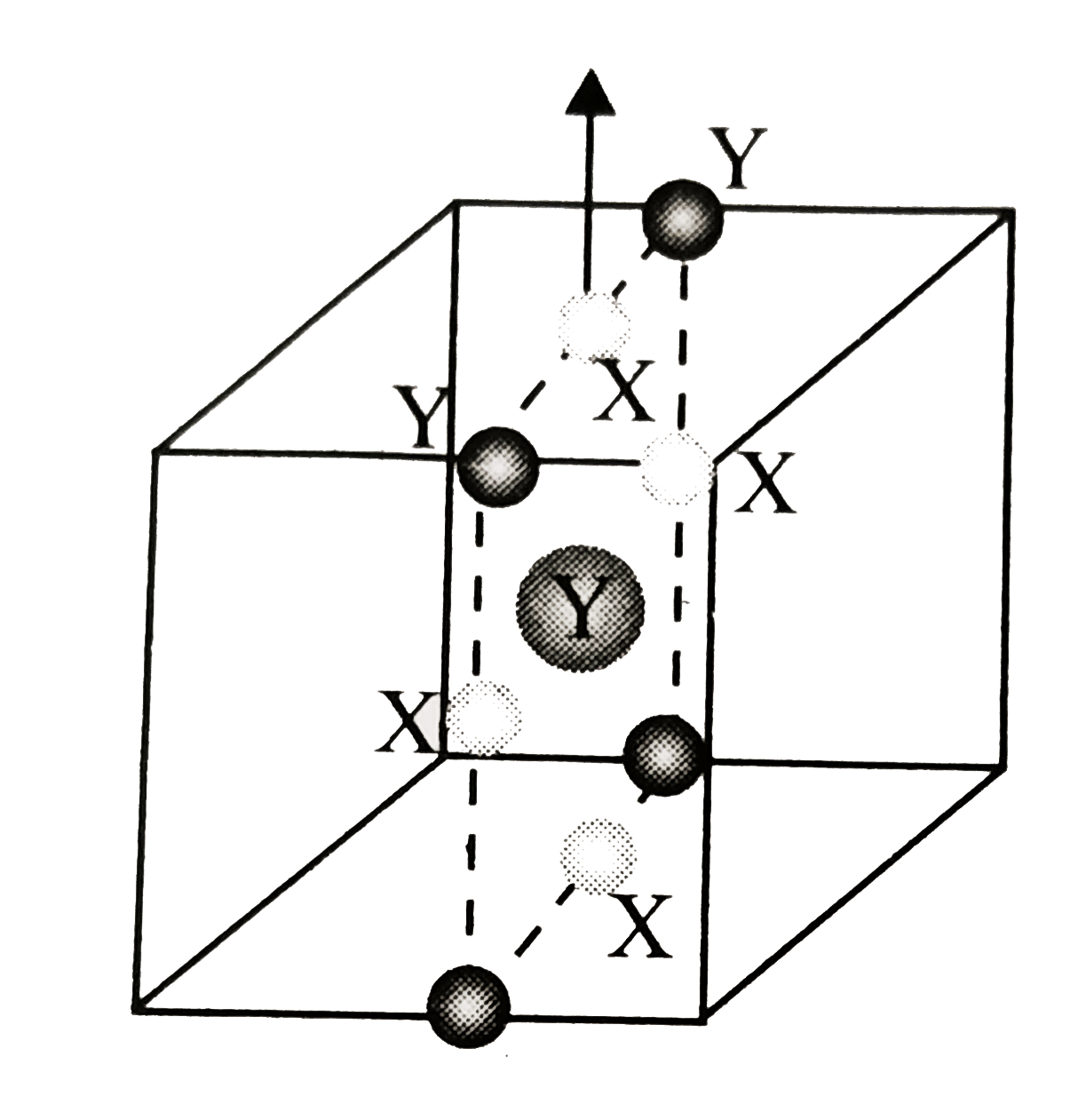
Atoms removed from one body diagonal
`= 2` atom form corner `+ 1` atom form body centre
`= 3` atoms. `Z_(eff(X)) = (n_(c))/(8) + (n_(f))/(2) = (8 - 2)/(8) + (6)/(2) = (15)/(4)`
`Z_(eff(Y)) = (n_(b))/(8) +(n_(c))/(4) = (1 - 1)/(1) + (12)/(4) = 0 + 3 = 3`
`Z_(eff(X + Y)) = (15)/(4) + 3 = (27)/(4)`
ii. Total number of atoms in the cube
`= 6 ("corner") + 6 ("face centre") +` Zero (body centre) `+ 12` (edge centres)
`= 24` atoms/unit cube
iii. `Z_(eff(X)) = (15)/(4), Z_(eff(Y)) = 3`
`implies X_((15/(4)) Y_(3)`.
Simplifying `X_(15) Y_(12)`

`Z_(eff(X)) = (n_(c)) /(8) + (n_(f))/(2) = (8 - 4)/(8) + (6 - 1)/(2) = 1 + 2 = 3`.
`Z_(eff(Y)) = (n_(b))/(8) +(n_(c))/(4) = (1 - 1)/(1) + (12)/(4) = 1 + 3 = 4`
`Z_(eff(X)) = 3 + 4 = 7`
ii. Total number of atoms in a cube
`= 4 ("corner") + 5 ("face centre") + 1` (body centre)
`+ 12` (edge centre)
`= 22` atoms/unit cube
iii. Formula: `Z_(eff(X)) = 3, Z_(eff(Y)) = 4`
`implies X_(3) Y_(4)`.
d. Plane passing through the middle of cube (other atoms are not shown)

i. `Z_(eff(X)) = (n_(c)) /(8) + (n_(f))/(2) = (8)/(8) + (6 - 4)/(2) = 1 + 1 = 2`
`Z_(eff(Y)) = (n_(b))/(8) +(n_(c))/(4) = ((1 - 1))/(1) + ((12 - 4))/(4) = 2`.
`Z_(eff(X + Y)) = 2 + 2 = 4`
ii. Total number of the atoms in the cube
`= 8 ("corner") + 2 ("face centres") +` zero (body centre) `+ 8` (edge centres)
`= 18` atoms/unit cube
iii. Formula: `Z_(eff(X)) = 2, Z_(eff(Y)) = 2`
e.
`Z_(eff(X)) = (n_(c)) /(8) + (n_(f))/(2) = (8)/(8) + ((6 - 2))/(2) = 1 + 2 = 3`
`Z_(eff(Y)) = (n_(b))/(8) +(n_(c))/(4) = ((1 - 1))/(1) + (12)/(4) = 0 + 3 = 3`.
`Z_(eff(X + Y)) = 3 + 3 = 6`.
ii. Total number atom in a cube `= 8` (corner) `+ 6` (face centre)
zero (body centre) `+ 12` (edge centre)
`= 24` atoms/unit cube
iii. Formula: `Z_(eff(X)) = 3, Z_(eff(Y)) = 3`
Formula is `X_(3) Y_(3)` or `3XY`.
Promotional Banner

Topper's Solved these Questions

  • SOLID STATE

    CENGAGE CHEMISTRY|Exercise Solved Examples|13 Videos
  • SOLID STATE

    CENGAGE CHEMISTRY|Exercise Exercises (Linked Comprehension)|13 Videos
  • REDUCTION AND OXIDATION REACTION OF ORGANIC COMPOUNDS

    CENGAGE CHEMISTRY|Exercise SUBJECTIVE TYPE|3 Videos
  • SOLUTIONS

    CENGAGE CHEMISTRY|Exercise Ex 2.3 (Objective)|9 Videos

Similar Questions

Explore conceptually related problems

A compound formed by elements X and Y has a cubic structure in which X atoms are at the corner of the cube and Y atoms are at the face centres. One atoms X is misssing from the corner. a. Calculate (i). Z_(eff') (ii). total number of the atoms in the cube, and (iii). formula of the compound. b. If alll the atoms are removed from one of the faces of the cube containing atoms at corners, as in (a) above, calculate (i) Z_(eff') (ii) total number of atoms in a cube, and (iii) formula of the compound.

A compound formed by elements A and B has a cubic structure in which A atoms are at the corners of the cube and B atoms are at the face centres. The formula of the compound will be

A compound formed by elements A and B has a cubic structure in which A atoms are at the corner of the cube and B atoms are at the face centres. Derive the fomula of the compound.

A compound formed by elements X and Y has a cubic structure in which X atoms are at the face centres. a. Calculate: (i) Z_(eff') (ii) total number of atoms in a cube, and (iii) formula of the compound. b. If all the atoms are removed from a single axis passing through the centre of the cube, calculate (i) Z_(eff') (ii) total number of atoms in a cube, and (iii) formula of the compound.

A compound formed by elements X and Y has a cubic structure in which X atoms are at the corner of the cube and also at alternate face entres. Y atoms are present at the body centre and also at the alternate edge centre of the cube. a. Calculate (i) Z_(eff') (ii) total number of atoms in the cube, and (iii) formula of the compound. b. If all the atoms are removed from one of the plane passing through the middle of the cube of the cube which contains atoms both on the edge entre as well as on the face centre, calculate (i) Z_(eff') (ii) total number of atoms in the cube, (iii) formula of the compound. c. If all the atoms are removed from the plane passing through the middle of the cube which contains atoms only on the edge centre but not on face centre, calculate (i) Z_(eff') (ii) total number of atoms in t he cube, and (iii) fomula of the compound. d. If all the atoms are removed from one of the plane passing through the middle of the cube which neither contains atoms on the edge centre nor on the face centre, calculate (i) Z_(eff') (ii) total number of atoms in the cube, and (iii) formula of the compound. e. If all the atoms are removed from on e of the axes passing through the middle of the cube containing face centre atoms, calculate (i) Z_(eff') (ii) total number of atoms in a cube, and (iii) formula of the compound. f. If all the atoms are remove from one of the axes passing through the middle of the cube nor containing face centre atoms, calculate (i) Z_(eff') (ii) total number of atoms in a cube, and (iii) formula of the compound.

A compound formed by elements X and Y has a cubic structure in which X atoms are at the corners of the cube of and two atoms (Y) are at each body diagonal of the cube. a. Calculate: (i) Z_(eff') (ii) total number of atoms in a cube, and (iii) formula of the compound. b. If all atoms form one body diagonal of the cube except corners are removed, calculate: (i) Z_(eff') (ii) total number of atoms in the cube, and (iii) formula of the compound.