Home
Class 12
CHEMISTRY
If all the atoms touching one face plane...

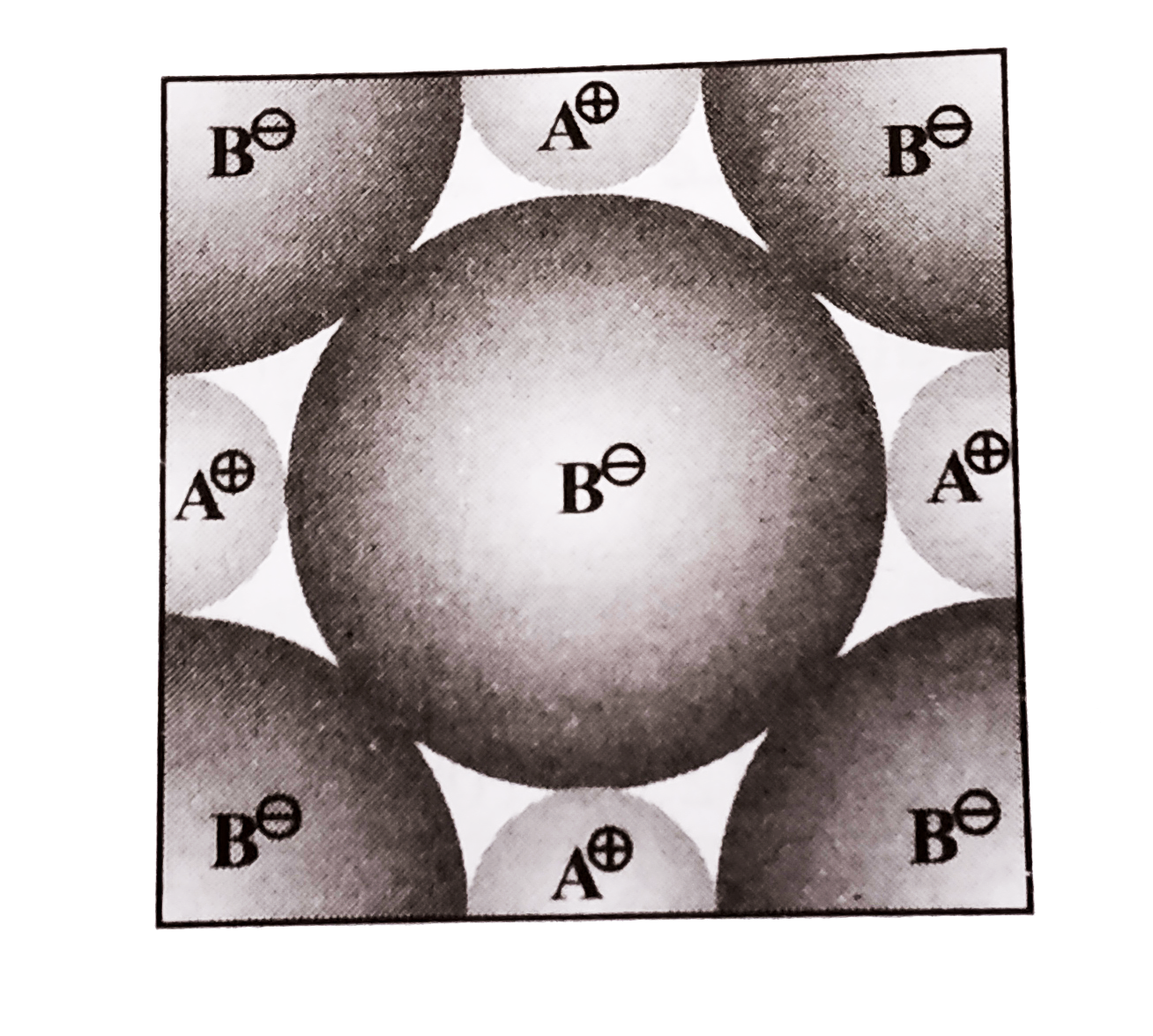
If all the atoms touching one face plane are removed in solid `A^(o+)B^(Θ)` having rock salt type structure, then the formula of the compound left and the defect brought by this removal, respectively, is

A

`AB`, Frenkel defect

B

`A_(2)B`, Frenkel defect

C

`AB`, Schottky defect

D

`A_(2)B`, Schottky defect

Text Solution

Verified by Experts

The correct Answer is:
C

c. (i) Since `A^(o+)B^(Θ)` has `NaCl`-type `(fc c)` structure.
So `B^(Θ)` are in `(fc c)` arramgement.

Number if `B^(Θ)` ions `= 4`
(Corner `+` face centre `= 1 + 3 = 4)`
Number if `A^(o+)` ions `= 4`
[ in `OV` formed at body centre `+` edge centre `= 1 + 3 = 4]`

Number if `B^(Θ)` ions removed
`= 4` corner `xx (1)/(8)` per corner share
`+ 1` face centre `xx (1)/(2)` per face centre share
`= (4)/(8) + (1)/(2) = 1`

Number if `B^(Θ)` left `= 4 - 1 = 3`

Number if `A^(o+)` ions removed
`= 4` edge centre `xx (1)/(4)` per edge centre share `= (4)/(4) = 1`
Number if `A^(o+)` ions left `= 4 - 1 = 3`
Thus, formula `= A_(3)B_(3) = 3AB.`
ii. As Atoms (or ions) are completely removed.
Hence, the defect in the crystal is Schottky type.
Promotional Banner

Topper's Solved these Questions

  • SOLID STATE

    CENGAGE CHEMISTRY|Exercise Solved Examples|13 Videos
  • SOLID STATE

    CENGAGE CHEMISTRY|Exercise Exercises (Linked Comprehension)|13 Videos
  • REDUCTION AND OXIDATION REACTION OF ORGANIC COMPOUNDS

    CENGAGE CHEMISTRY|Exercise SUBJECTIVE TYPE|3 Videos
  • SOLUTIONS

    CENGAGE CHEMISTRY|Exercise Ex 2.3 (Objective)|9 Videos

Similar Questions

Explore conceptually related problems

In a solid having rock salt structure, if all tge atoms touching one body diagonal plane are removed (except at body centre), then the formula of the left unit cell is

A solid AB has rock salt structure. How many atoms of A and B are present in the unit cell ?

If the atoms touching one of the 2-fold, 3-fold and 4-fold axis of symmetry are removed , then formula of compound is _____

Atoms A,B,C, D are present at corners , face-centres , body-centres and edge-centres respectively (a)If the atoms touching all the rectangular planes of symmetry are removed, then what is the formula of the compound ? (b)If body centre is at origin and the atoms present in (or touching) first octant are removed, then what is the formula of the compound ?

A compound formed by elements X and Y has a cubic structure in which X atoms are at the corner of the cube and also at the face centers. Y atoms are present at the body centre and at the edge centre of the cube. a. Celculate (i) Z_(eff') (ii) total number of atoms in the cube, and (iii) formula of the compound. b. If all the atoms are removed from one of the body diagonals of the cube, calculate (i) Z_(eff') (ii) total number of atoms in the cube, and (iii) formula of the compound. c. If all the atoms from the diagonals of the one of the face of the cube are removed, calculate (i) Z_(eff') (ii) total number of atoms in the cube, and (iii) formula of the compound. d. If all the atoms are removed from one of the plane passing through the middle of t he cube, calculate (i) Z_(eff') (ii) total number of atoms in the cube, and (iii) formula of the compound. e. If all the atoms are removed from one of the axes passing through one of the face centres of the cube, calculate (i) Z_(eff') (ii) total number of atoms in the cube, and (iii) formula of the compound.

A compound formed by element A and B crystallizes in the cubic structure where B atoms are atg the face-centres. The formula of the compound is

