Home
Class 12
CHEMISTRY
Follwing are equimolal aqueous solution:...

Follwing are equimolal aqueous solution:
a.`1 m urea` , b.`1 m KCl` , c.`1 m MgCl_(2)` , d.`1 m Na_(3)PO_(4)`
Arrange them in increaseing
i. Boiling point , ii.Freezing point , iii. Osmotic pressure , iv.Vapour pressure

Text Solution

Verified by Experts
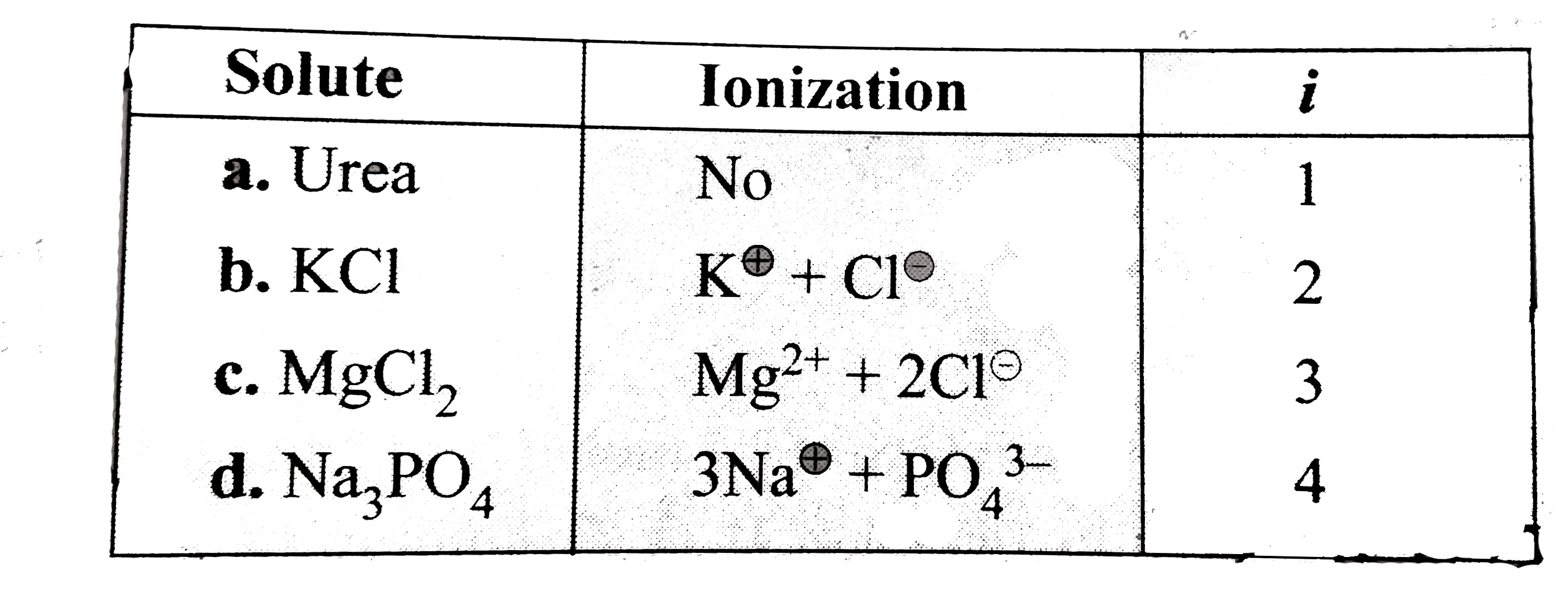
While analysing the colligative properties, if the density of the solution is not given, take the molarity of the solution same as molality and vice-versa.
In such type of questions, always assume `100%` dissociation for the ionic solutes until and unless specified

i. Boiling point of solution
`T_(b)=T_(b)(@)+(DeltaT_(b))`
`DeltaT_(b)=i(K_(b)m)`
Thus, greater the value of `i`, greater the value of `DeltaT_(b)` , and boiling point of solution.
`altblt cltd`
ii. Freezing point of solution
`T_(f)=T_(f)(@)-(DeltaT_(f))`
`DeltaT_(f)=i(K_(f)m)`
Thus, greater the value of `i`, greater the value of `DeltaT_(f)` , but smaller the value of freezing point.
`dltcltblta`
iii. Osmotic pressure `(pi)`
`(pi)=iCRT`
Thus, greater the value of i, larger the value of osmotic pressure.
`altblt cltd`
iv. Vapour pressure of solution
`DeltaP/P_(A)^(@)=ichi_(B)`
or `DeltaP/P_(A)^(@)=i n_(B)/(n_(A)+n_(B)) ~~n_(B)/n_(A)`
Thus, greater the value of `i`,greater the value of `DeltaP`. Hence , smaller the value of vapour pressure of solution.
`dltcltblta`
Promotional Banner

Topper's Solved these Questions

  • SOLUTIONS

    CENGAGE CHEMISTRY|Exercise Solved Examples|40 Videos
  • SOLUTIONS

    CENGAGE CHEMISTRY|Exercise Exercises (Linked Comprehension)|58 Videos
  • SOLID STATE

    CENGAGE CHEMISTRY|Exercise Ex 1.2 (Objective)|9 Videos
  • SURFACE CHEMISTRY

    CENGAGE CHEMISTRY|Exercise Archives Subjective|2 Videos

Similar Questions

Explore conceptually related problems

Addition of non-volatile solute to a solvent always inceases the colligative properties such as osmotic pressure, DeltaP, DeltaT_(b) and DeltaT_(f) . All these colligative properties are direactly propertional to molality if solutions are dilute. The increase in colligative properties on addition of non-volatile solute is due to incease in number of solute particles. For different aqueous solutions of 0.1 N NaCl, 0.1 N urea, 0.1 N Na_(2)SO_(4) and 0.1 N Na_(3)PO_(4) solution at 27^(@)C , the correct statement are : (P) The order of osmotic pressure is, NaCl gt Na_(2)SO_(4) gt Na_(3)PO_(4) gt urea (Q) pi = (DeltaT_(b))/(K_(b)) xx ST for urea solution (R) Addition of salt on ice increases its melting point (S) Addition of salt on ice brings in melting earlier

Out of 1M urea solution and 1M KCI solution, which has higher freezing point ?

Consider the following solutions: I.1 M sucrose , II. 1 M KCl III.1 M benzoic acid in benzene IV. 1 M (NH_(3))_(3)PO_(4) Which of the following is/are true?

The elevation in boiling points of 0.1m aqueous solutions of NaCI, CuSO_(4) and Na_(2)SO_(4) are in the ratio

Depression in freezing point for 1 M urea, 1 M NaCl and 1 M CaCl_(2) are in the ratio of

Arrange the following solutions as directed: Increasing order of boiling points. 0.001 m NaCl , 0.001 m urea 0.001 m MgCl_(2) , 0.001 m CH_(3)COOH Increasing order freezing points. 0.1 M ethanol , 0.1 M Ba_(3)(PO_(4)_(2) 0.1 M Na_(2)SO_(4) Increasing order of osmotic pressure. 0.1 M glucose , 1% urea solution 0.1 M common salt Increasing order of Van't Hoff factor. ltBrgt NaNO_(3) , BaCl_(2) K_(3)[Fe(CN)_(6] , C_(6)H_(12)O_(6) CH_(3)COOH

If osmotic pressure of 1M urea is pi , what will be the osmotic pressure for 0.1 M NaCl?

