Home
Class 11
PHYSICS
Pulleys shown in the system are massless...

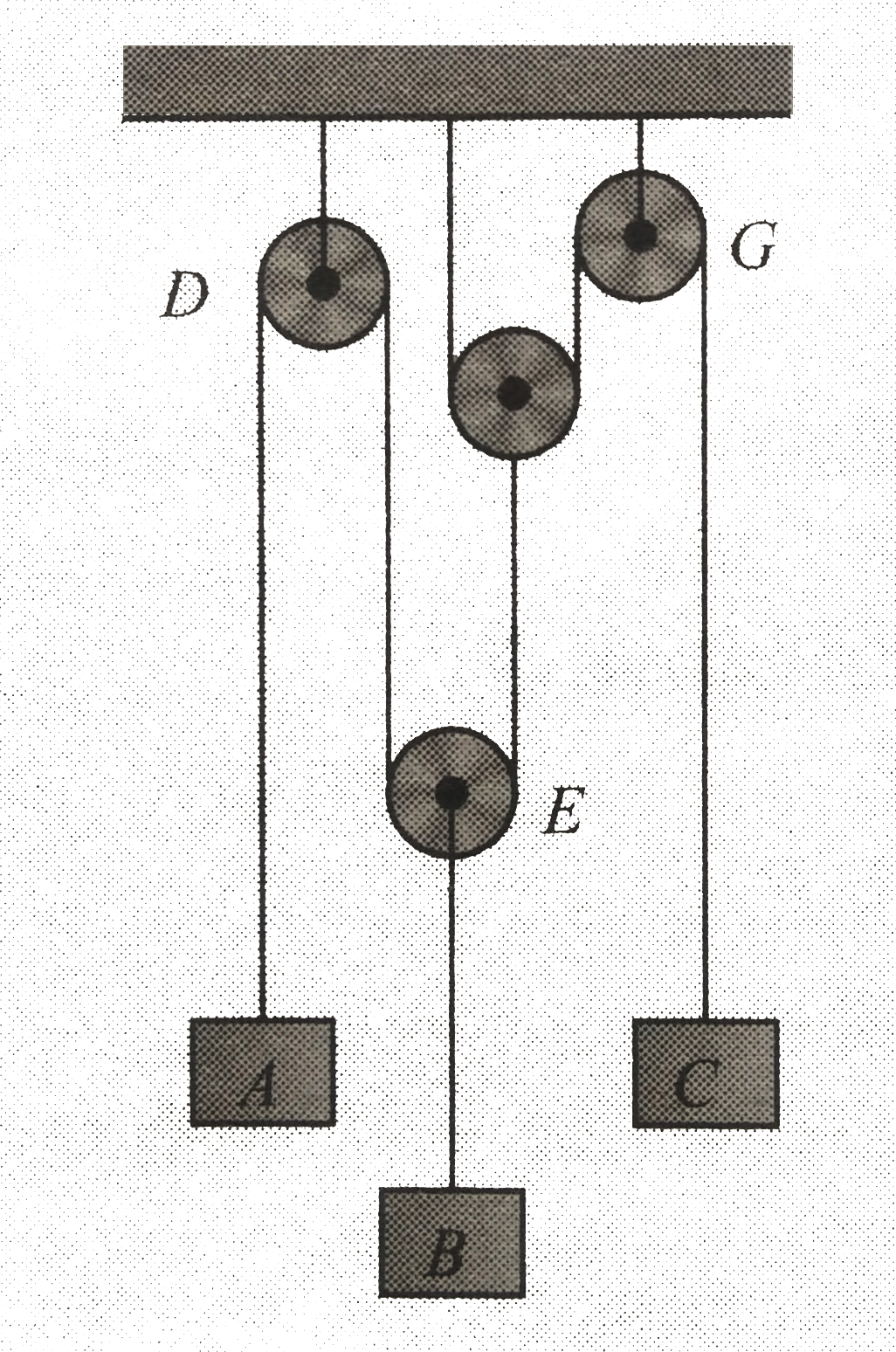
Pulleys shown in the system are massless and fricionless. Threads are inextensible. The mass of blocks A, B, and C are `m_(1)=2kg, m_(2)=4kg`, and `(m_3)=2.75 kg`, respectively. Calculate the acceleration of each block.

Text Solution

Verified by Experts

Let the acceleration of blocks A and B be a and b vertically upwards, and acceleration of block C is c downwards, respectively,

As length of strings are constant. The sum of change in segment length should be zero.
For string 1: [writing from left to right]
`(-x_A)+(-x_B)+(x_(P)-x_(B))=0`
`x_(P)=x_(A)+2x_(B)`...(i)
For string 2: `(-x_P)+(-x_P)+(x_c)=0`
`x_(C) = 2x_(P)` ..(ii)
form (i) and (ii) : `x_(C)=2x_(A)+4x_(B)`
`implies c=2a+4b` ...(iii)
Now considering FBDs, we get the following :

For block A, `T_(1)-m_(1)g=m_(1)a` ...(i)
For block B, `2T_(1)-m_(2)g=m_(2)b` ..(ii)
For pulley F, `T_(1)=2T_(2)` ...(iii)
For block C, `m_(3)g-T_(2)=m_(3)(2a+4b)` ...(iv)
Solving above equations,
`T_(1)=22N, T_(2)=11N`
`a=1 ms^(-2), b=1ms^(-2)`
Hence, acceleration of block A,
`a=1 ms^(-2)(uarr)`
Acceleration of block B,
`b=1 ms^(-2)(uarr)`
Acceleration of block `C=(2a+4b)=6ms^(-2)(darr)`.
Promotional Banner

Topper's Solved these Questions

  • NEWTON'S LAWS OF MOTION 1

    CENGAGE PHYSICS|Exercise Exercise 6.1|11 Videos
  • NEWTON'S LAWS OF MOTION 1

    CENGAGE PHYSICS|Exercise Exercise 6.2|35 Videos
  • NEWTON'S LAWS OF MOTION 1

    CENGAGE PHYSICS|Exercise Integer|5 Videos
  • MISCELLANEOUS VOLUME 2

    CENGAGE PHYSICS|Exercise INTEGER_TYPE|10 Videos
  • NEWTON'S LAWS OF MOTION 2

    CENGAGE PHYSICS|Exercise Integer type|1 Videos

Similar Questions

Explore conceptually related problems

Pulleys shown in the system of the figure are massless and friction less. Threads are inextensible. Mass of block A, B and C are m_(1) kg,m_(2) =4kg and m_(3) = 2.75kg , respectively .Calculate acceleration of A block

In the arrangement shown in the figure pulleys are small, light and frictionless, threads are inextensible and mass of blocks A , B and C is m_(1)=5kg , m_(2)=4kg and m_(3)=2.5kg respectively and co-efficient of friction for both the planes is mu=0.50 . Calculate the acceleration of block A (in m//s^(2) ) when the system is released from rest. ( g=10 m//s^(2) )

In the arrangement , shown below pulleys are massless and frictionless and threads are inextensible , block of mass m_(1) will remain at rest if

In the arrangement shown in figure pulleys are mass of block A,b and C is m_(1) = 5 kg m_(2) = 4 kg and m_(3) = 2.5 kg respectively .Co-efficient acceleration of friction for both the plane is mu = 0.50 Calculate acceleration of which block when system is released from rest

If m_(1) =10kg,m_(2)=4kg,m_(3) =2kg , the acceleration of system is .

Two block A and B are arrenged as shown in figure (m_(A) = 5 kg and m_(B) = 10 kg) Find the acceleration of blocks if F = 40 N

In the arrangement shown in the figure, pulleys are light, small and smooth. Mass of blocks A,B and C is m_(1) =14 kg, m_ (2) =11kg and M =52kg respectively. The block A can slide freely along a vertical rail fixed to left vertical face of block C Assuming all the surface to be smooth magntitude of acceleration of block A is sqrt((10)/(A) Calculate x .

Pulleys are ideal and string are massless. The masses of blocks are m_(1) = 4kg and m_(2) = 1kg as shown.If all surfaces are smooth then the acceleration of m_(2) in m//s^(2) is ( g =10 m//s^(2) )

Two masses m_(1) and m_(2) are joined with the help of massless string passing over a pulley of Radius R and mass M . Assume that string doesn't slip over the pulley. Take m_(1)=10kg , m_(2)=5kg , M=10 kg , R=1m . (a) Calculate the acceleration of each book. (b) Calculate the tensions in the thread.