Home
Class 11
PHYSICS
A block of mass m can slide freely in a ...

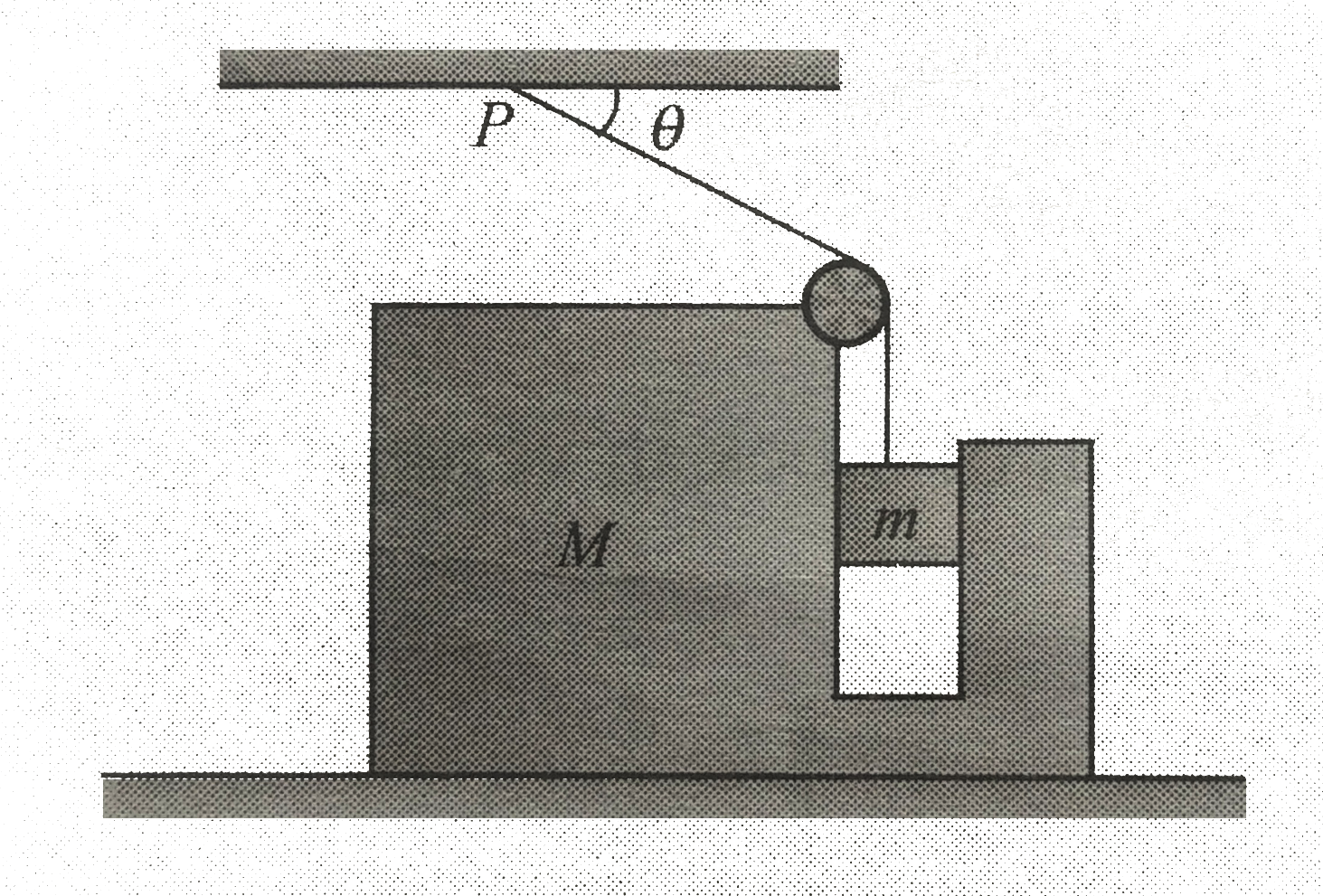
A block of mass m can slide freely in a slot made in a bigger of mass M as shown in fig. There is no friction anywhere in the system.

The block m is connected to one end of a string whose other end is fixed at point P. system is released from rest when the string at P makes an angle `theta` with horizontal. Find the acceleration of m and M after release.

Text Solution

Verified by Experts
Method 1: Just after the release of system, block M will move towards left (say with acceleration A) and block m will move down with respect ot M (say with acceleration a). As there is no motion of M is vertical direction, hence the acceleration of m in verticle direction will be same as that of M, i.e. A, because horizontal both move together.
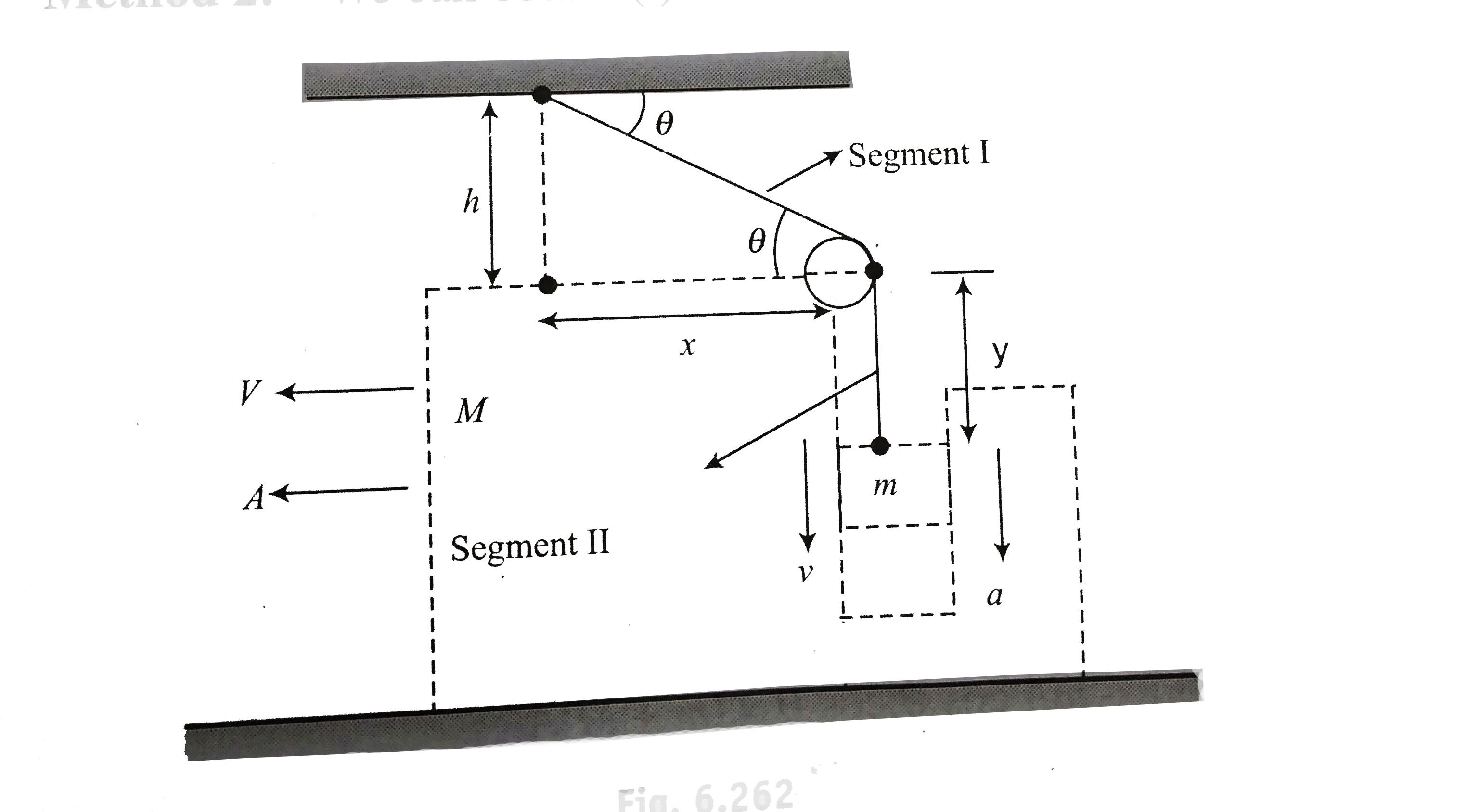
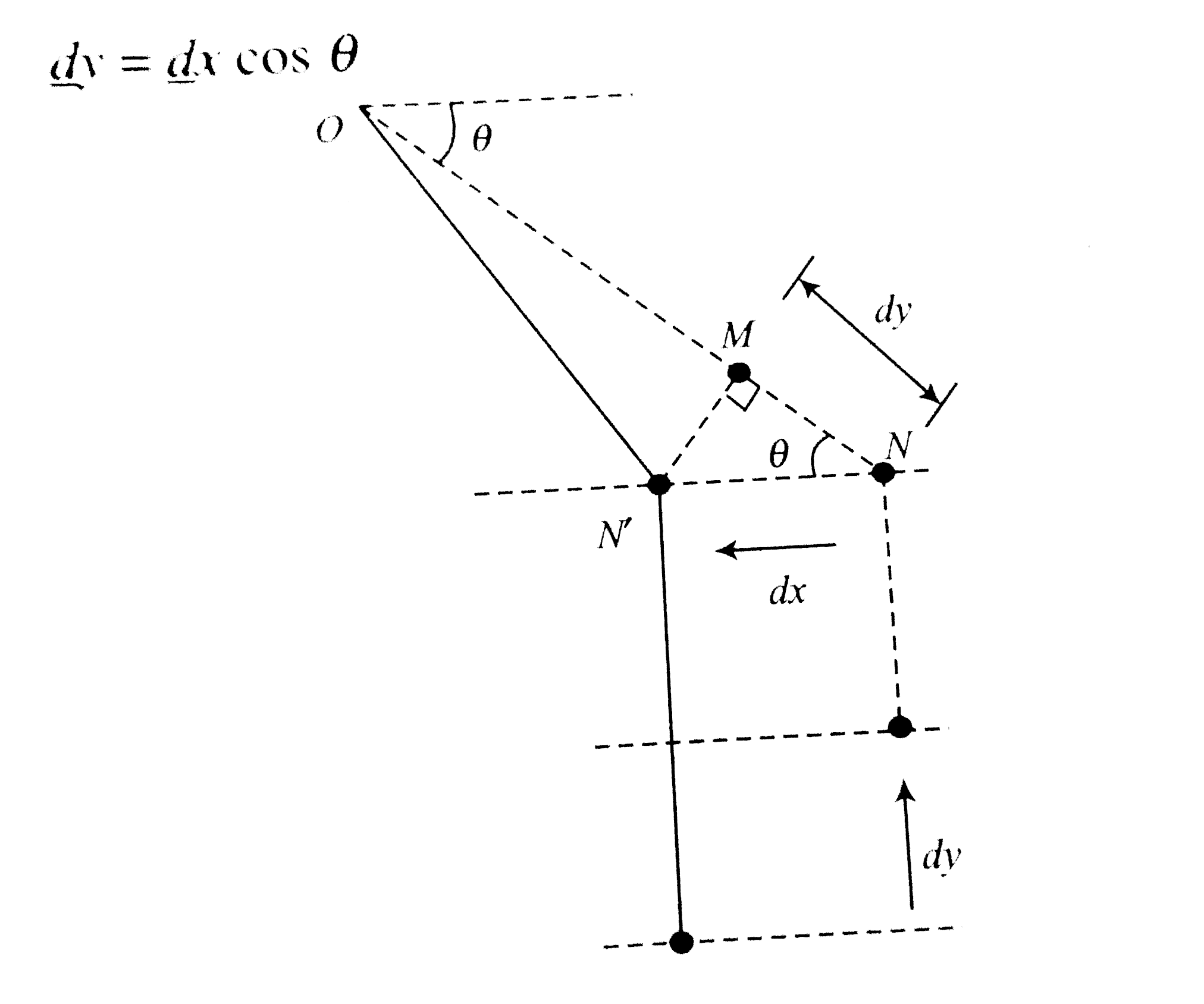
Finding constraint Method 1: Let just after release, during a small time dt, the displacement of m(w.r.t. M) is dy downwards and that of M is dx horizontally as shown in fig.
Decreases in the length of segment I`=underset(bar)d xcos theta`
Increases in the length of segment II' `underset(bar)d y`
As the total length of the string is constant , so
`underset(bar)d = underset(bar)d x cos theta` ..(i)

Divinding both sides by dt, we get
`(dy)/(dt)=(dx)/(dt) cos theta implies v = V cos theta` ..(ii)
differenting w.r.t. `t=(dv)/(dt)=V(- sin theta)(d theta)/(dt)+(dV)/(dt) cos theta`
But initially `V=0`, as `a=A cos theta` ...(iii)
(`:. (dv)/(dt) = a , (dV)/(dt)=A`)
Method 2: we can obtain (i) in the following way.

The displacment of M towards left is dx, then its component along AP is `dx cos theta` should be decreased in the length of segment I and this should be equal to increases in the length of segment II which is dy. Hence, `dy=dx cos theta`.
`rArr a = A cos theta`
Method 3:
Total length of string : `l=sqrt(h^(2)+y^(2))+x`
differentiating w.r.t. `t=(dl)/(dt) =(d(h^(2)+x^(2))^(1//2))/(dt) +(dx)/(dt)`
`rArr 0=(2y(dy)/(dt))/(2sqrt(h^(2)+y^(2)))+(dx)/(dt)rArr0= cos theta (-V)+r`
(`because (dx)/(dt)=v, (dy)/(dt)=-V` (as y decreases with time)
and `cos theta=(y)/(sqrt(h^(2)+y^(2)))`
`implies v=V cos theta` which is same as (ii)
Now finding acceleration of blocks
We can use any of the following method to find the value of A and a .

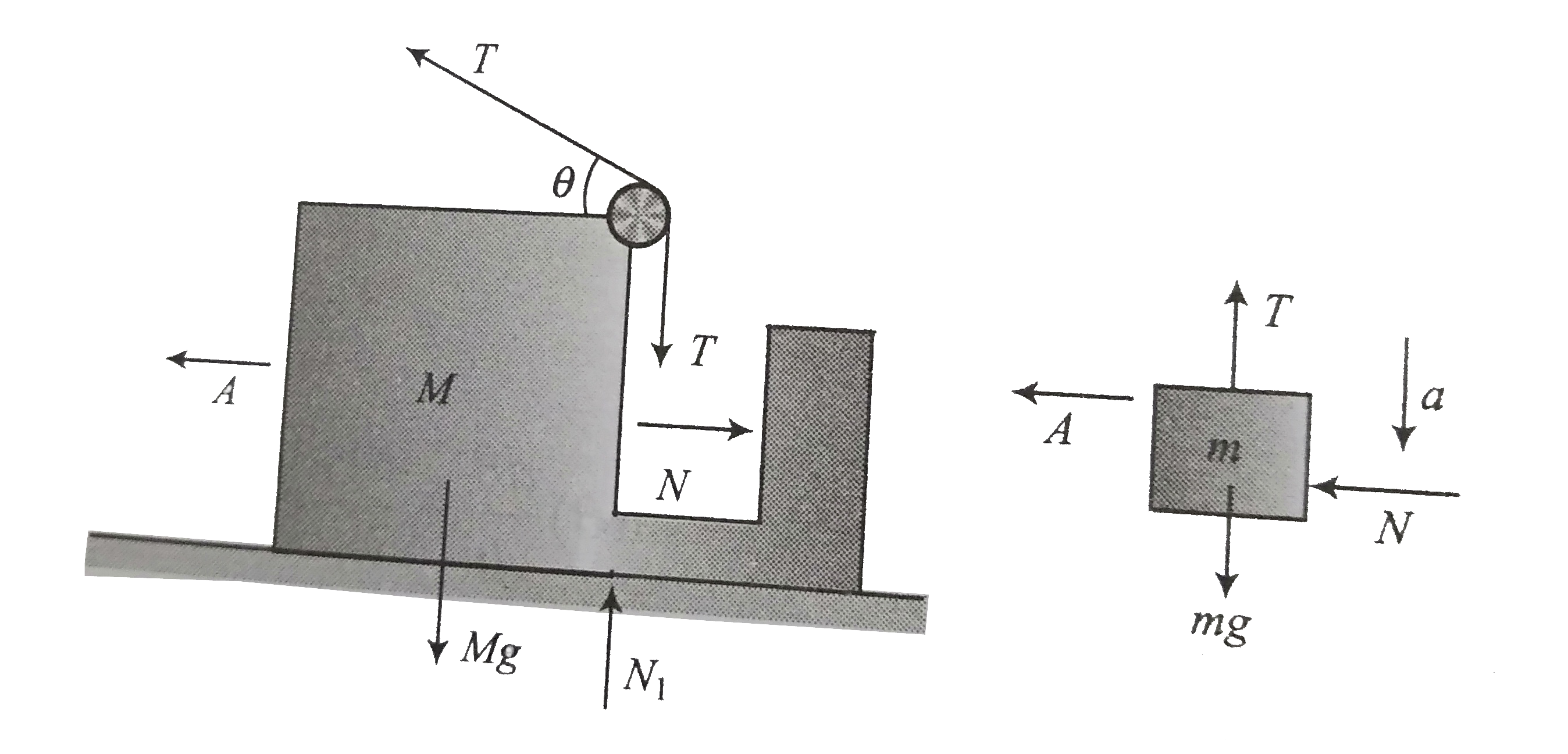
Method 1: From FBD of M:
`T cos theta-N = MA` ...(iv)
From FBD of m: `N=mA` ..(v)
`mg-t=ma` ..(vi)
Combining (iv) and (v) we get
`T cos theta=(m+M)A` ...(vii)
Putting `a=A cos theta` in (iv) we get
`mg-T=mA cos theta` ..(viii)
Put the value of T form (viii) into (vii) we get
`(mg-mA cos theta)cos theta=(m+M)A`
`implies A=(mg cos theta)/(M+m(1+cos^(2)theta))`
and `a=A cos theta=(mg cos^(2)theta)/(M+m(1+cos^(2) theta))`
The net acceleration of m is
`sqrt(A^(2)+a^(2))=A sqrt(1+cos^(2) theta)=(mg cos thetasqrt(1+cos^(2) theta))/(M+m(1+cos^(2) theta))`
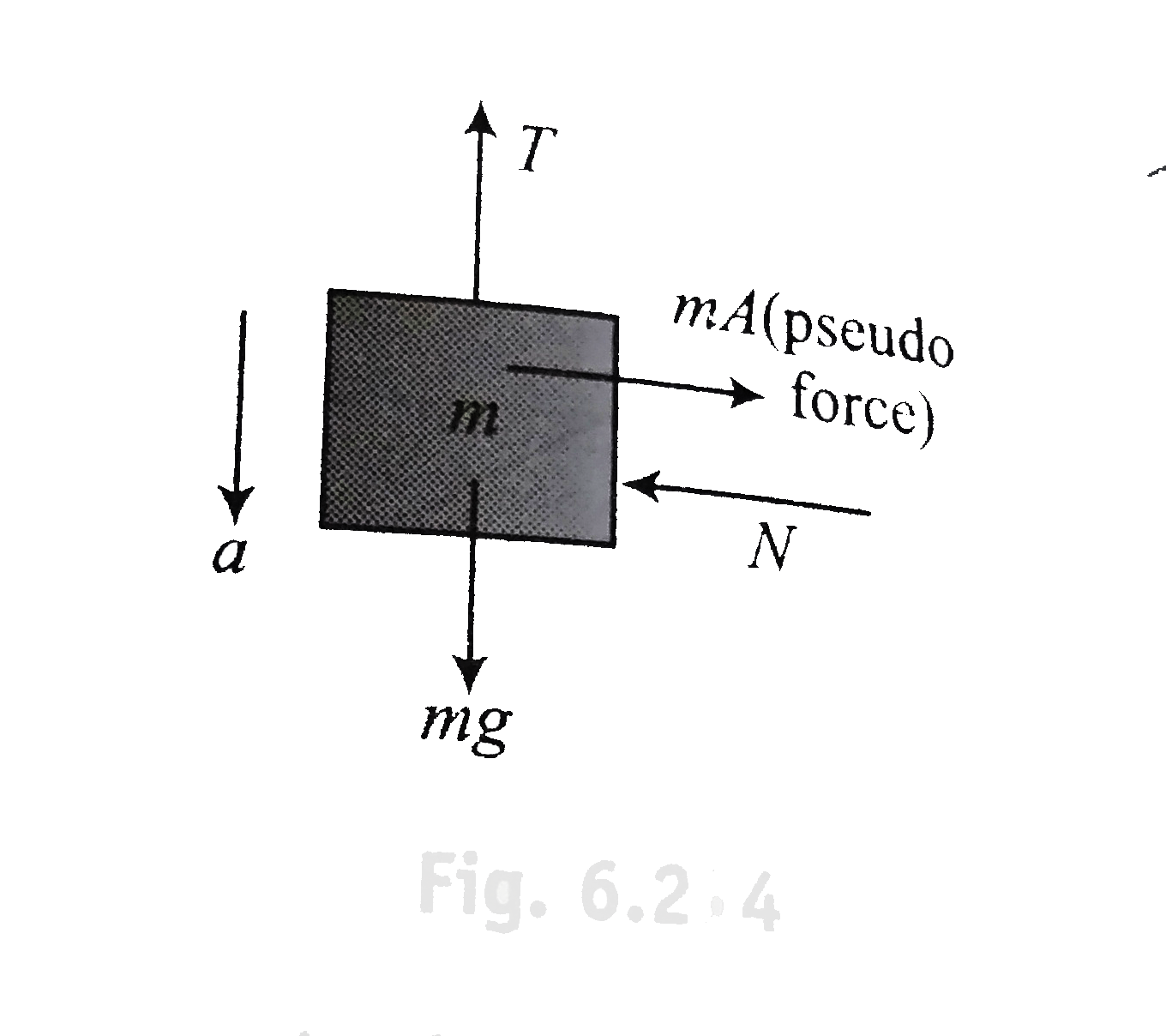
Method 2: Analyzing the block with w.r.t. wedge

W.r.t M, m has only vertcal acceleration which is a downwards. Here we have to apply pseudo force because M is a non inertial frame.
FBD of m w.r.t. M:
`N=mA, mg-T=ma`
These equation are same as (v) and (vi). Now solve to get answer.
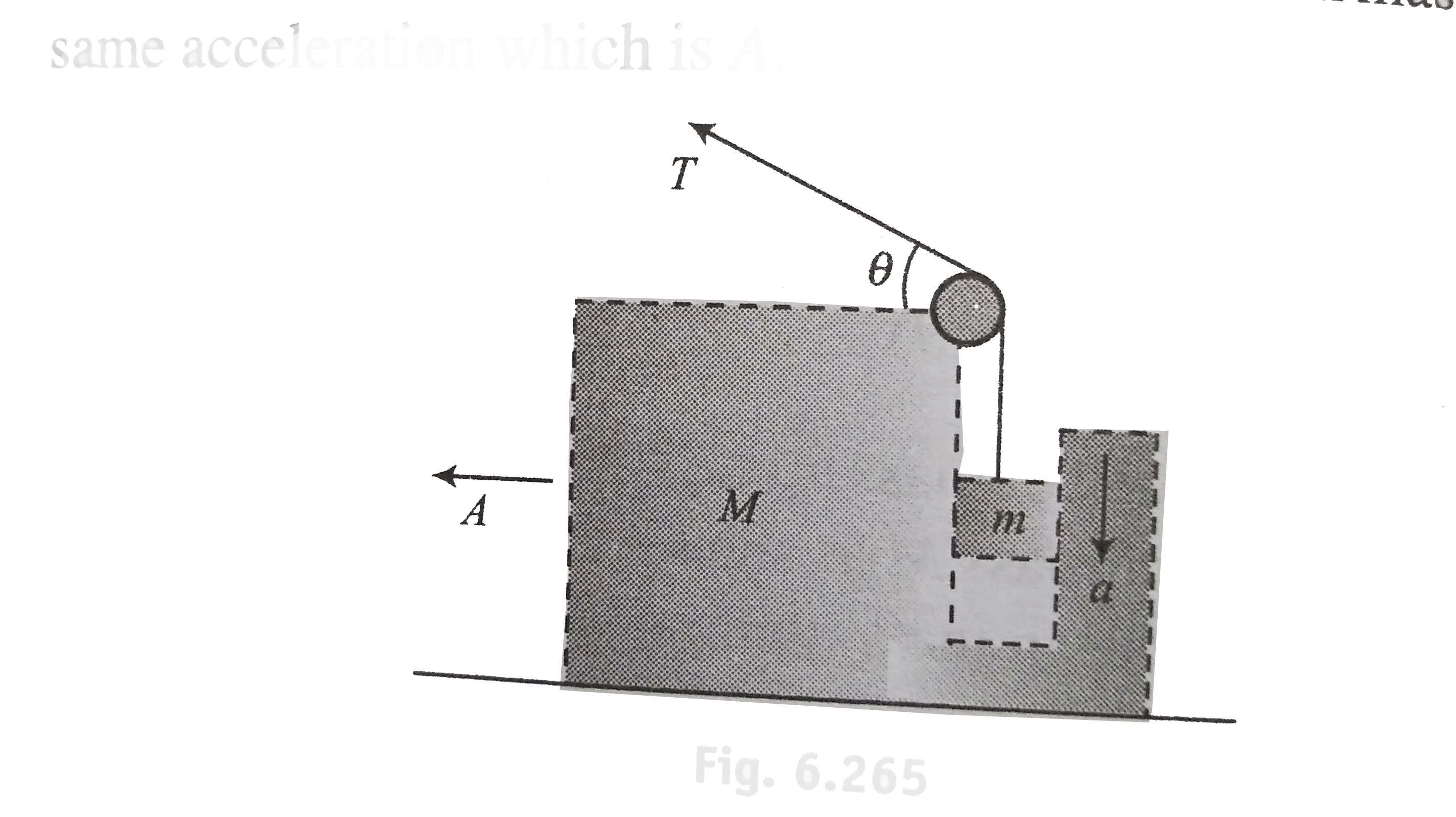
Method 3: Analyzing the block and wedge together
Analyzing the system of `(M+m)`, i.e. , block and wedge together in horizontal direction, in horizontal direction both masses have same acceleration which is A.

`T cos theta=(M+m)A` ...(ix)
Analyzing the motion of blcok in vertical direction
`mg-T=ma` ..(x)

Solving (ix) and (x) , we get
`A=(mg cos theta)/(M+m(1+cos^(2) theta))`
and `a=(mg cos^(2)theta)/(M+m(1+cos^(2) theta))`
Promotional Banner

Topper's Solved these Questions

  • NEWTON'S LAWS OF MOTION 1

    CENGAGE PHYSICS|Exercise Exercise 6.1|11 Videos
  • NEWTON'S LAWS OF MOTION 1

    CENGAGE PHYSICS|Exercise Exercise 6.2|35 Videos
  • NEWTON'S LAWS OF MOTION 1

    CENGAGE PHYSICS|Exercise Integer|5 Videos
  • MISCELLANEOUS VOLUME 2

    CENGAGE PHYSICS|Exercise INTEGER_TYPE|10 Videos
  • NEWTON'S LAWS OF MOTION 2

    CENGAGE PHYSICS|Exercise Integer type|1 Videos

Similar Questions

Explore conceptually related problems

A block of mass m can slide freely along the verticle surface of a bigger block of mass M as shown in fig. There is no friction anywhere in the system. The block m is connected to one end is fixed at point P. The string between P_(1) and P is horizontal and other parts of the string are vertical. system is released from rest. Find the acceleration of m and M during their subsequent motion.

A thin uniformed rod of mass m and length L is hinged at one end and from other end a light string is attached. The string is wound over a frictionless pullely (having mass 2m ) and a block of mass 2m is connected to string on other side of pulley as shown. the system is released from rest when the rod id making an angle of 37^(@) with horizontal. Based on above information answer the following question : Just after releases of the system from rest acceleration of block is

In the system shown in figure, the block A is released from rest. Find Tension in the string.

A ring A which can slide on a smooth wire is connected to one end of a string as shown in fig. Other end of the string is connected to a hanging mass B. Find the speed of the ring when the string makes an angle theta with the wire and mass B is going down with a velocity v.

A block of mass m is placed at rest on a smooth wedge of mass M placed at rest on a smooth horizontal surface. As the system is released

A block of mass M si suspended by two strings angles theta_(1) and theta_(2) with the horizontal. Find the tensions in the strings.

The block of mass m is at rest. Find the tension in the string A .

A ring of mass m can slide on the vertical smooth rod. Ring is connected by block with string as shown in figure. Pulley is of mass-less and smooth the system is released from reast. Initial tension in string is

A block of mass M is placed on the top of a bigger block of mass 10 M as shown in figure. All the surfaces are frictionless. The system is released from rest, then the distance moved by the bigger block at the instant the smaller block reaches the ground :

A mass less string is wrapped around a uniform disc of mass m and radius r . The string passes over a mass less pulley and is tied to a block of mass M at its other end (see figure). The system is released from rest. Assume that the string does not slip with respect to the disc. (a) Find the acceleration of the block for the case M = m (b) Find (M)/(m) for which the block can accelerate upwards.