Home
Class 11
PHYSICS
In fig. mass m is being pulled on the in...

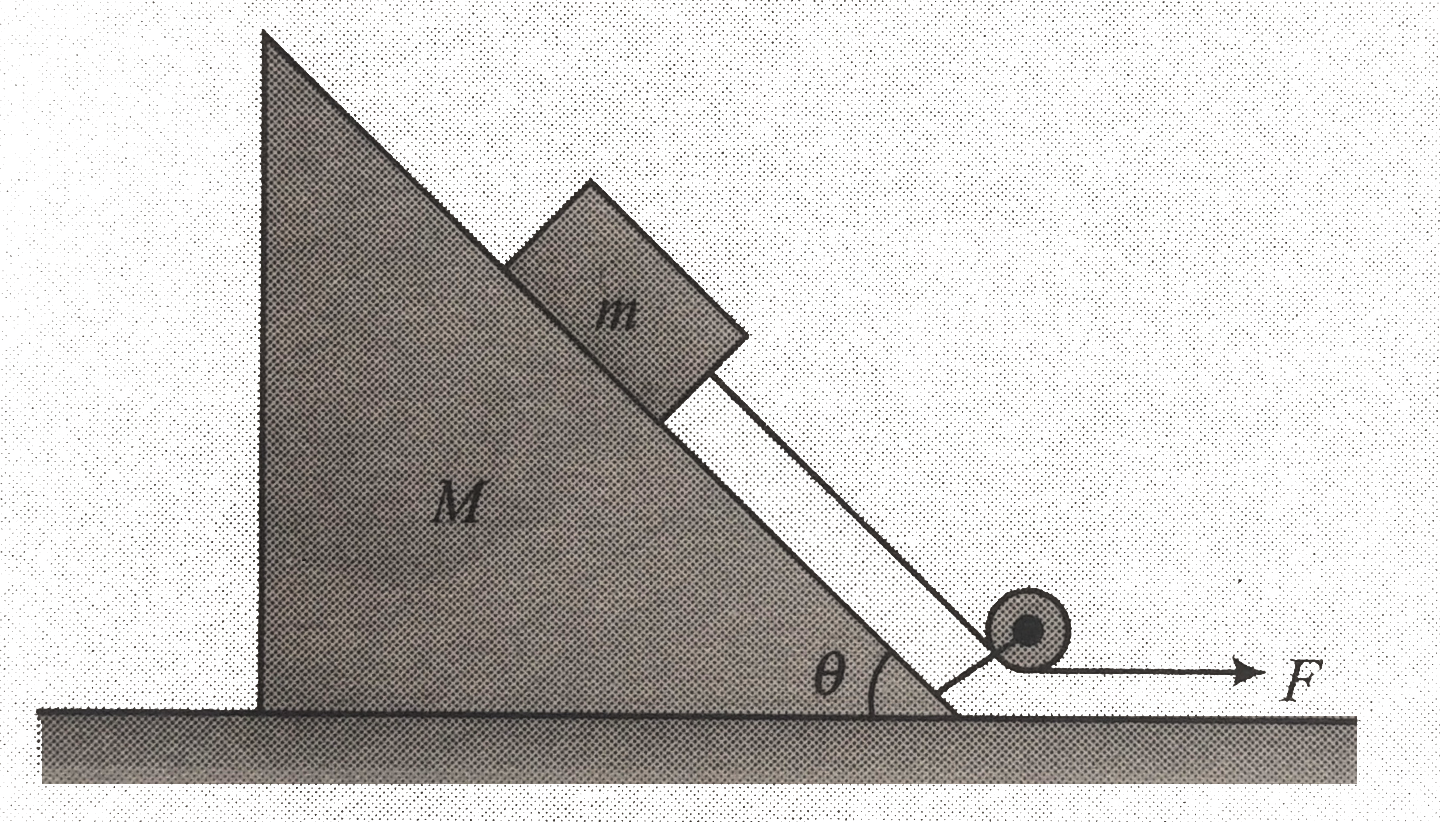
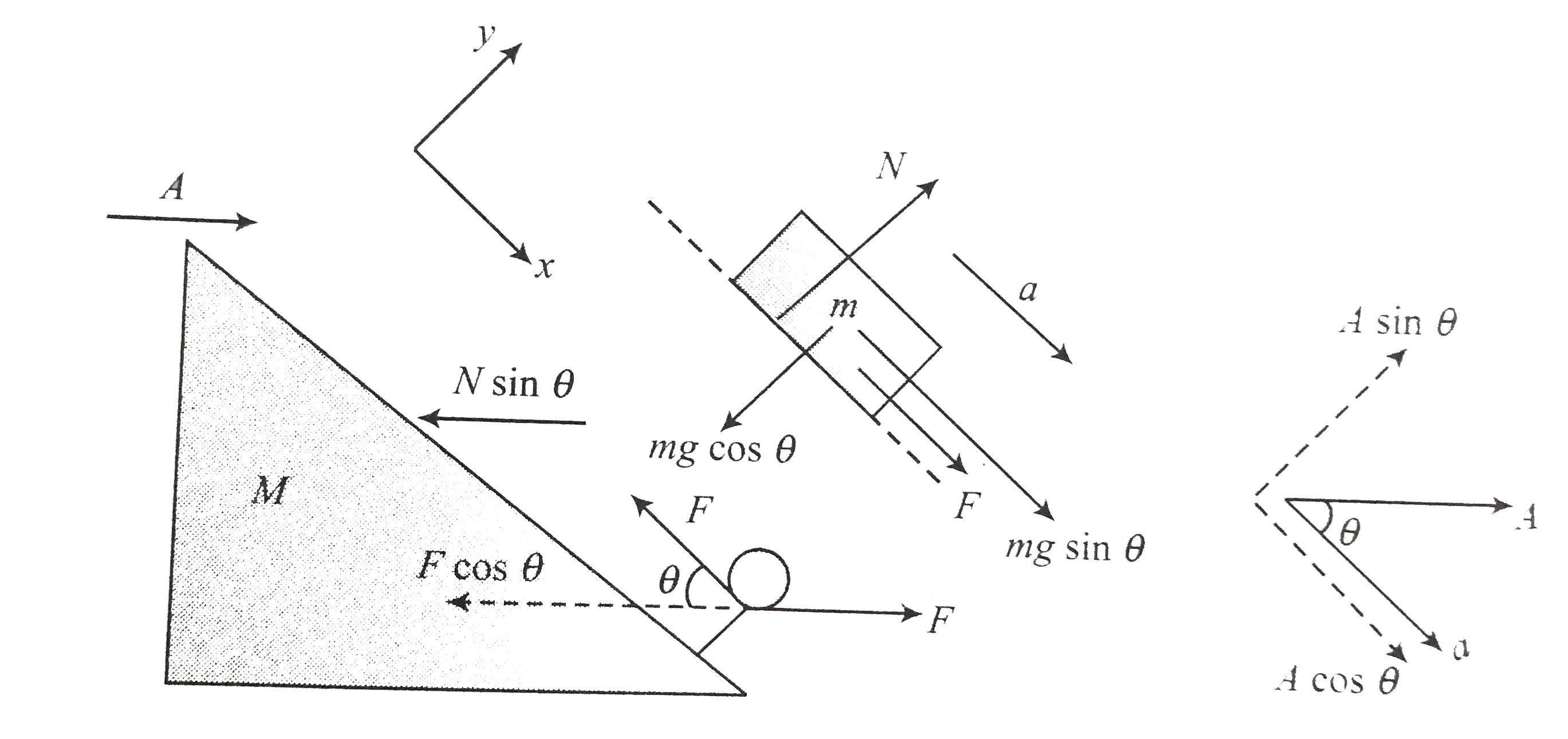
In fig. mass `m` is being pulled on the incline of a wedge of mass M. All the surfaces are smooth. Find the acceleration of the wedge.

A

`a=(F(1-cos theta)mg 2sin theta cos theta)/(M+2m sin^(2)theta)`

B

`a=(F(1+cos theta)+mg sin theta cos theta)/(M+m sin^(2)theta)`

C

`a=(F(1-cos theta)-mg sin theta cos theta)/(M+m sin^(2)theta)`

D

`a=(F(1+cos theta)-mg sin theta cos theta)/(M-m sin^(2)theta)`

Text Solution

Verified by Experts

The correct Answer is:
C

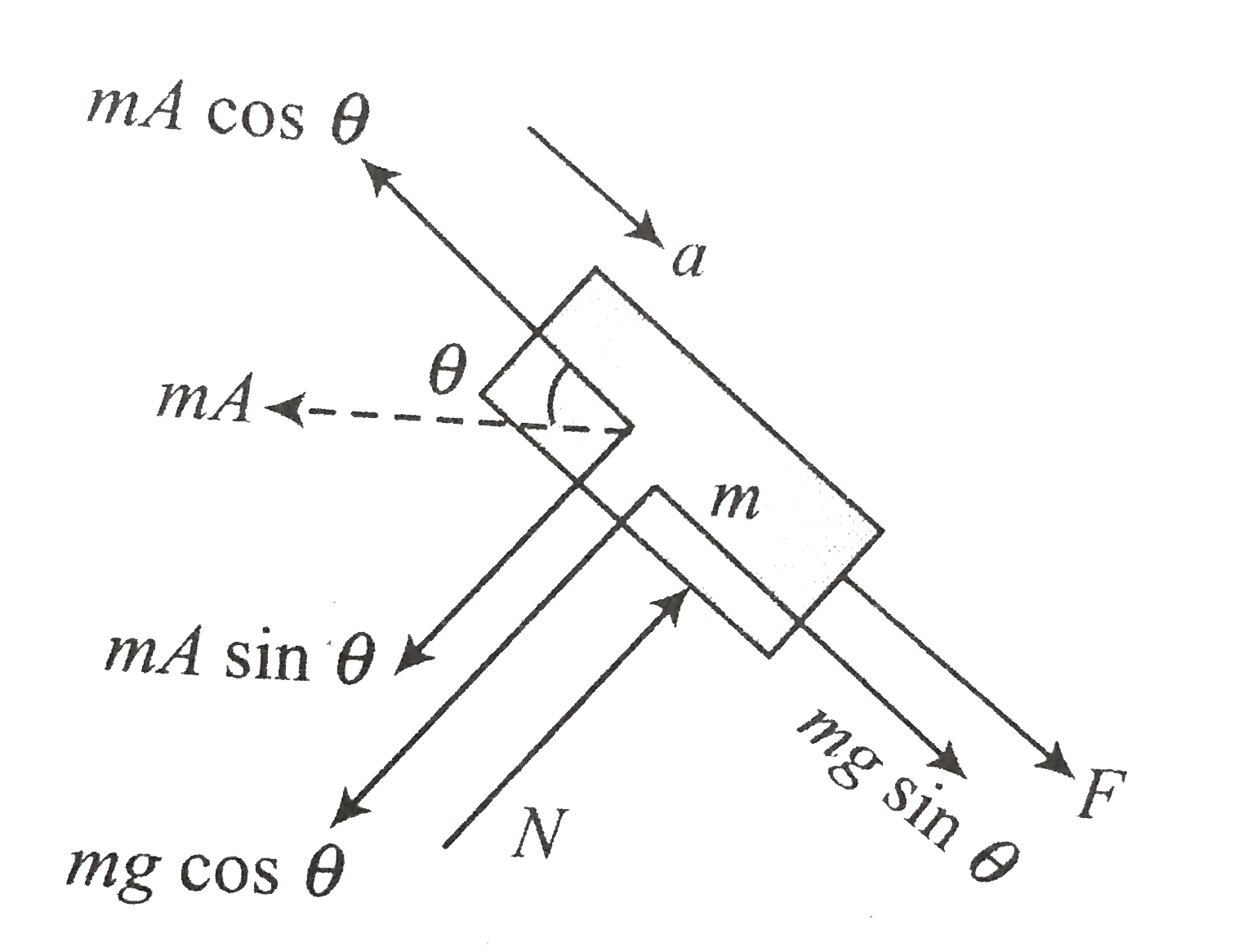
Method -1: Let the acceleration of block relative to wedge be `vec(a)_(mM)=vec(a)` and acceleration of wedge on ground be `vec(a_(M))=vec(A)`. Free body diagram as in fig.

Equation of motion of M,
`F-N sin theta-F cos theta=MA` ...(i)
Equation of motion of m in y-direction,
`N-mg cos theta=ma_(y)=mA sin theta` ..(ii)
Substituting the value of N from (ii) in (i), we can get the value of A.
`A=(F(1-cos theta)-mg sin theta cos theta)/(M+m sin^(2)theta)`
Method 2: If we make the FBD of m w.r.t. M, pseudo force `mA` is to be applied because M is non-inertial. W.r.t. M, there is no acceleration of m in y-direction, so balancing the forces in y-direction.
`N=mg cos theta+mA sin theta`
which is same as (ii).

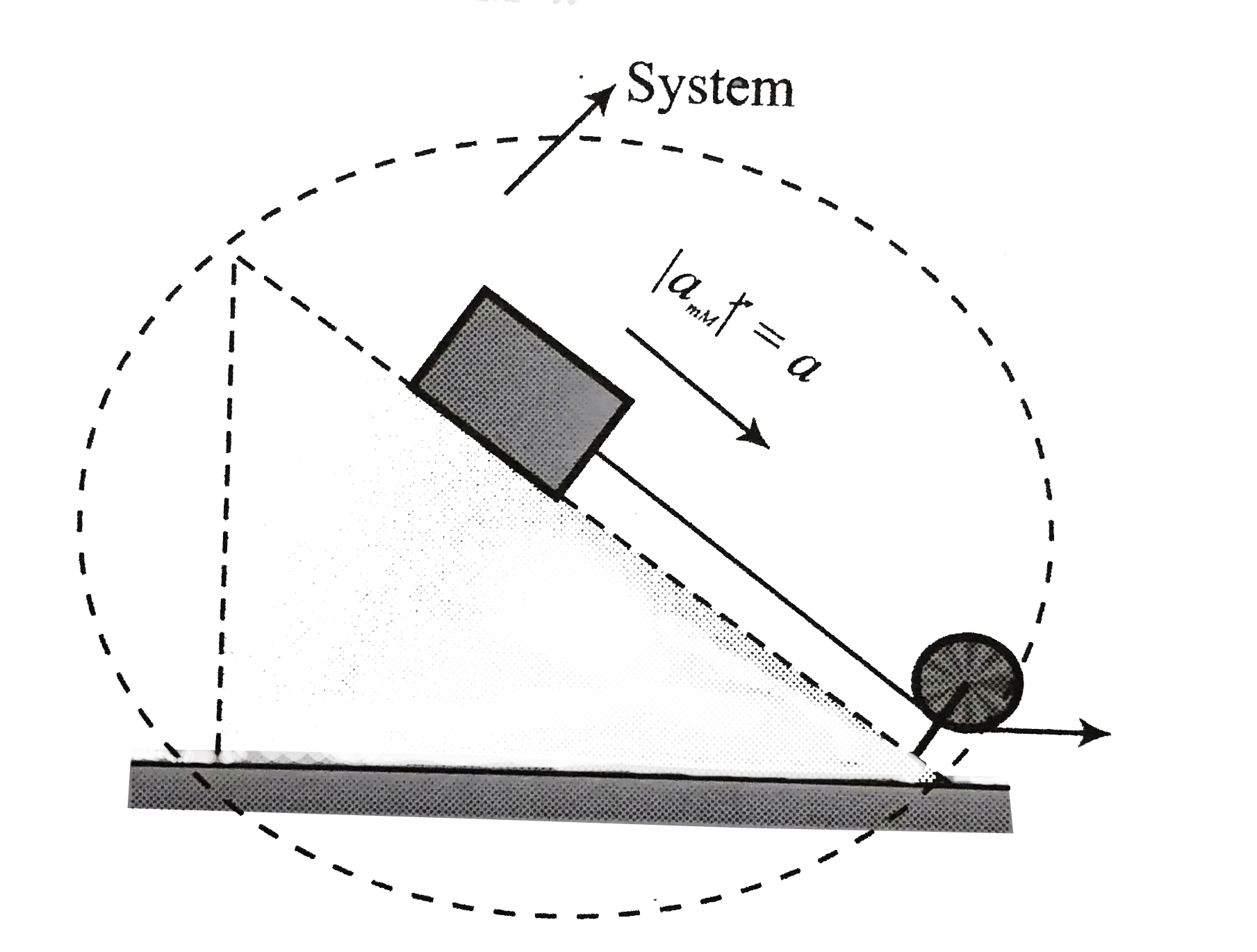
Method 3: Taking block and wedge as system.
External force acting in horizontal direction is F.
`Sigma F_(x)=m(a_(m))_(x)+M(a_(M))_(x)`

Let the acceleration of block w.r.t. wedge is a. or `|vec(a)_(m,M)|=a`
`(vec(a)_(m))_(x)=(vec(a)_(m,M))_(x)+(vec(a)_(M))_(x)`
`|(vec(a)_(m))_(x)|=a cos theta +A`
Hence,
`F=m(a cos theta+A)+MA`
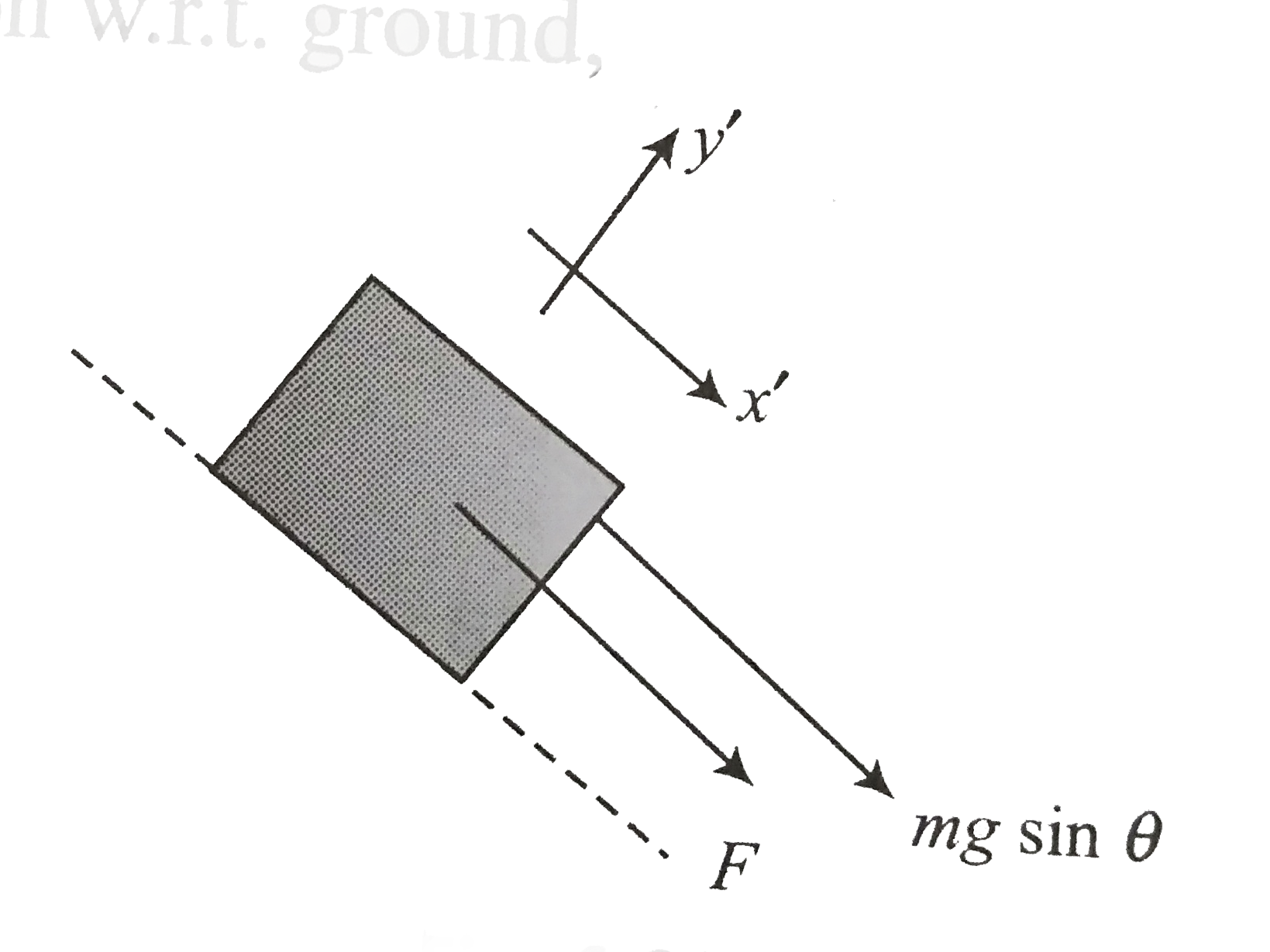
Now analyzing the sloping surface and writing equation w.r.t ground,

`Sigma vec(F)_(x') = m(vec(a)_(m))_(x')`
`(vec(a)_(m))_(x')=(vec(a)_(m,M))_(x')+(vec(a)_(m))_(x')`
`=a+A cos theta`
`F+mg sin theta = m(a+A cos theta)` ...(ii)
From (i) and (ii) ,
`A=(F(1-cos theta)-mg sin theta cos theta)/(M+m sin^(2)theta)`.
Promotional Banner

Topper's Solved these Questions

  • NEWTON'S LAWS OF MOTION 1

    CENGAGE PHYSICS|Exercise Exercise 6.1|11 Videos
  • NEWTON'S LAWS OF MOTION 1

    CENGAGE PHYSICS|Exercise Exercise 6.2|35 Videos
  • NEWTON'S LAWS OF MOTION 1

    CENGAGE PHYSICS|Exercise Integer|5 Videos
  • MISCELLANEOUS VOLUME 2

    CENGAGE PHYSICS|Exercise INTEGER_TYPE|10 Videos
  • NEWTON'S LAWS OF MOTION 2

    CENGAGE PHYSICS|Exercise Integer type|1 Videos

Similar Questions

Explore conceptually related problems

In the Fig. shown, mass 'm' is being pulled on the incline of a wedge of mass M. All the surface are smooth. Find the acceleration of the wedge.

All surfaces are smooth The acceleration of mass m relative to the wedge is .

All surfaces are smooth. The acceleration of mass m relative to the wedge is

In the arrangement shown in the figure , the rod of mass m held by two smooth walls , remain always perpendicular to the surface of the wedge of mass M . Assuming all the surface are frictionless, find the acceleration of the rod wedge.

Figure-2.54 shows a block of mass m is placed on an inclined wedge of mass M If the system is released from rest find the acceleration of m and M.

A block of mass m is placed on the inclined sufrace of a wedge as shown in fig. Calculate the acceleration of the wedge and the block when the block is released. Assume all surfaces are frictionless.

A block of mass M is connected with a particle of mass m by a light inextensible string as shown in fig. Assuming all contaction surfaces as smooth, find the acceleration of the wedge after releasing the system.

In the arrangement shown in figure, the rod of mass m help by two smooth walls, remains always perpendicular to the surface of the wedge of mass M . Assuumming all the surface to be frictionless, find the acceleration of the rod and that of the wedge.

All the surfaces are smooth as shown in figure. The acceleration of mass m relative to wedge is :

In the arrangement shown in figure wedge of mass M moves towards left with an acceleration a. All surfaces are smooth. The acceleration of mass m relative to wedge is