Home
Class 11
PHYSICS
Three blocks arranged with pullwy and sp...

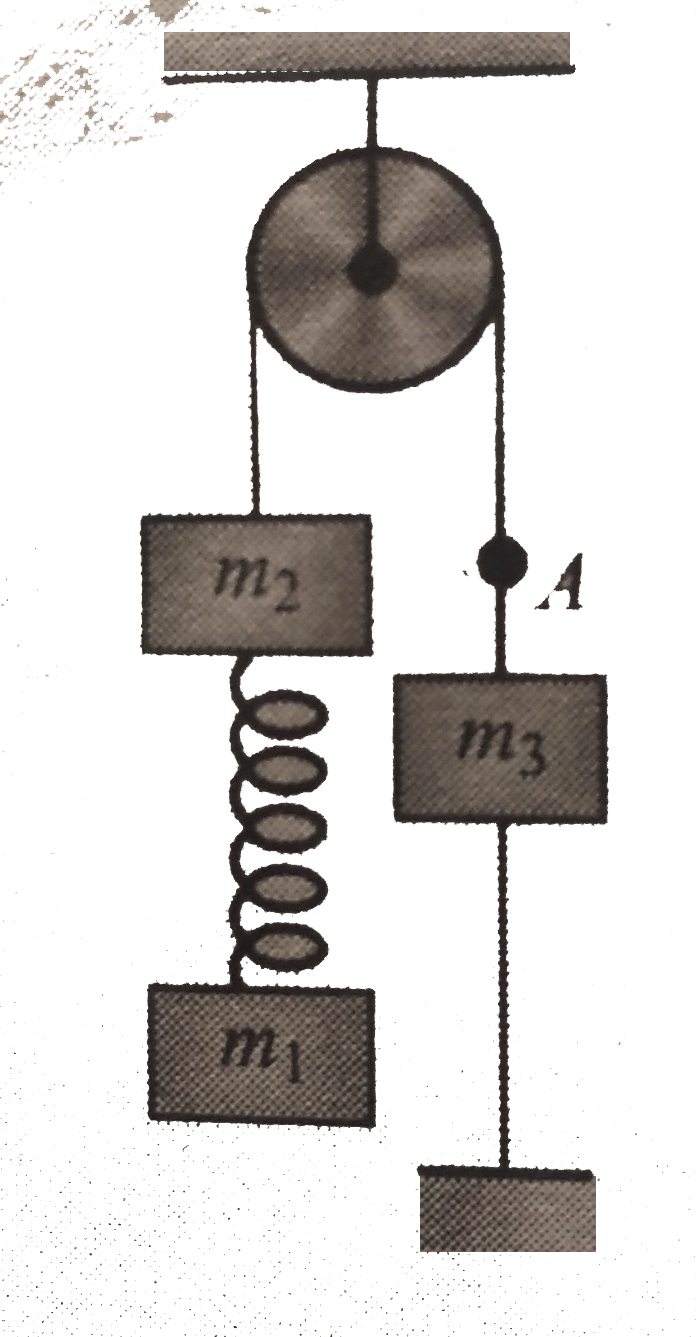
Three blocks arranged with pullwy and spring as shown in fig. If the string connecting blocks `m_(2)` and `m_(3)` is cut at point A, find the acceleration of masses `m_(1), m_(2)` and `m_(3)`. Just after the string is cut at point A.

Text Solution

Verified by Experts
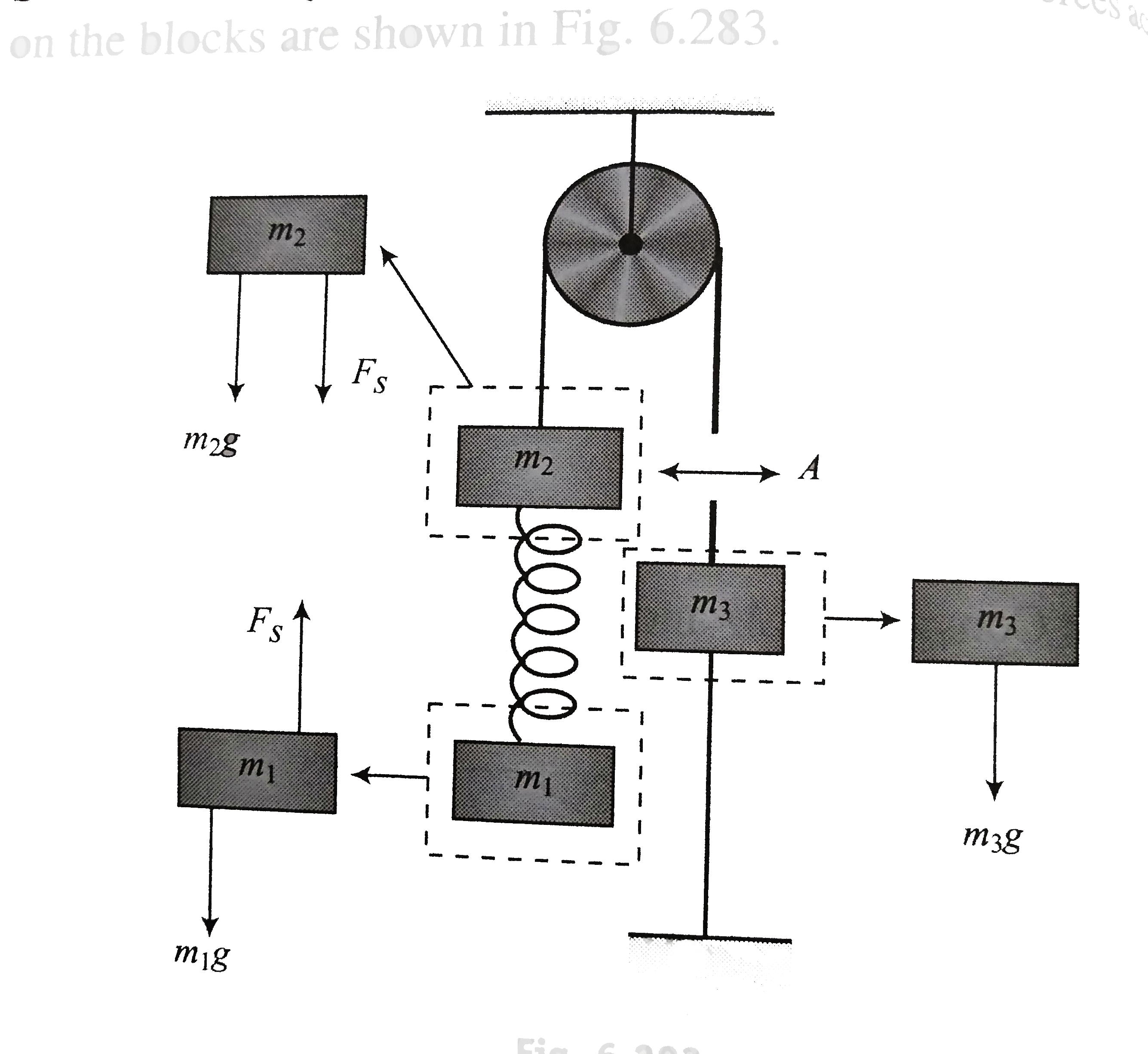
Let us analyzes the system at equilibrium. The forces acting on the blocks are shown in fig.

Just after cutting the string at A, the tensions T and T' will be zero. But the spring force will remain unchanged just after cutting. the figure shows the forces acting on the blocks just after cutting the string.
The forces acting on `m_(1)` just before and just after cutting the string are same and just before cutting string `m_(1)` were in equilibrium. Hence, the acceleration of `m_(1)` will be zero just after cutting the string.
At equilibrium, `F_(S)=(m_1)g`
As `F_(S)` does not change just before and just after cutting the string, acceleration of `m_(2)`
`a_(2)=(m_(2)g+F_(S))/(m_2) = (m_(2)g+m_(1)g)/(m_2) = (1+(m_(1))/(m_2))g`
From the free-body diagram of block `m_(3)` just after cutting the string, only `m_(3)g` will act and tensions in the string will disappear. Hence, acceleration of `m_(3)`.
`a_(3)=(m_(3)g)/(m_3) = g`
Finally, acceleration of `m_(1)=0`
Acceleration of `m_(2)=(1+(m_1)/(m_2))g` and acceleration of `m_(3)=g`.
Promotional Banner

Topper's Solved these Questions

  • NEWTON'S LAWS OF MOTION 1

    CENGAGE PHYSICS|Exercise Exercise 6.1|11 Videos
  • NEWTON'S LAWS OF MOTION 1

    CENGAGE PHYSICS|Exercise Exercise 6.2|35 Videos
  • NEWTON'S LAWS OF MOTION 1

    CENGAGE PHYSICS|Exercise Integer|5 Videos
  • MISCELLANEOUS VOLUME 2

    CENGAGE PHYSICS|Exercise INTEGER_TYPE|10 Videos
  • NEWTON'S LAWS OF MOTION 2

    CENGAGE PHYSICS|Exercise Integer type|1 Videos

Similar Questions

Explore conceptually related problems

Find the acceleration of masses m_(1), m_(2) and m_(3) shown in figure-2.119 just after the string is cut at point A. [0,(1+(m_(1))/(m_(2)))g, g]

System shown in fig is in equilibrium and at rest. The spring and string are massless now the string is cut. The acceleration of mass 2m and m just after the string is cut will be:

Two block of masses m_(1) and m_(2) are connected as shown in the figure. The acceleration of the block m_(2) is:

Two block of masses m_(1) and m_(2) are in equilibrium. The block m_(2) hangs from a fixed smooth pulley by an inextensible string that is fitted with a light spring of stiffness k as shown in fig. Neglecting friction and mass of the string, find the acceleration of the bodies just after the string S is cut.

The system shown in the following figure is in equilibrium and at rest. The spring and string are massless. Now, the string is cut. The acceleration of mass 2m and m, just after the string is cut, will be

Three blocks of masses m_1, m_2 and m_3 are connected as shown in the figure. All the surfaces are frictionless and the string and the pulleys are light. Find the acceleration of m_1

In the figure, blocks A and B of masses 2m and m are connected with a string and system is hanged vertically wioth the help of spring. Spring has negligible mass. Find out magnitude of acceleration of masses 2 m and m just after the instant when the string is cut

Two blocks of masses m_1 and m_2 are connected as shown in the figure. The acceleration of the block m_2 is :

Two blocks A and B of same mass m attached with a light string are suspended by a spring as shown in fig. Find the acceleration of block A and B just after the string is cut.

