Home
Class 11
PHYSICS
In the system shown in fig., m(A)=4m, m(...

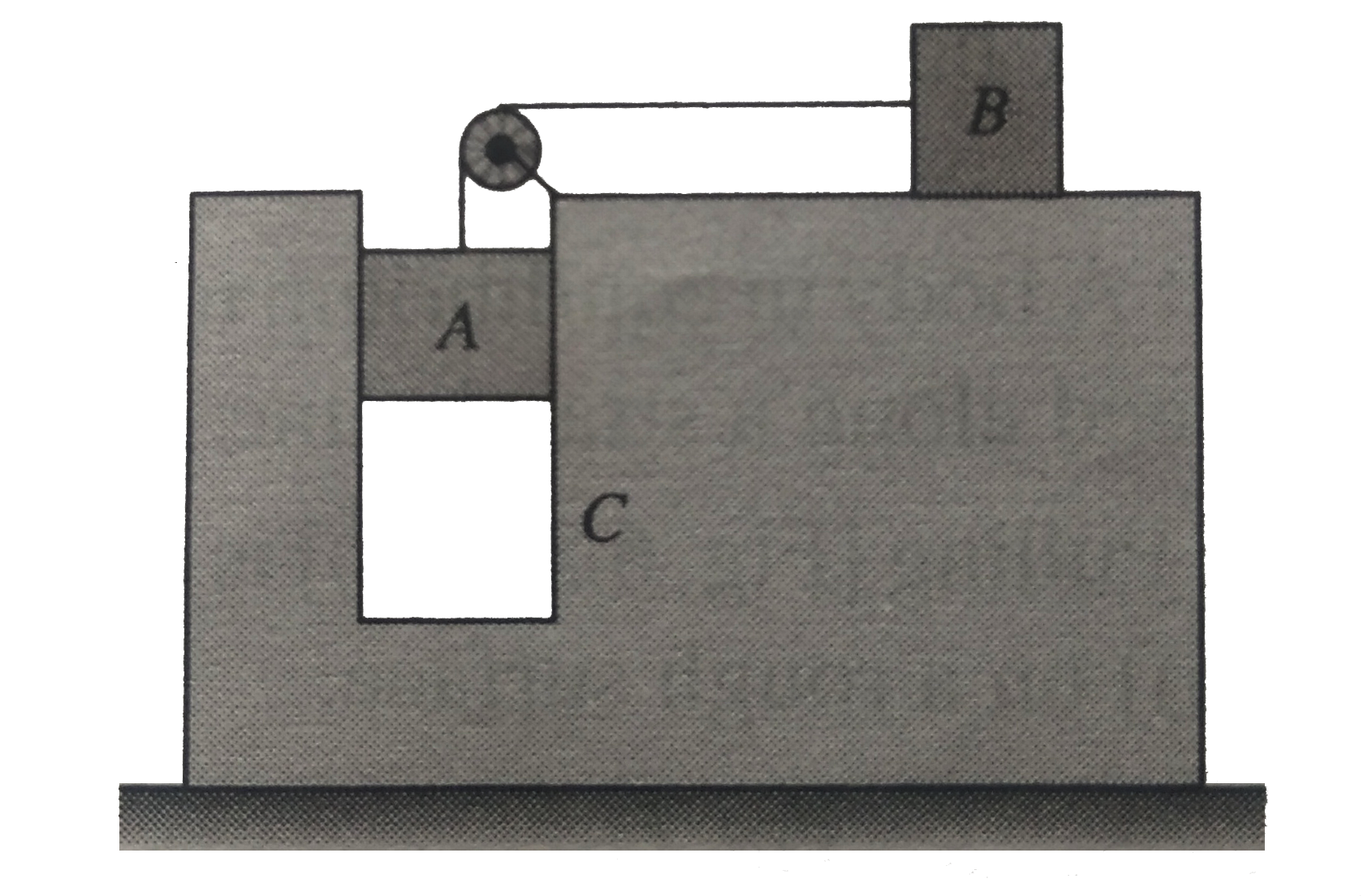
In the system shown in fig., `m_(A)=4m`, `m_(B)=3m`, and `m_(c)=8m`. Friction is absent everywhere. String is inextensible and light. If the system is released from rest, then

Acceleration of Block B is

A

`1.5 mg`

B

`5.8 mg`

C

`4.7 mg`

D

`3.2 mg`

Text Solution

Verified by Experts

The correct Answer is:
A

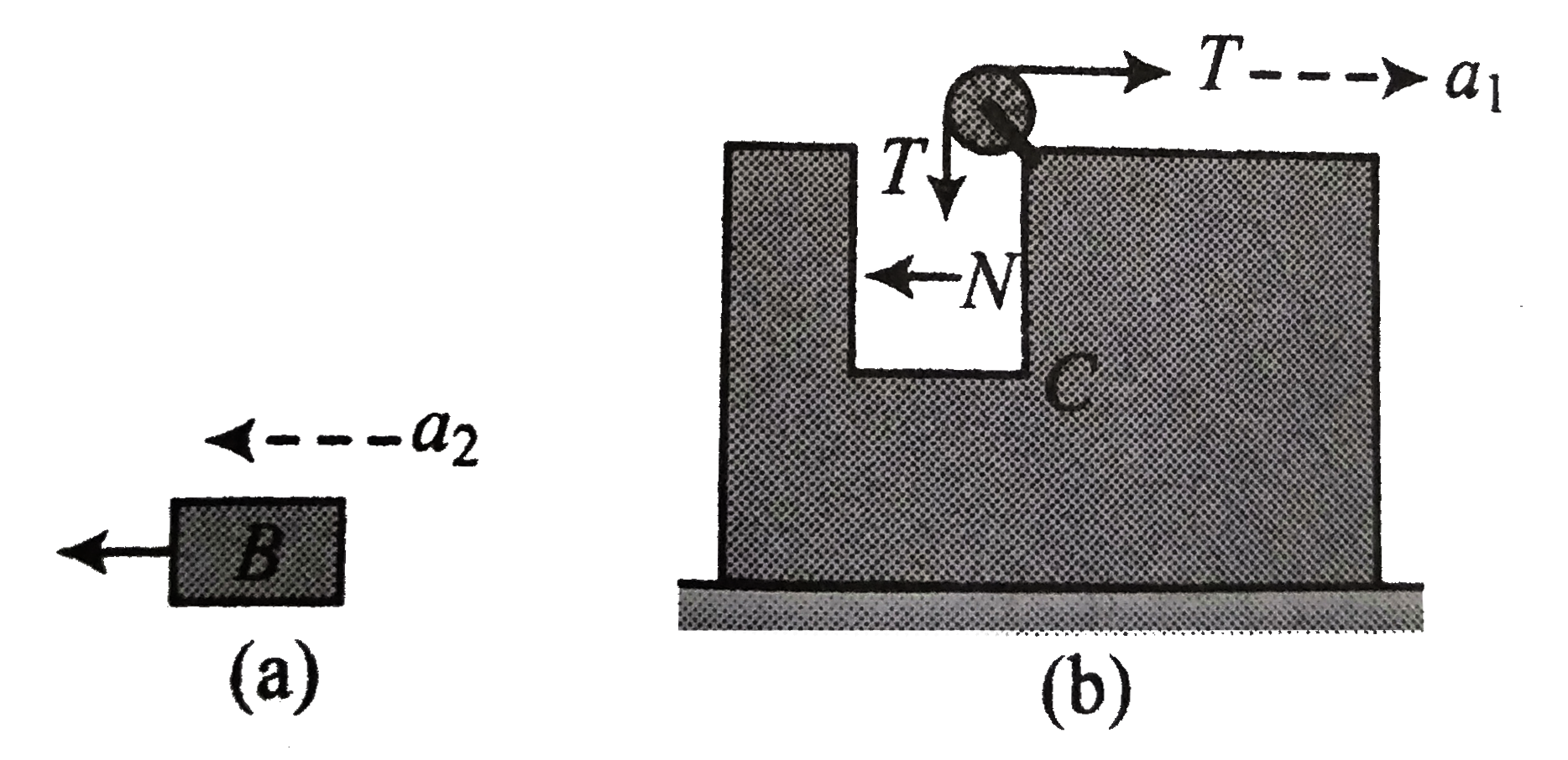
Let acceleration of block C be `a_(1)` (rightwards) and acceleration of block B be `a_(2)` (lefwards).
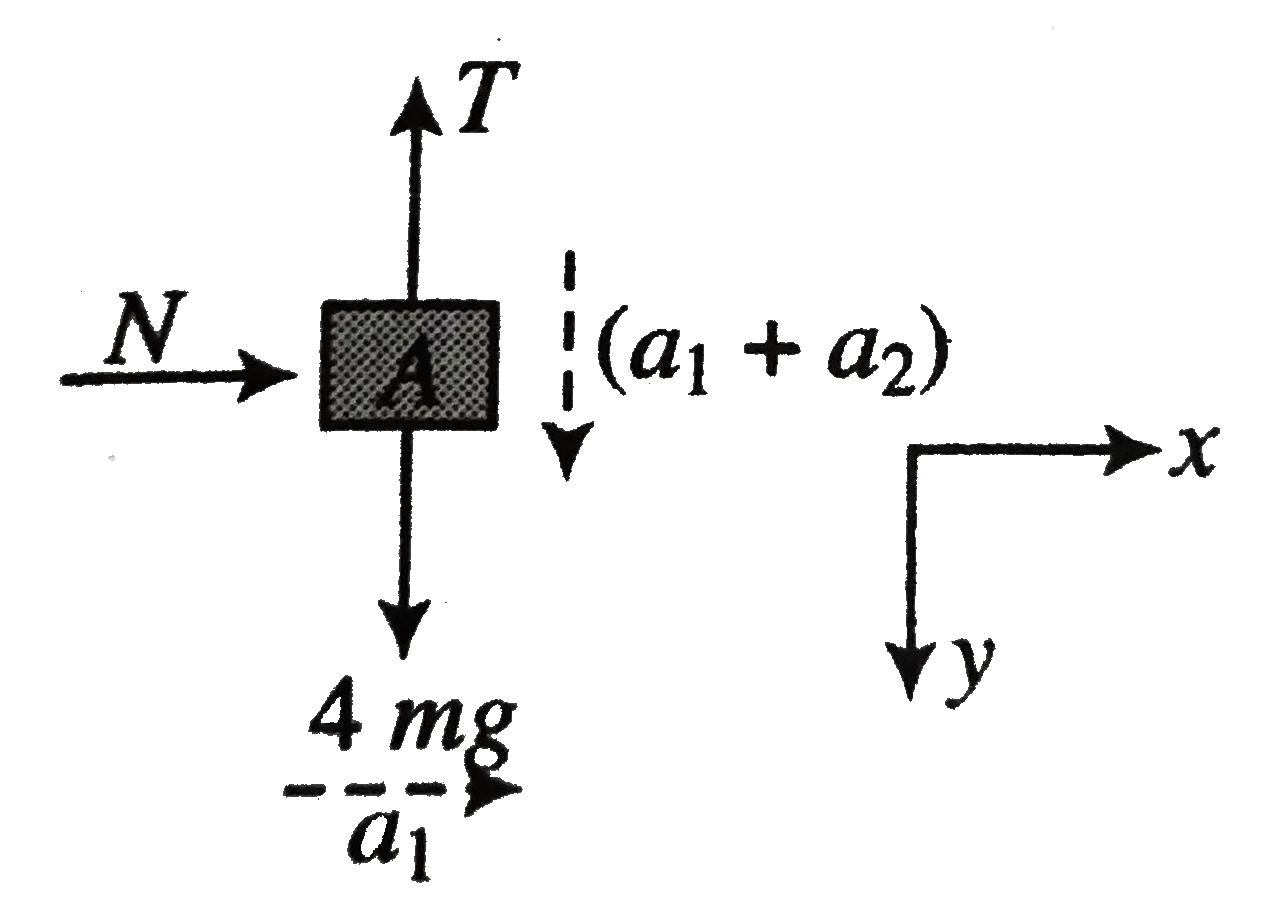
Then acceleration of A will be `(a_(1)+a_(2))` downwards and `a_(1)` rightwards.
Free body diagram of A is shown in fig.

Using `Sigma F_(x)=ma_(x)` and `Sigma F_(y)=ma_(y)`, we get
`N=4m(a_(1))` ..(i)
and `4mg-T=4m(a_(1)+a_(2))` ..(ii)
Free bocy diagram of B (showing horizontal force only) is shown in the figure.

Using `Sigma F_(x)=ma_(x)`, we get
`T=3ma_(2)` ...(iii)
Free body diagram of C (showing horizontal force only) is shown in fig.
Using `Sigma F_(x)=ma_(x)`, we get
`T-N=8ma_(1)`...(iv)
We have four unknowns `T, N, a_(1)`, and `a_(2)`. solving these four equations, we get
`a_(1)=g/8` and `a_(2) = g/2`, `a_(1)+a_(2)=5/8 g`
Thus, acceleration of A is `g//8` in horizontal direction and `5g//8` in vertical direction.
Acceleration of B is `g//2` in horizontal direction (leftwards) and acceleration of C is `g//8 in horizontal direction (rightwards).
Promotional Banner

Topper's Solved these Questions

  • NEWTON'S LAWS OF MOTION 1

    CENGAGE PHYSICS|Exercise Integer|5 Videos
  • NEWTON'S LAWS OF MOTION 1

    CENGAGE PHYSICS|Exercise Assertion-reasoning|15 Videos
  • MISCELLANEOUS VOLUME 2

    CENGAGE PHYSICS|Exercise INTEGER_TYPE|10 Videos
  • NEWTON'S LAWS OF MOTION 2

    CENGAGE PHYSICS|Exercise Integer type|1 Videos

Similar Questions

Explore conceptually related problems

In the system shown in fig., m_(A)=4m , m_(B)=3m , and m_(c)=8m . Friction is absent everywhere. String is inextensible and light. If the system is released from rest, then Acceleration of block C is

In the system shown in fig., m_(A)=4m , m_(B)=3m , and m_(c)=8m . Friction is absent everywhere. String is inextensible and light. If the system is released from rest, then Acceleration of Block A in horizontal direction is

In the system shown in fig., all pulleys are mass less and the string is inextensible and light. (a) After the system is released, find the acceleration of mass m_(1) (b) If m_(1) = 1 kg, m_(2) = 2 kg "and" m_(3) = 3 kg then what must be value of mass m_(4) so that it accelerates downwards?

In the system shown in figure m_(B)=4kg , and m_(A)=2kg . The pulleys are massless and friction is absent everywhere. The acceleration of block A is.

In the arrangement shown in the figure (m_(A))/(m_(B))=(2)/(3) and the ratio of density of block B and the liquid is 2:1 The system is released from rest. Then

In the arrangement shown in the fig. all pulleys are mass less and the strings are inextensible and light. Block A has mass M. (a) If the system stays at rest after it is released, find the mass of the block B. (b) If mass of the block B is twice the value found in part (a) of the problem, calculate the acceleration of block A.

Figure-2.54 shows a block of mass m is placed on an inclined wedge of mass M If the system is released from rest find the acceleration of m and M.

In the system shown in fig. m_(1) gt m_(2) . The system is held at rest by thread BC. Now thread BC is burnt. Answer the following: Just after burning the thread, what is the acceleration of m_(2) ?

Two blocks A and B are arranged as shown in figure.The pulleys are light and frictionless.The strings are light and inextensible.If the acceleration of the block B is 3m/s^(2) ,then the acceleration of the block A is __________ m/s^(2)

CENGAGE PHYSICS-NEWTON'S LAWS OF MOTION 1-Linked Comperhension
  1. A ball of mass 0.2 kg travelling in a straight line with a speed of m/...

    Text Solution

    |

  2. A ball weighing 10g hits a hard surface vertically with a speed of 5m/...

    Text Solution

    |

  3. In the system shown in fig., m(A)=4m, m(B)=3m, and m(c)=8m. Friction i...

    Text Solution

    |

  4. In the system shown in fig., m(A)=4m, m(B)=3m, and m(c)=8m. Friction i...

    Text Solution

    |

  5. In the system shown in fig., m(A)=4m, m(B)=3m, and m(c)=8m. Friction i...

    Text Solution

    |

  6. In the system shown in fig., m(A)=4m, m(B)=3m, and m(c)=8m. Friction i...

    Text Solution

    |

  7. Study in fig. and answer the following questions accordingly. Neglect ...

    Text Solution

    |

  8. Study in fig. and answer the following questions accordingly. Neglect ...

    Text Solution

    |

  9. Study in fig. and answer the following questions accordingly. Neglect ...

    Text Solution

    |

  10. Three blocks A, B, and C of masses 3M, 2M, and M are suspended vertica...

    Text Solution

    |

  11. Three blocks A, B, and C of masses 3M, 2M, and M are suspended vertica...

    Text Solution

    |

  12. Three blocks A, B, and C of masses 3M, 2M, and M are suspended vertica...

    Text Solution

    |

  13. In fig, all the pulleys and strings are massless and all the surfaces ...

    Text Solution

    |

  14. In fig, all the pulleys and strings are massless and all the surfaces ...

    Text Solution

    |

  15. In fig, all the pulleys and strings are massless and all the surfaces ...

    Text Solution

    |

  16. In fig. both pulleys and the string are massless and all the surfaces ...

    Text Solution

    |

  17. In fig. both pulleys and the string are massless and all the surfaces ...

    Text Solution

    |

  18. In fig. both pulleys and the string are massless and all the surfaces ...

    Text Solution

    |

  19. In the arrangement shown in fig., all pulleys are smooth and massless....

    Text Solution

    |

  20. In the arrangement shown in fig., all pulleys are smooth and massless....

    Text Solution

    |