Home
Class 11
PHYSICS
In the system shown in fig., m(A)=4m, m(...

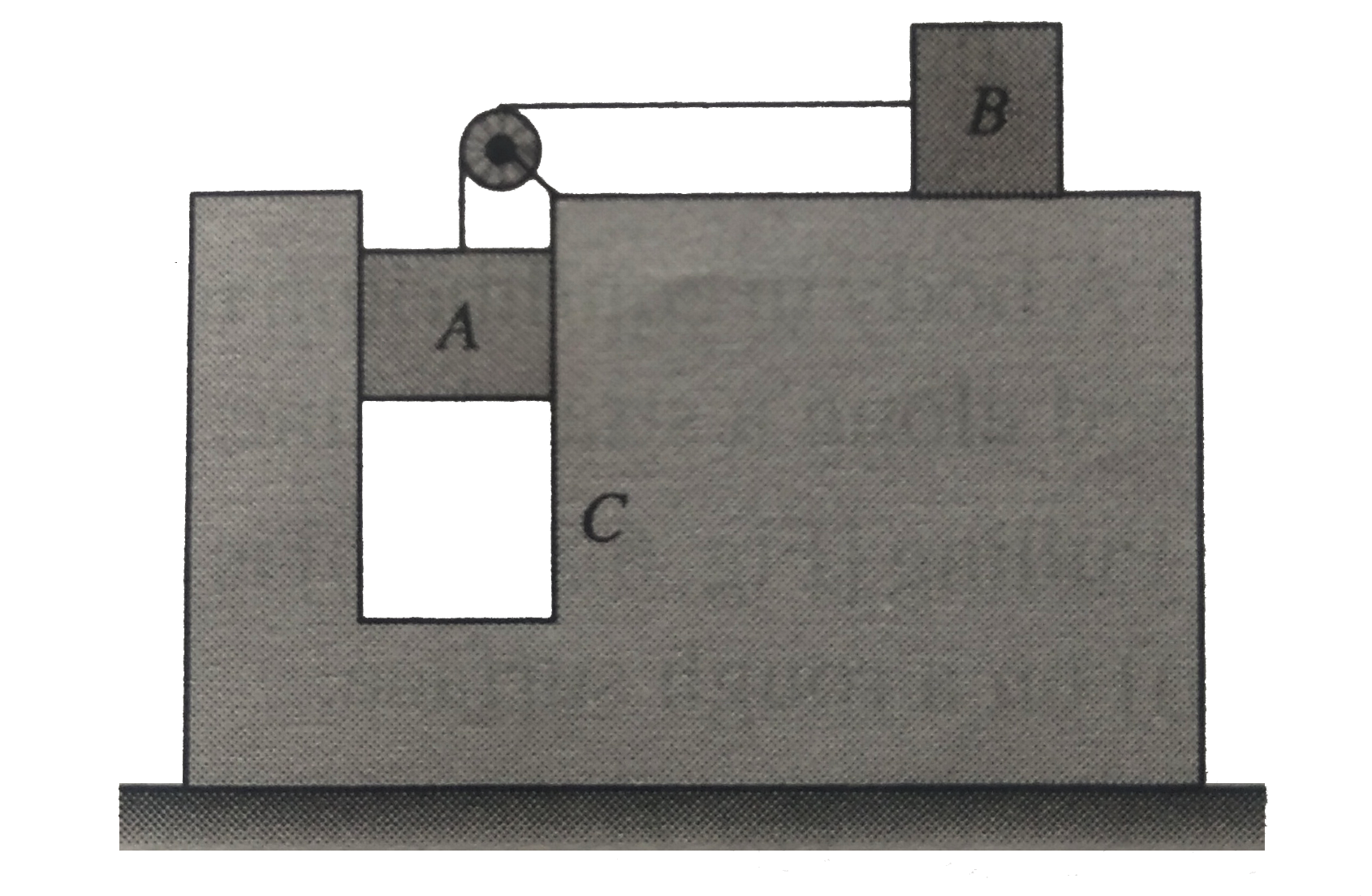
In the system shown in fig., `m_(A)=4m`, `m_(B)=3m`, and `m_(c)=8m`. Friction is absent everywhere. String is inextensible and light. If the system is released from rest, then

Acceleration of Block A in horizontal direction is

A

`5//4 ms^(-2)`

B

`21//2 ms^(-2)`

C

`11//7 ms^(-2)`

D

`27//5 ms^(-2)`

Text Solution

Verified by Experts

The correct Answer is:
A

Let acceleration of block C be `a_(1)` (rightwards) and acceleration of block B be `a_(2)` (lefwards).
Then acceleration of A will be `(a_(1)+a_(2))` downwards and `a_(1)` rightwards.
Free body diagram of A is shown in fig.

Using `Sigma F_(x)=ma_(x)` and `Sigma F_(y)=ma_(y)`, we get
`N=4m(a_(1))` ..(i)
and `4mg-T=4m(a_(1)+a_(2))` ..(ii)
Free bocy diagram of B (showing horizontal force only) is shown in the figure.

Using `Sigma F_(x)=ma_(x)`, we get
`T=3ma_(2)` ...(iii)
Free body diagram of C (showing horizontal force only) is shown in fig.
Using `Sigma F_(x)=ma_(x)`, we get
`T-N=8ma_(1)`...(iv)
We have four unknowns `T, N, a_(1)`, and `a_(2)`. solving these four equations, we get
`a_(1)=g/8` and `a_(2) = g/2`, `a_(1)+a_(2)=5/8 g`
Thus, acceleration of A is `g//8` in horizontal direction and `5g//8` in vertical direction.
Acceleration of B is `g//2` in horizontal direction (leftwards) and acceleration of C is `g//8 in horizontal direction (rightwards).
Promotional Banner

Topper's Solved these Questions

  • NEWTON'S LAWS OF MOTION 1

    CENGAGE PHYSICS|Exercise Integer|5 Videos
  • NEWTON'S LAWS OF MOTION 1

    CENGAGE PHYSICS|Exercise Assertion-reasoning|15 Videos
  • MISCELLANEOUS VOLUME 2

    CENGAGE PHYSICS|Exercise INTEGER_TYPE|10 Videos
  • NEWTON'S LAWS OF MOTION 2

    CENGAGE PHYSICS|Exercise Integer type|1 Videos

Similar Questions

Explore conceptually related problems

In the system shown in fig., m_(A)=4m , m_(B)=3m , and m_(c)=8m . Friction is absent everywhere. String is inextensible and light. If the system is released from rest, then Acceleration of Block B is

In the system shown in fig., m_(A)=4m , m_(B)=3m , and m_(c)=8m . Friction is absent everywhere. String is inextensible and light. If the system is released from rest, then Acceleration of block C is

In the system shown in figure m_(B)=4kg , and m_(A)=2kg . The pulleys are massless and friction is absent everywhere. The acceleration of block A is.

In the system shown in fig., all pulleys are mass less and the string is inextensible and light. (a) After the system is released, find the acceleration of mass m_(1) (b) If m_(1) = 1 kg, m_(2) = 2 kg "and" m_(3) = 3 kg then what must be value of mass m_(4) so that it accelerates downwards?

Figure-2.54 shows a block of mass m is placed on an inclined wedge of mass M If the system is released from rest find the acceleration of m and M.

In the arrangement shown in the figure (m_(A))/(m_(B))=(2)/(3) and the ratio of density of block B and the liquid is 2:1 The system is released from rest. Then

Figure-2.64 shows a block of mass M supporting a bar of mass m through a pulley system. If system is released from rest, find the acceleration of block M and the tension in the strings

In the system shown in fig. m_(1) gt m_(2) . The system is held at rest by thread BC. Now thread BC is burnt. Answer the following: Just after burning the thread, what is the acceleration of m_(2) ?

Block A of mass m and block B of mass 2m are placed on a fixed triangular wedge by means of a light and inextensible string and a frictionless pulley as shown in fig . The wedge is inclined at 45^(@) to the horizontal on both sides . The coefficient of friction between the block A and the wedge is 2//3 and that between the block B and the wedge is 1//3 .If the system of A and B is released from rest then find . a. the acceleration of A b. tension in the string c.the magnitude and direction of the frictional force acting on A

Friction is absent everywhere and the threads, spring and pulleys are massless. If m_(A) = m_(B) = M , then the angular frequency of the system for small oscillations will be

CENGAGE PHYSICS-NEWTON'S LAWS OF MOTION 1-Linked Comperhension
  1. In the system shown in fig., m(A)=4m, m(B)=3m, and m(c)=8m. Friction i...

    Text Solution

    |

  2. In the system shown in fig., m(A)=4m, m(B)=3m, and m(c)=8m. Friction i...

    Text Solution

    |

  3. In the system shown in fig., m(A)=4m, m(B)=3m, and m(c)=8m. Friction i...

    Text Solution

    |

  4. Study in fig. and answer the following questions accordingly. Neglect ...

    Text Solution

    |

  5. Study in fig. and answer the following questions accordingly. Neglect ...

    Text Solution

    |

  6. Study in fig. and answer the following questions accordingly. Neglect ...

    Text Solution

    |

  7. Three blocks A, B, and C of masses 3M, 2M, and M are suspended vertica...

    Text Solution

    |

  8. Three blocks A, B, and C of masses 3M, 2M, and M are suspended vertica...

    Text Solution

    |

  9. Three blocks A, B, and C of masses 3M, 2M, and M are suspended vertica...

    Text Solution

    |

  10. In fig, all the pulleys and strings are massless and all the surfaces ...

    Text Solution

    |

  11. In fig, all the pulleys and strings are massless and all the surfaces ...

    Text Solution

    |

  12. In fig, all the pulleys and strings are massless and all the surfaces ...

    Text Solution

    |

  13. In fig. both pulleys and the string are massless and all the surfaces ...

    Text Solution

    |

  14. In fig. both pulleys and the string are massless and all the surfaces ...

    Text Solution

    |

  15. In fig. both pulleys and the string are massless and all the surfaces ...

    Text Solution

    |

  16. In the arrangement shown in fig., all pulleys are smooth and massless....

    Text Solution

    |

  17. In the arrangement shown in fig., all pulleys are smooth and massless....

    Text Solution

    |

  18. In the arrangement shown in fig., all pulleys are smooth and massless....

    Text Solution

    |

  19. In the arrangement shown in fig., all pulleys are smooth and massless....

    Text Solution

    |

  20. Two blocks of masses m(1) and m(2) are connected with a light spring o...

    Text Solution

    |

