Home
Class 11
PHYSICS
In the arrangement shown in fig., all pu...

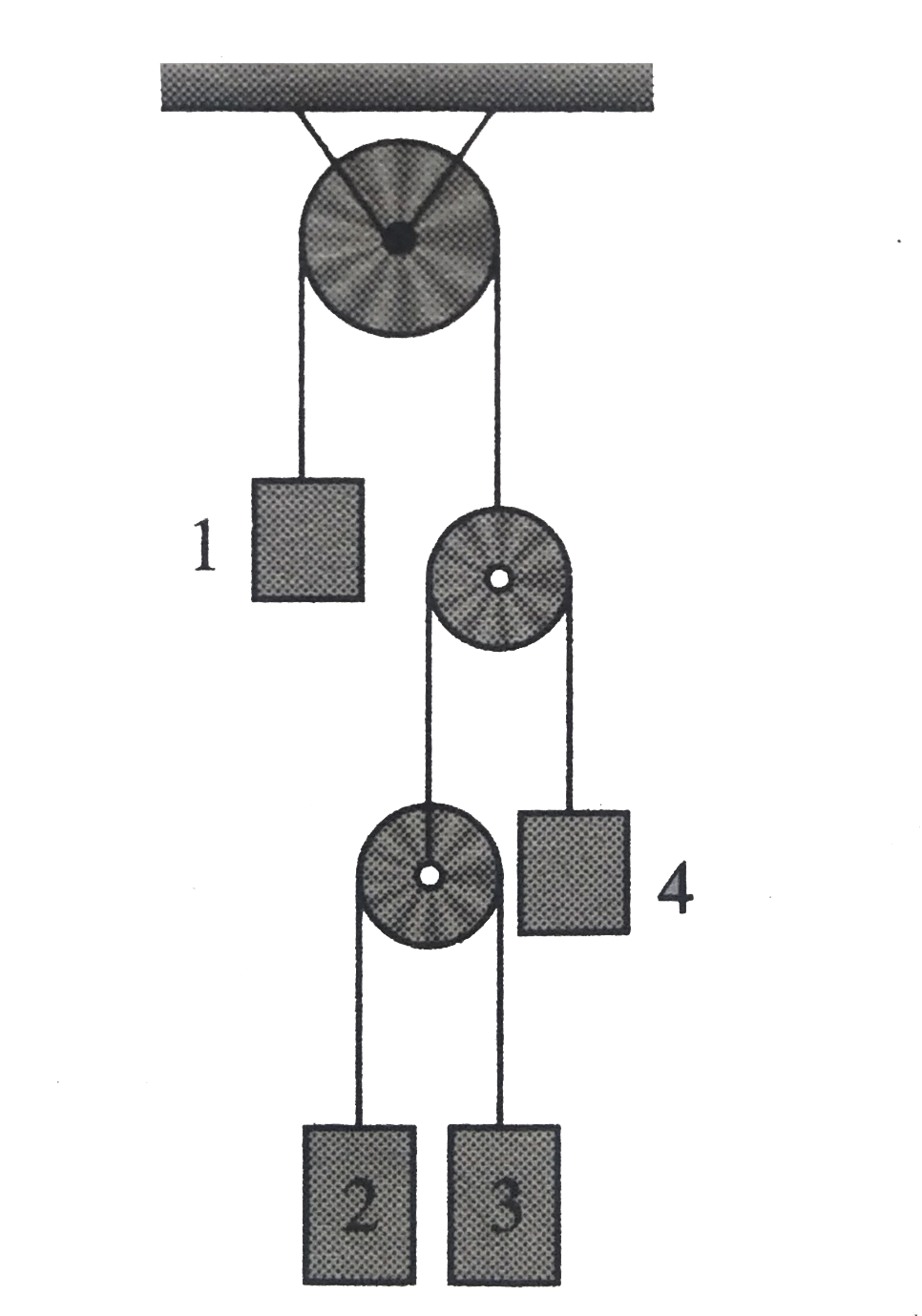
In the arrangement shown in fig., all pulleys are smooth and massless. When the system is released from the rest, acceleration of block 2 and 3 relative to 1 are `1 ms^(-2)` downwards and `5ms^(-2)` downwards, respectively. Acceleration of block 3 relative to 4 is zero.

Find the absoulte acceleration of block 3.

A

`2 ms^(-2)` upwards

B

`1 ms^(-2)` downwards

C

`3 ms^(-2)` downwards

D

`1.5 ms^(-2)` upwards

Text Solution

Verified by Experts

The correct Answer is:
C

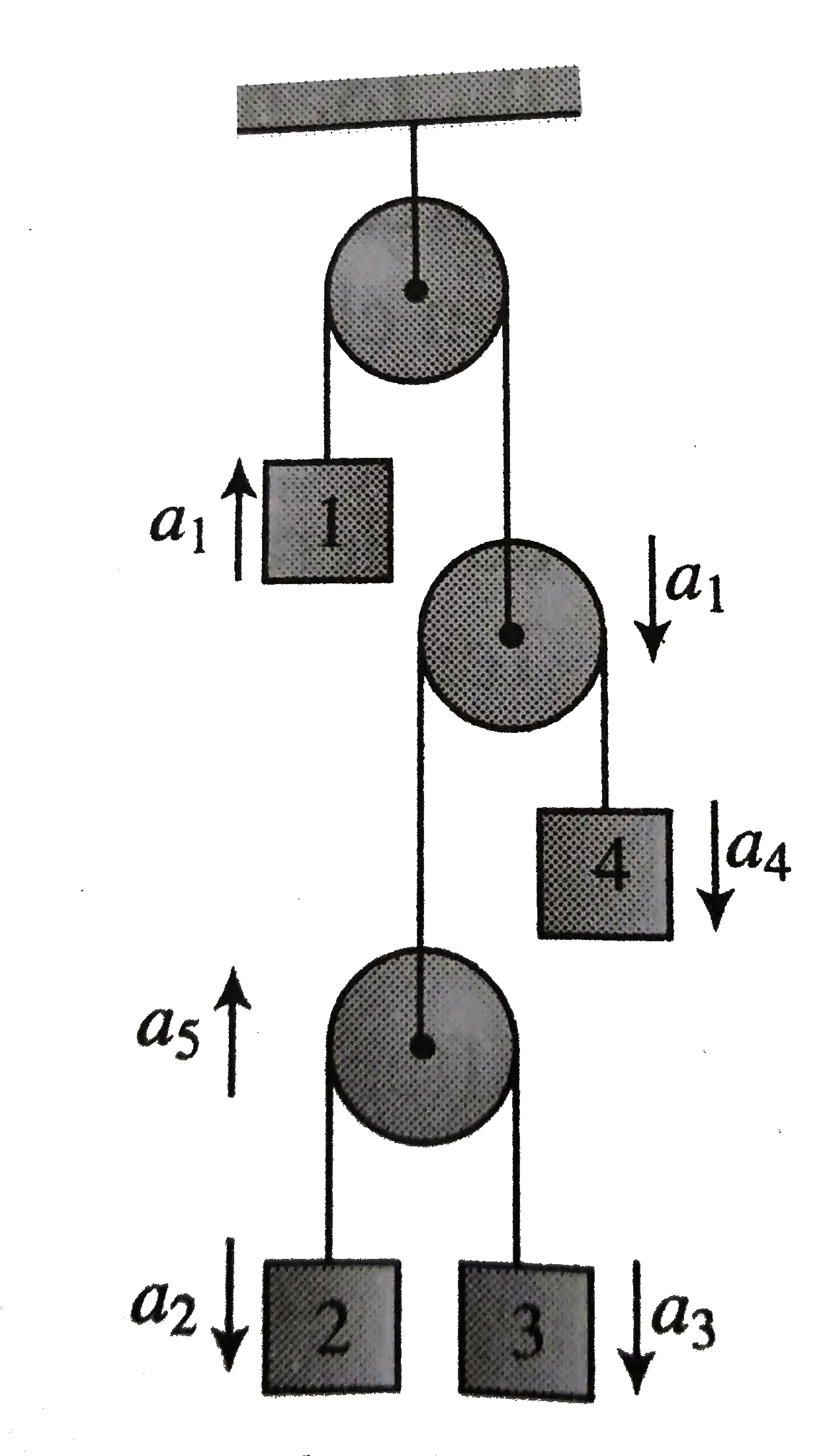
Acceleration of dirrerent objects is shown in figure. All the acceleration are w.r.t. ground
Given : `a_(3)=a_(4)` ..(i)
`a_(2)+a_(1)=1` ..(ii)
`a_(3)+a_(1)=5` ..(iii)
from fig, we can write
`-a_(5)=(a_(2)+a_(3))/(2) ..(iv)`
`a_(1)=(a_(4)+a_(5))/(2)` ..(v)
Solving the above equations, we get
`a_(1)=2 ms^(-2), a_(2) = 1ms^(-2)`,
`a_(3)=a_(4)=3 ms^(-2)`.
Promotional Banner

Topper's Solved these Questions

  • NEWTON'S LAWS OF MOTION 1

    CENGAGE PHYSICS|Exercise Integer|5 Videos
  • NEWTON'S LAWS OF MOTION 1

    CENGAGE PHYSICS|Exercise Assertion-reasoning|15 Videos
  • MISCELLANEOUS VOLUME 2

    CENGAGE PHYSICS|Exercise INTEGER_TYPE|10 Videos
  • NEWTON'S LAWS OF MOTION 2

    CENGAGE PHYSICS|Exercise Integer type|1 Videos

Similar Questions

Explore conceptually related problems

In the arrangement shown in fig., all pulleys are smooth and massless. When the system is released from the rest, acceleration of block 2 and 3 relative to 1 are 1 ms^(-2) downwards and 5ms^(-2) downwards, respectively. Acceleration of block 3 relative to 4 is zero. Find the absolute acceleration of block 1.

The acceleration of block is( g=10 ms-2)

What is the acceleration of block A when the system is released from rest ?

In the arrangement shown the fixed pulley is massless and frictionless. If the acceleration of block of mass 1kg is (30)/(x)m//s^(2) . Find the value of x .

If pulleys shown in the diagram are smooth and massless and a_(1) and a_(2) are acceleration of blocks of mass 4 kg and 8 kg respectively, then -

In the arrangement shown, the blocks of unequal masses are held at rest. When released, acceleration of the blocks is

The acceleration of 3 kg block in the arrangement shown in the diagram ,when the given system is released from rest is

The system shown in figure starts from rest, and each block moves with a constant acceleration. If the relative acceleration of block C with respect to block B is 6m//s^(2) upward and the relative acceleration of block D with respect to block C after 3s from starts.

CENGAGE PHYSICS-NEWTON'S LAWS OF MOTION 1-Linked Comperhension
  1. In the arrangement shown in fig., all pulleys are smooth and massless....

    Text Solution

    |

  2. In the arrangement shown in fig., all pulleys are smooth and massless....

    Text Solution

    |

  3. In the arrangement shown in fig., all pulleys are smooth and massless....

    Text Solution

    |

  4. In the arrangement shown in fig., all pulleys are smooth and massless....

    Text Solution

    |

  5. Two blocks of masses m(1) and m(2) are connected with a light spring o...

    Text Solution

    |

  6. Two blocks of masses m(1) and m(2) are connected with a light spring o...

    Text Solution

    |

  7. Two blocks of masses m(1) and m(2) are connected with a light spring o...

    Text Solution

    |

  8. Two smooth block are placed at a smooth corner as shown in fig. Both t...

    Text Solution

    |

  9. Two smooth block are placed at a smooth corner as shown in fig. Both t...

    Text Solution

    |

  10. Two smooth block are placed at a smooth corner as shown in fig. Both t...

    Text Solution

    |

  11. Two containers of sand are arranged like the block as shown in fig. th...

    Text Solution

    |

  12. Two containers of sand are arranged like the block as shown in fig. th...

    Text Solution

    |

  13. A time varying force F=6t-2t^(2)N, at t=0 starts acting on a body of m...

    Text Solution

    |

  14. A time varying force F=6t-2t^(2)N, at t=0 starts acting on a body of m...

    Text Solution

    |

  15. A time varying force F=6t-2t^(2)N, at t=0 starts acting on a body of m...

    Text Solution

    |

  16. For the system shown in fig, there is no friction anywhere. Masses m(1...

    Text Solution

    |

  17. For the system shown in fig, there is no friction anywhere. Masses m(1...

    Text Solution

    |

  18. Two blocks of masses m(1) and m(2) are connected with a light spring o...

    Text Solution

    |

  19. A mass M is suspended as shown in fig. The system is in equilibrium. A...

    Text Solution

    |

  20. A mass M is suspended as shown in fig. The system is in equilibrium. A...

    Text Solution

    |

