Home
Class 11
PHYSICS
Two blocks of masses m(1) and m(2) are c...

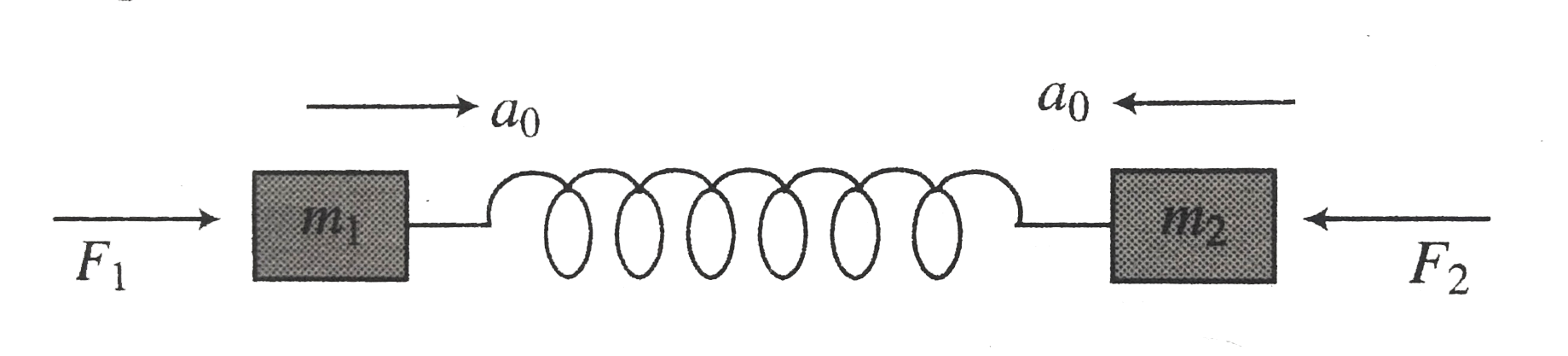
Two blocks of masses `m_(1)` and `m_(2)` are connected with a light spring of force constant k and the whole system is kept on a frictionless horizontal surface. The masses are applied forces `F_(1)` and `F_(2)` as shown in fig. At any time the blocks have same acceleration `a_(0)` but in opposite direction. Now answer the following :

The value of `a_(0)` is

A

`(F_(1)-F_(2))/(m_(1)+m_(2))`

B

`(F_(1)-F_(2))/(m_(1)-m_(2))`

C

`(F_(1)+F_(2))/(m_(1)-m_(2))`

D

`(F_(1)+F_(2))/(m_(1)+m_(2))`

Text Solution

Verified by Experts

The correct Answer is:

B

Let x be the compression in spring at any time

`F_(1)-kx=m_(1)a_(0), F_(2)-kx=m_(2)a_(0)`
Solve to get: `a_(0)=(F_(1)-F_(2))/(m_(1)-m_(2))`
and `kx=(m_(1)F_(2)-F_(1)m_(2))/(m_(1)-m_(2))`
Just after `m_(2)` is removed:
`a_(2)=(kx)/(m_2)= (F_(2)-m_(2)a_(0))/(m_2) =(F_2)/(m_2)-a_(0)`.
Promotional Banner

Topper's Solved these Questions

  • NEWTON'S LAWS OF MOTION 1

    CENGAGE PHYSICS|Exercise Integer|5 Videos
  • NEWTON'S LAWS OF MOTION 1

    CENGAGE PHYSICS|Exercise Assertion-reasoning|15 Videos
  • MISCELLANEOUS VOLUME 2

    CENGAGE PHYSICS|Exercise INTEGER_TYPE|10 Videos
  • NEWTON'S LAWS OF MOTION 2

    CENGAGE PHYSICS|Exercise Integer type|1 Videos

Similar Questions

Explore conceptually related problems

Two blocks of masses m_(1) and m_(2) are connected with a light spring of force constant k and the whole system is kept on a frictionless horizontal surface. The masses are applied forces F_(1) and F_(2) as shown in fig. At any time the blocks have same acceleration a_(0) but in opposite direction. Now answer the following : the value of spring force is

Two blocks of masses m_(1) and m_(2) are connected with a light spring of force constant k and the whole system is kept on a frictionless horizontal surface. The masses are applied forces F_(1) and F_(2) as shown in fig. At any time the blocks have same acceleration a_(0) but in opposite direction. Now answer the following : If F_(2) is removed at this moment, then just after the acceleration of m_(2) is

Two blocks of masses m_(1) and m_(2) being connected with a light spring of stiffness k are driven with forces F_(1) and F_(2) on a smooth horizontal plane.

Two blocks of masses m_(1) =1kg and m_(2) = 2kg are connected by a spring of spring constant k = 24 N/m and placed on a frictionless horizontal surface. The block m_(1) is imparted an initial velocity v_(0) = 12cm/s to the right. The amplitude of osciallation is

Two blocks of masses m and m' are connected by a light spring on a horizontal frictionless table . The spring is compressed and then released . Find the ratio of acceleration of masses .

Two blocks of masses m_(1) and m_(2) are connected by an ideal sprit, of force constant k . The blocks are placed on smooth horizontal surface. A horizontal force F acts on the block m_(1) . Initially spring is relaxed, both the blocks are at rest. What is acceleration of centre of mass of system at the instant of maximum elongation of spring

Two blocks of equal mass m are connected by an unstretched spring and the system is kept at rest on a frictionless horizontal surface. A constant force F is applied on the first block pulling away from the other as shown in Fig. Then the displacement of the centre of mass in at time t is

Two blocks of masses m_(1) and m_(2) are connected by an ideal sprit, of force constant k . The blocks are placed on smooth horizontal surface. A horizontal force F acts on the block m_(1) . Initially spring is relaxed, both the blocks are at rest. Which of the following statement is not true tn the watt of above system.

Two blocks of mass m_(1) and m_(2) are connected by a spring of force constant k. Block of mass m_(1) os pulled by a constant force f_(2) [see fig 4E.19 (a)] find the maximum elongation in the spring .

CENGAGE PHYSICS-NEWTON'S LAWS OF MOTION 1-Linked Comperhension
  1. In the arrangement shown in fig., all pulleys are smooth and massless....

    Text Solution

    |

  2. In the arrangement shown in fig., all pulleys are smooth and massless....

    Text Solution

    |

  3. In the arrangement shown in fig., all pulleys are smooth and massless....

    Text Solution

    |

  4. Two blocks of masses m(1) and m(2) are connected with a light spring o...

    Text Solution

    |

  5. Two blocks of masses m(1) and m(2) are connected with a light spring o...

    Text Solution

    |

  6. Two blocks of masses m(1) and m(2) are connected with a light spring o...

    Text Solution

    |

  7. Two smooth block are placed at a smooth corner as shown in fig. Both t...

    Text Solution

    |

  8. Two smooth block are placed at a smooth corner as shown in fig. Both t...

    Text Solution

    |

  9. Two smooth block are placed at a smooth corner as shown in fig. Both t...

    Text Solution

    |

  10. Two containers of sand are arranged like the block as shown in fig. th...

    Text Solution

    |

  11. Two containers of sand are arranged like the block as shown in fig. th...

    Text Solution

    |

  12. A time varying force F=6t-2t^(2)N, at t=0 starts acting on a body of m...

    Text Solution

    |

  13. A time varying force F=6t-2t^(2)N, at t=0 starts acting on a body of m...

    Text Solution

    |

  14. A time varying force F=6t-2t^(2)N, at t=0 starts acting on a body of m...

    Text Solution

    |

  15. For the system shown in fig, there is no friction anywhere. Masses m(1...

    Text Solution

    |

  16. For the system shown in fig, there is no friction anywhere. Masses m(1...

    Text Solution

    |

  17. Two blocks of masses m(1) and m(2) are connected with a light spring o...

    Text Solution

    |

  18. A mass M is suspended as shown in fig. The system is in equilibrium. A...

    Text Solution

    |

  19. A mass M is suspended as shown in fig. The system is in equilibrium. A...

    Text Solution

    |

  20. A mass M is suspended as shown in fig. The system is in equilibrium. A...

    Text Solution

    |

