Home
Class 11
PHYSICS
Two smooth block are placed at a smooth ...

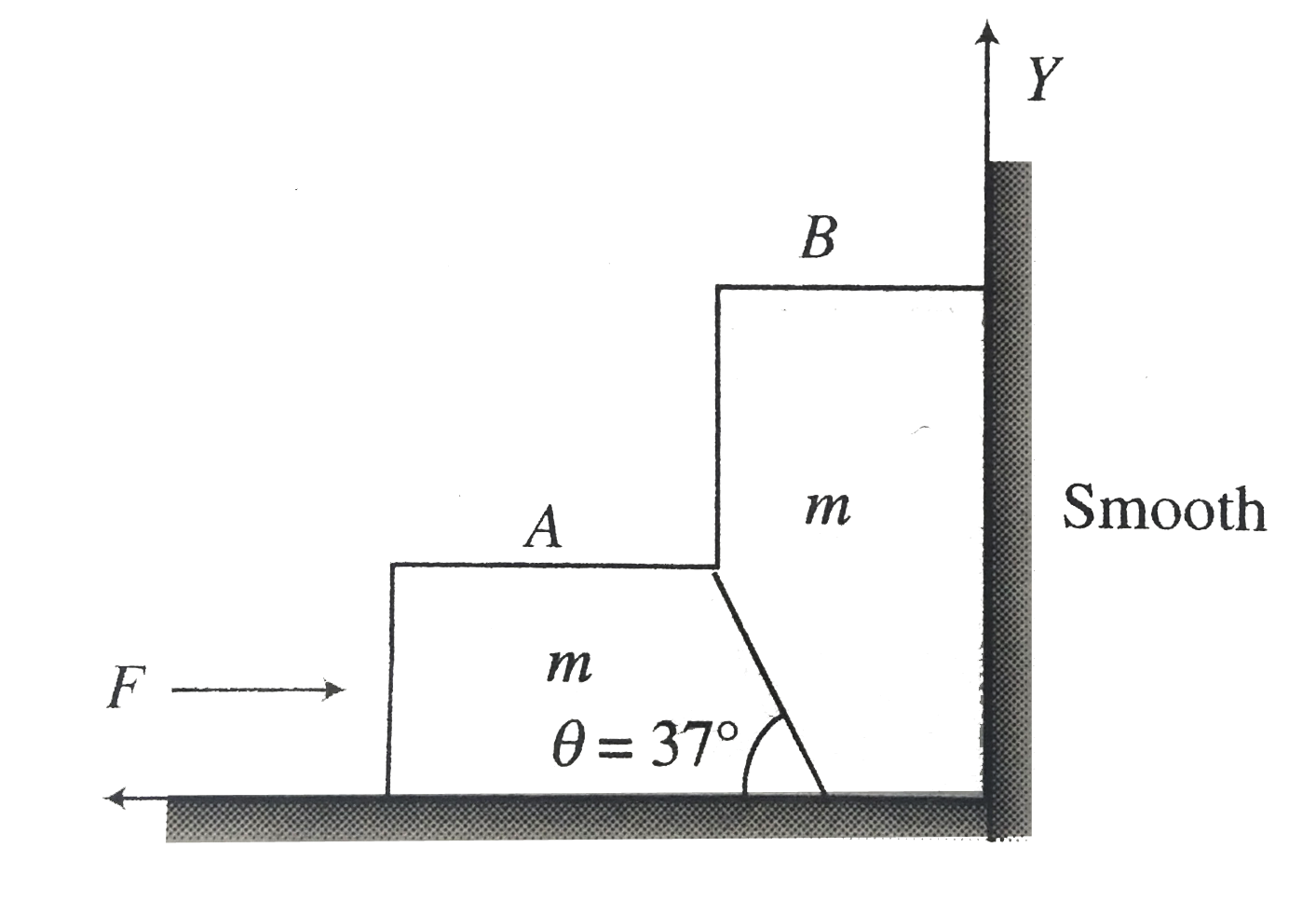
Two smooth block are placed at a smooth corner as shown in fig. Both the bloks are having mass m. We apply a force F on the block m. Block A presses block B in the normal direction, due to which pressing force on vertical wall will increase, and pressing force on the horizontal wall decreases, as we increases `F(theta = 37^(@)` with horizontal).

As soon as the pressing force on the horizontal wall by block B become zero, it will lose contact with ground. If the value of F further increases, block B will accelerate in the upward direction and simulaneously block A will towards right.
If both the blocks are stationary, the force exerted by ground of block A is

A

`mg + (3F)/(4)`

B

`mg - (3F)/(4)`

C

`mg + (4F)/(3)`

D

`mg - (4F)/(3)`

Text Solution

Verified by Experts

The correct Answer is:
C

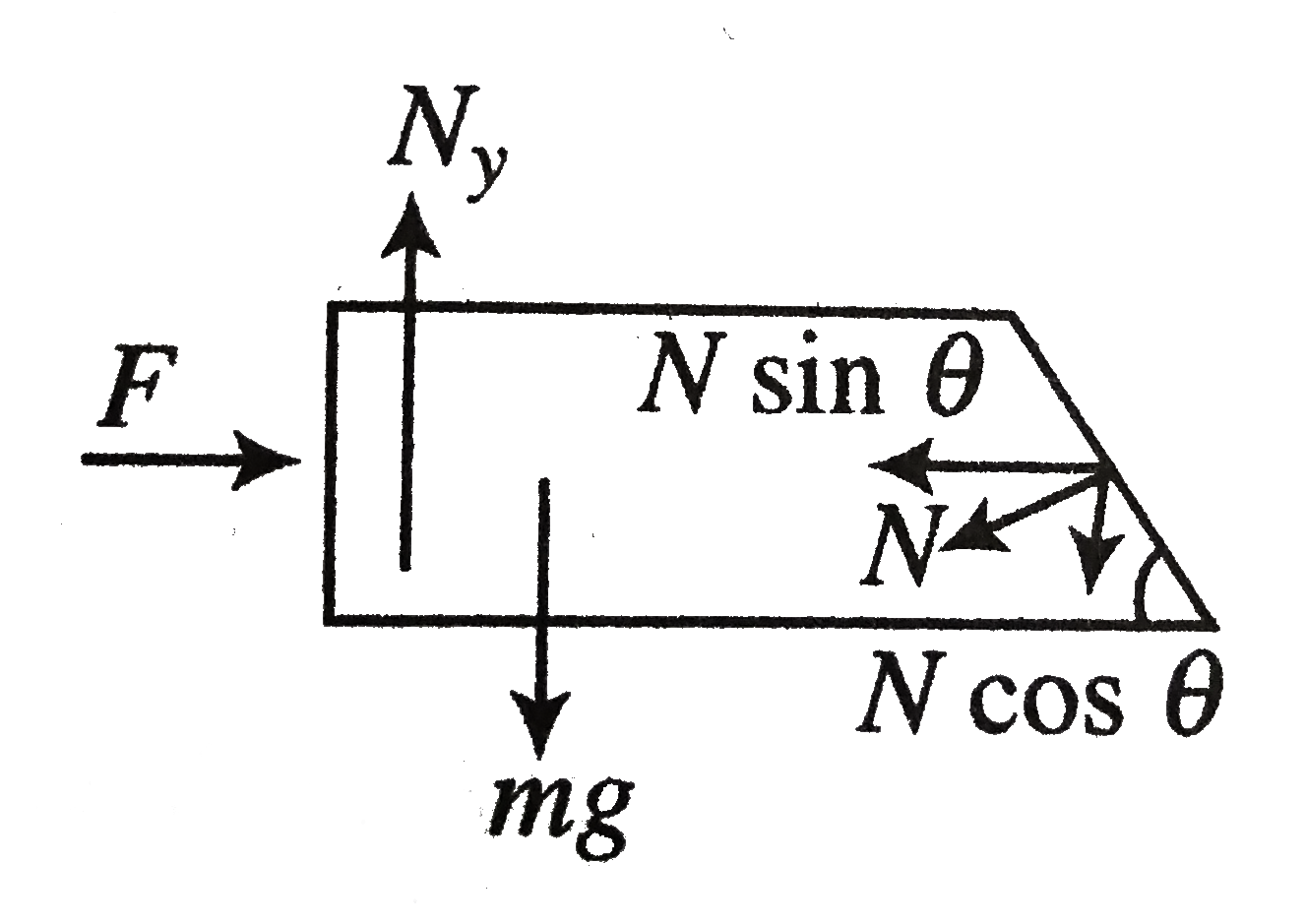
If both the blocks are stationary.
Balancing forces along x-direction `F=N sin theta`
`rArr N=F//sin theta`
Balancing forces along y-direction
`N_(y)=mg+N cos theta`
`mg+((F)/(sin theta)) cos theta = mg+F cot theta`
`.N_(y) = mg + (4F)/(3)`
Promotional Banner

Topper's Solved these Questions

  • NEWTON'S LAWS OF MOTION 1

    CENGAGE PHYSICS|Exercise Integer|5 Videos
  • NEWTON'S LAWS OF MOTION 1

    CENGAGE PHYSICS|Exercise Assertion-reasoning|15 Videos
  • MISCELLANEOUS VOLUME 2

    CENGAGE PHYSICS|Exercise INTEGER_TYPE|10 Videos
  • NEWTON'S LAWS OF MOTION 2

    CENGAGE PHYSICS|Exercise Integer type|1 Videos

Similar Questions

Explore conceptually related problems

Two smooth block are placed at a smooth corner as shown in fig. Both the bloks are having mass m. We apply a force F on the block m. Block A presses block B in the normal direction, due to which pressing force on vertical wall will increase, and pressing force on the horizontal wall decreases, as we increases F(theta = 37^(@) with horizontal). As soon as the pressing force on the horizontal wall by block B become zero, it will lose contact with ground. If the value of F further increases, block B will accelerate in the upward direction and simulaneously block A will towards right. If the acceleration of block A is a rightwards, then the acceleration of block B will be

Two smooth block are placed at a smooth corner as shown in fig. Both the bloks are having mass m. We apply a force F on the block m. Block A presses block B in the normal direction, due to which pressing force on vertical wall will increase, and pressing force on the horizontal wall decreases, as we increases F(theta = 37^(@) with horizontal). As soon as the pressing force on the horizontal wall by block B become zero, it will lose contact with ground. If the value of F further increases, block B will accelerate in the upward direction and simulaneously block A will towards right. What is the minimum value of F to lift block B from ground?

A block is placed on a smooth inclined plane as shown . For what value of horizontal force F, the block will remain at rest ?

A horizontal force F acts on the block of mass m and the block remains stationary, thr value of friction force is.

Two block of masses m_(1) and m_(2) are placed side by side on a smooth horizontal surface as shown in fig. A horizontal force F is applied on the block . (a) Find the acceleration of each block. (b) Find the normal reaction between the two blocks.

Two blocks of masses 1 kg and 2 kg are placed in contact on a smooth horizontal surface as shown in fig. A horizontal force of 6N is applied d(a) on a 1-kg block. Find the force of interaction of the blocks. .

A block of mass m is placed on a smooth inclined plane of inclination theta with the horizontal. The force exerted by the plane on the block has a magnitude

Blocks are in contact on a frictionless table. A horizontal force F=3N is applied to one block as shown. The force exerted by the smaller block m_(2) on block m_(1) is :

Two blocks of masses 4kg and 2kg are placed side on a smooth horizontal surface as shown in the figure. A horizontal force of 20N is applied on 4kg block. Find (a) the acceleration of each block. (b) the normal reaction between two blocks.

Two blocks of masses m and 2m are placed on a smooth horizontal surface as shown in the figure. Find the acceleration of each block and normal reaction between two blocks if a horizontal force F_(0) is applied on (a) m and (b) 2m

CENGAGE PHYSICS-NEWTON'S LAWS OF MOTION 1-Linked Comperhension
  1. In the arrangement shown in fig., all pulleys are smooth and massless....

    Text Solution

    |

  2. In the arrangement shown in fig., all pulleys are smooth and massless....

    Text Solution

    |

  3. In the arrangement shown in fig., all pulleys are smooth and massless....

    Text Solution

    |

  4. Two blocks of masses m(1) and m(2) are connected with a light spring o...

    Text Solution

    |

  5. Two blocks of masses m(1) and m(2) are connected with a light spring o...

    Text Solution

    |

  6. Two blocks of masses m(1) and m(2) are connected with a light spring o...

    Text Solution

    |

  7. Two smooth block are placed at a smooth corner as shown in fig. Both t...

    Text Solution

    |

  8. Two smooth block are placed at a smooth corner as shown in fig. Both t...

    Text Solution

    |

  9. Two smooth block are placed at a smooth corner as shown in fig. Both t...

    Text Solution

    |

  10. Two containers of sand are arranged like the block as shown in fig. th...

    Text Solution

    |

  11. Two containers of sand are arranged like the block as shown in fig. th...

    Text Solution

    |

  12. A time varying force F=6t-2t^(2)N, at t=0 starts acting on a body of m...

    Text Solution

    |

  13. A time varying force F=6t-2t^(2)N, at t=0 starts acting on a body of m...

    Text Solution

    |

  14. A time varying force F=6t-2t^(2)N, at t=0 starts acting on a body of m...

    Text Solution

    |

  15. For the system shown in fig, there is no friction anywhere. Masses m(1...

    Text Solution

    |

  16. For the system shown in fig, there is no friction anywhere. Masses m(1...

    Text Solution

    |

  17. Two blocks of masses m(1) and m(2) are connected with a light spring o...

    Text Solution

    |

  18. A mass M is suspended as shown in fig. The system is in equilibrium. A...

    Text Solution

    |

  19. A mass M is suspended as shown in fig. The system is in equilibrium. A...

    Text Solution

    |

  20. A mass M is suspended as shown in fig. The system is in equilibrium. A...

    Text Solution

    |

