Home
Class 11
PHYSICS
For the system shown in fig, there is no...

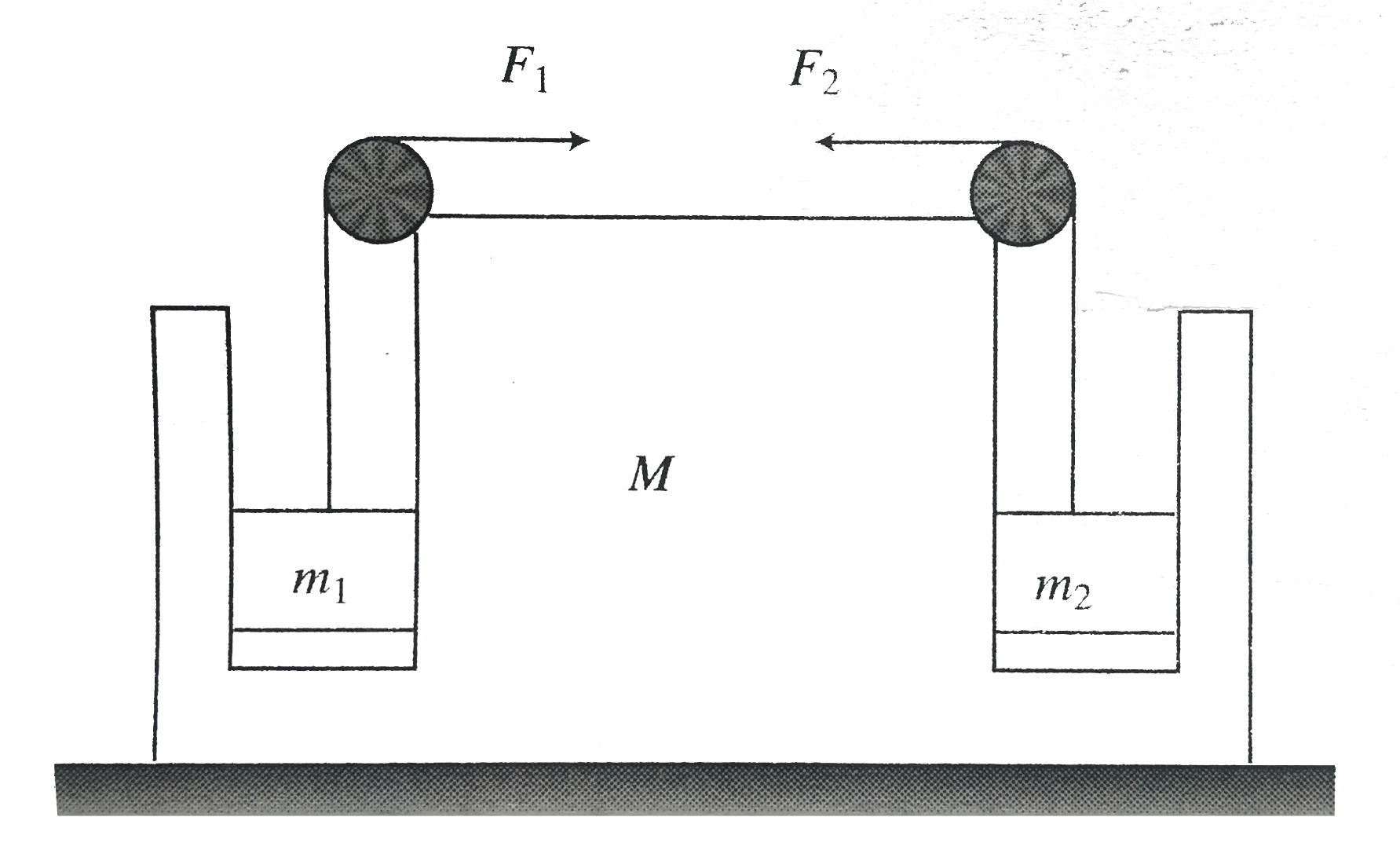
For the system shown in fig, there is no friction anywhere. Masses `m_(1) and m_(2)` can move up or down in the slots cut in mass M. Two non-zero horizontal force `F_(1)` and `F_(2)` are applied as shown. The pulleys are massles and frictionless. Given `m_(1) != m_(2)`

According to the above passage, which is correct?

A

It is not possible for the entire system to be in equilibrium.

B

For some values `F_(1) and F_(2)`, it is possible that the entire system is in equilibrium.

C

It is possble that `F_(1)` and `F_(2)` are applied in such a way that `m_(1)` and `m_(2)` remain in equilibrium but M does not.

D

None of the above

Text Solution

Verified by Experts

The correct Answer is:

A

Let `m_(1)` and `m_(2)` do not accelerate up or down, then
`F_(1)=m_(1)g, F_(2)=m_(2)g`, but `m_(1) != m_(2)`, so `F_(1) != F_(2)`
Hence net horizontal force on M is `F_(1)-F_(2)`. So M cannot be in equilibrium. If M accelerates horizontally, then `m_(1)` and `m_(2)` also accelerated horizontally.
Promotional Banner

Topper's Solved these Questions

  • NEWTON'S LAWS OF MOTION 1

    CENGAGE PHYSICS|Exercise Integer|5 Videos
  • NEWTON'S LAWS OF MOTION 1

    CENGAGE PHYSICS|Exercise Assertion-reasoning|15 Videos
  • MISCELLANEOUS VOLUME 2

    CENGAGE PHYSICS|Exercise INTEGER_TYPE|10 Videos
  • NEWTON'S LAWS OF MOTION 2

    CENGAGE PHYSICS|Exercise Integer type|1 Videos

Similar Questions

Explore conceptually related problems

For the system shown in fig, there is no friction anywhere. Masses m_(1) and m_(2) can move up or down in the slots cut in mass M. Two non-zero horizontal force F_(1) and F_(2) are applied as shown. The pulleys are massles and frictionless. Given m_(1) != m_(2) Let F_(1) and F_(2) are applied in such a way that m_(1) and m_(2) do not move w.r.t. M. then what is the magnitude of the acceleration of M? Let m_(1) gt m_(2) .

In the system shown in fig the pulley is frictionless and the string massless if m_(1)=m_(2) thrust on the pulley will be:

Find the acceleration of masses m_(1) and m_(2) moving down the smooth incline plane. The string and the pulley are masseless and frictionless.

Two masses m_(1) and m_(2) are attached to a string which passes over a frictionless smooth pulley. When m_(1)=10kg,m_(2)=6kg , the acceleration of masses is

In the system shown, the initial acceleration of the wedge of mass 5M is (there is no friction anywhere)

In the arrangement shown in Fig there is no friction between of mass 2m and ground but there is friction between the block of masses m is stationary with respect to block of mass 2m The value of friction between m and 2m is

In the situation shown in figure F=500 newton applied on the pulley m_(1)=50 kg and m_(2) = 10 kg and pulley and strings are massless and frictionless. Then the acceleration of the pulley is : [g = 10 m//s^(2)]

Blocks are in contact on a frictionless table. A horizontal force F = 3N is applied to one block as shown. The force exerted by the smaller block m_(2) on block m_(1) is-

CENGAGE PHYSICS-NEWTON'S LAWS OF MOTION 1-Linked Comperhension
  1. In the arrangement shown in fig., all pulleys are smooth and massless....

    Text Solution

    |

  2. In the arrangement shown in fig., all pulleys are smooth and massless....

    Text Solution

    |

  3. In the arrangement shown in fig., all pulleys are smooth and massless....

    Text Solution

    |

  4. Two blocks of masses m(1) and m(2) are connected with a light spring o...

    Text Solution

    |

  5. Two blocks of masses m(1) and m(2) are connected with a light spring o...

    Text Solution

    |

  6. Two blocks of masses m(1) and m(2) are connected with a light spring o...

    Text Solution

    |

  7. Two smooth block are placed at a smooth corner as shown in fig. Both t...

    Text Solution

    |

  8. Two smooth block are placed at a smooth corner as shown in fig. Both t...

    Text Solution

    |

  9. Two smooth block are placed at a smooth corner as shown in fig. Both t...

    Text Solution

    |

  10. Two containers of sand are arranged like the block as shown in fig. th...

    Text Solution

    |

  11. Two containers of sand are arranged like the block as shown in fig. th...

    Text Solution

    |

  12. A time varying force F=6t-2t^(2)N, at t=0 starts acting on a body of m...

    Text Solution

    |

  13. A time varying force F=6t-2t^(2)N, at t=0 starts acting on a body of m...

    Text Solution

    |

  14. A time varying force F=6t-2t^(2)N, at t=0 starts acting on a body of m...

    Text Solution

    |

  15. For the system shown in fig, there is no friction anywhere. Masses m(1...

    Text Solution

    |

  16. For the system shown in fig, there is no friction anywhere. Masses m(1...

    Text Solution

    |

  17. Two blocks of masses m(1) and m(2) are connected with a light spring o...

    Text Solution

    |

  18. A mass M is suspended as shown in fig. The system is in equilibrium. A...

    Text Solution

    |

  19. A mass M is suspended as shown in fig. The system is in equilibrium. A...

    Text Solution

    |

  20. A mass M is suspended as shown in fig. The system is in equilibrium. A...

    Text Solution

    |
