Home
Class 11
PHYSICS
For the system shown in fig, there is no...

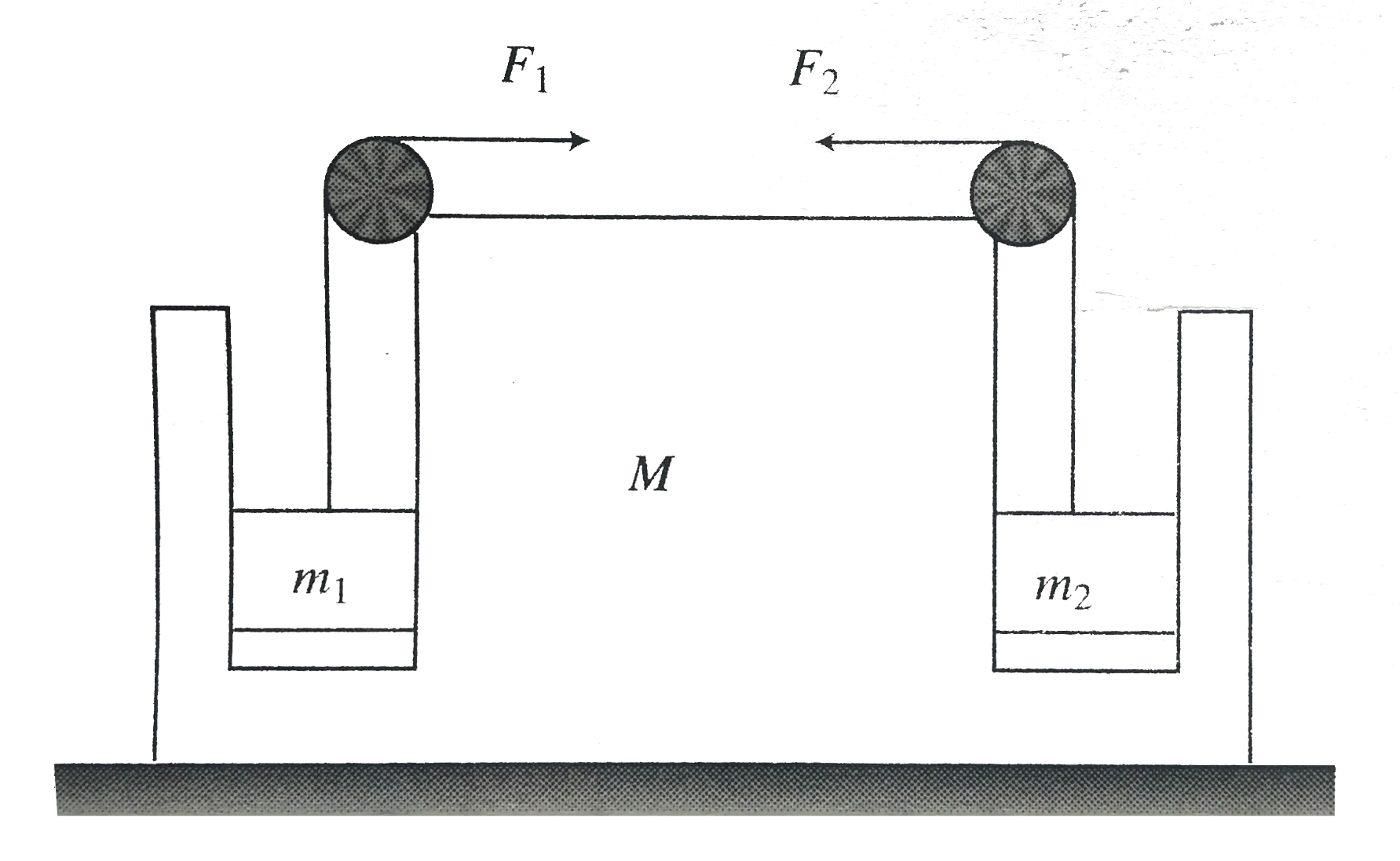
For the system shown in fig, there is no friction anywhere. Masses `m_(1) and m_(2)` can move up or down in the slots cut in mass M. Two non-zero horizontal force `F_(1)` and `F_(2)` are applied as shown. The pulleys are massles and frictionless. Given `m_(1) != m_(2)`

Let `F_(1)` and `F_(2)` are applied in such a way that `m_(1) and m_(2)` do not move w.r.t. M. then what is the magnitude of the acceleration of M? Let `m_(1) gt m_(2)`.

A

`((m_(1)+m_(2))g)/(M+m_(1)+m_(2))`

B

`((m_(1)-m_(2))g)/(M)`

C

`((m_(1)-m_(2))g)/(M+m_(1)+m_(2))`

D

`(F_(1)-F_(2))/(M)`

Text Solution

Verified by Experts

The correct Answer is:

C

`a=("Net force")/("Net mass") = (F_(1)-F_(2))/(M+m_(1)+m_(2)) = (m_(1)g-m_(2)g)/(M+m_(1)+m_(2))`
Promotional Banner

Topper's Solved these Questions

  • NEWTON'S LAWS OF MOTION 1

    CENGAGE PHYSICS|Exercise Integer|5 Videos
  • NEWTON'S LAWS OF MOTION 1

    CENGAGE PHYSICS|Exercise Assertion-reasoning|15 Videos
  • MISCELLANEOUS VOLUME 2

    CENGAGE PHYSICS|Exercise INTEGER_TYPE|10 Videos
  • NEWTON'S LAWS OF MOTION 2

    CENGAGE PHYSICS|Exercise Integer type|1 Videos

Similar Questions

Explore conceptually related problems

For the system shown in fig, there is no friction anywhere. Masses m_(1) and m_(2) can move up or down in the slots cut in mass M. Two non-zero horizontal force F_(1) and F_(2) are applied as shown. The pulleys are massles and frictionless. Given m_(1) != m_(2) According to the above passage, which is correct?

In the system shown in fig the pulley is frictionless and the string massless if m_(1)=m_(2) thrust on the pulley will be:

Find the acceleration of masses m_(1) and m_(2) moving down the smooth incline plane. The string and the pulley are masseless and frictionless.

All surfaces assumed to be frictionless calculate the horizontal force F that must be applied so that m_(1) and m_(2) do not move relative to m_(3) is :–

Two blocks of masses m_(1) and m_(2) being connected with a light spring of stiffness k are driven with forces F_(1) and F_(2) on a smooth horizontal plane.

What force F must be applied so that m_(1) and m_(2) are at rest on m_(3) in

In the system shown in the fig. there is no friction and string is light. Mass of movable pulley P_(2) "is" M_(2) . If pulley P_(1) is massless, what should be value of applied force F to keep the system in equilibrium?

Three block of masses m_(1),m_(2) and m_(3) kg are placed in contact with each other on a frictionless table. A force F is applied on the heaviest mass m_(1) , the acceleration of m_(2) will be

CENGAGE PHYSICS-NEWTON'S LAWS OF MOTION 1-Linked Comperhension
  1. In the arrangement shown in fig., all pulleys are smooth and massless....

    Text Solution

    |

  2. In the arrangement shown in fig., all pulleys are smooth and massless....

    Text Solution

    |

  3. In the arrangement shown in fig., all pulleys are smooth and massless....

    Text Solution

    |

  4. Two blocks of masses m(1) and m(2) are connected with a light spring o...

    Text Solution

    |

  5. Two blocks of masses m(1) and m(2) are connected with a light spring o...

    Text Solution

    |

  6. Two blocks of masses m(1) and m(2) are connected with a light spring o...

    Text Solution

    |

  7. Two smooth block are placed at a smooth corner as shown in fig. Both t...

    Text Solution

    |

  8. Two smooth block are placed at a smooth corner as shown in fig. Both t...

    Text Solution

    |

  9. Two smooth block are placed at a smooth corner as shown in fig. Both t...

    Text Solution

    |

  10. Two containers of sand are arranged like the block as shown in fig. th...

    Text Solution

    |

  11. Two containers of sand are arranged like the block as shown in fig. th...

    Text Solution

    |

  12. A time varying force F=6t-2t^(2)N, at t=0 starts acting on a body of m...

    Text Solution

    |

  13. A time varying force F=6t-2t^(2)N, at t=0 starts acting on a body of m...

    Text Solution

    |

  14. A time varying force F=6t-2t^(2)N, at t=0 starts acting on a body of m...

    Text Solution

    |

  15. For the system shown in fig, there is no friction anywhere. Masses m(1...

    Text Solution

    |

  16. For the system shown in fig, there is no friction anywhere. Masses m(1...

    Text Solution

    |

  17. Two blocks of masses m(1) and m(2) are connected with a light spring o...

    Text Solution

    |

  18. A mass M is suspended as shown in fig. The system is in equilibrium. A...

    Text Solution

    |

  19. A mass M is suspended as shown in fig. The system is in equilibrium. A...

    Text Solution

    |

  20. A mass M is suspended as shown in fig. The system is in equilibrium. A...

    Text Solution

    |
