Home
Class 11
PHYSICS
Two blocks A and B are connected by a li...

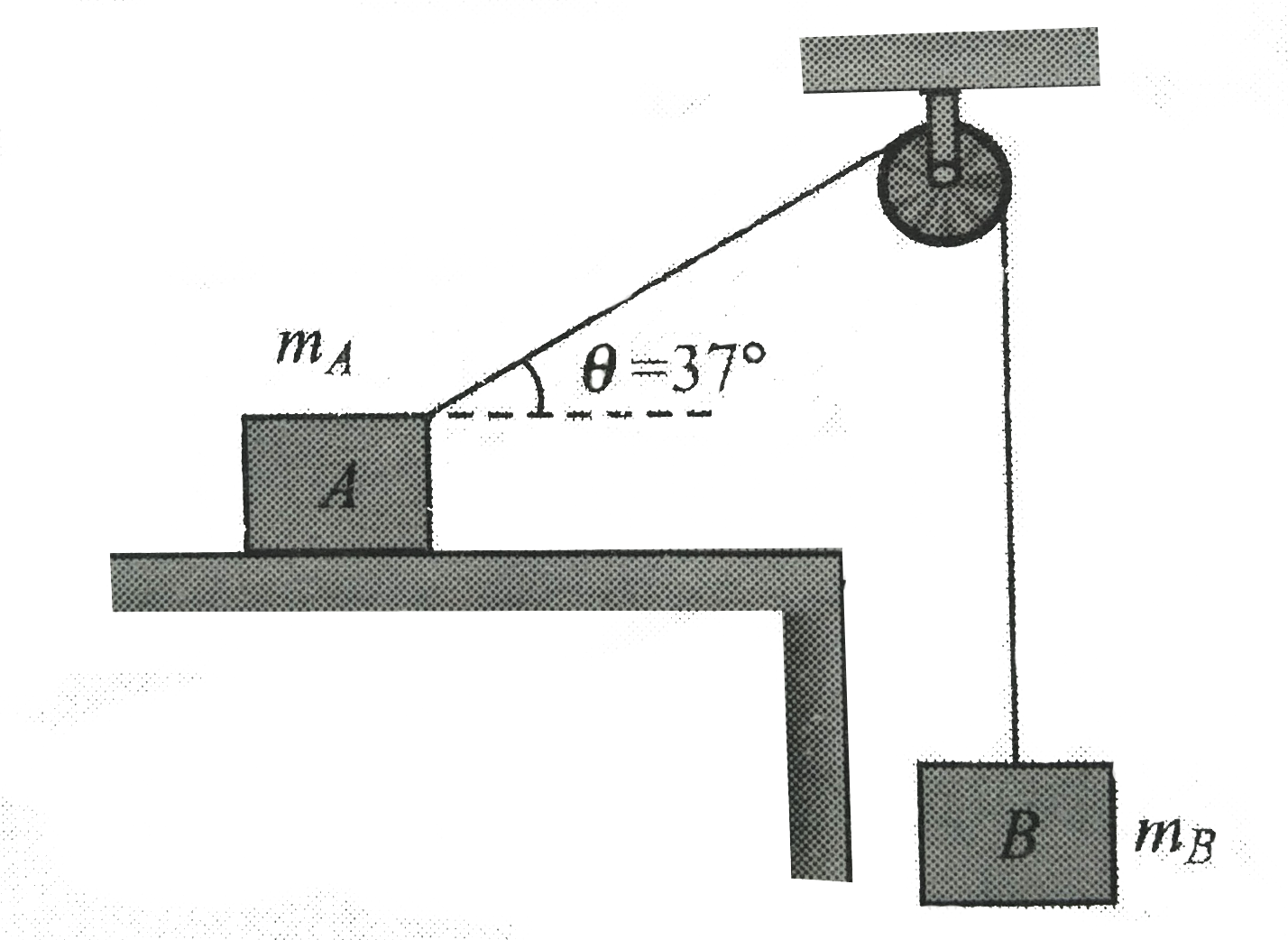
Two blocks `A` and `B` are connected by a light inextensible string passing over a fixed smooth pulley as shown in figure The coefficient of friction between the block `A` and `B` the horizontal table is ` mu = 0.5 `. If the block `A` is just , find ratio of the masses of the blocks

A

`(12)/(5)`

B

`(11)/(5)`

C

`(13)/(5)`

D

`(17)/(5)`

Text Solution

Verified by Experts

The correct Answer is:
B

From `FBD`of `A` and `B` shown in Fig the block `A` is just to slip . The friction will reach to it’s limiting value
`f_("lim")= mu N`….(i)
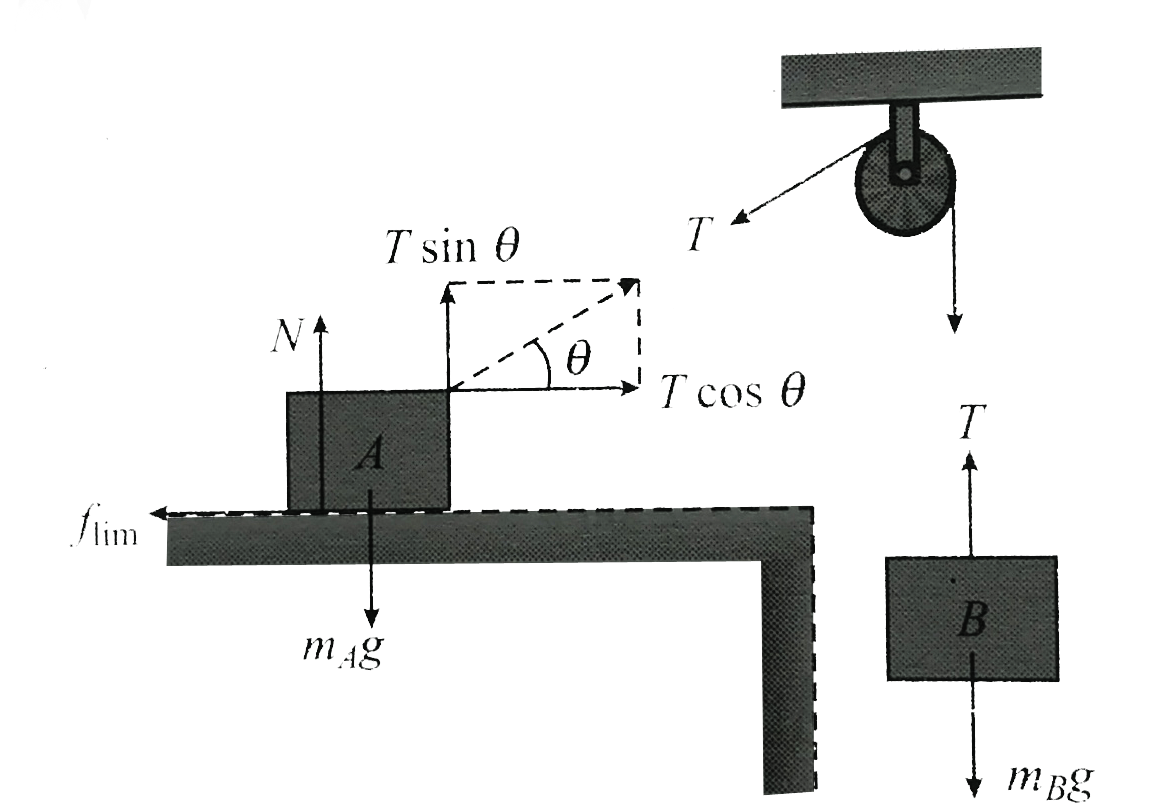
From `FBD` of `A`
`N + T sin theta = m_(0)A` ….(ii)
`T cos theta = f_(max)= muN`.....(iii)
From (ii), `N = m_(0)A - T sin theta `.....(iv)
From (iii) and (iv)
`T cos theta = mu m_(A)g - mu T sin theta` ....(v)
`T( cos theta + mu sin theta) = mu m_(0)A` ....(vi)
From `FBD` of `B,T = m_(B) g` ....(vii)
Taking ratio of (vi) and (vii)
`(mu)/(cos theta + mu sin theta)= (m_(B))/(m_(A))`
`:. (m_(A))/(m_(B)) = (cos theta + mu sin theta))/(mu) = (cos 37^(@) + (0.5)sin 37^(@))/((0.5)) = (11)/(5)`
Promotional Banner

Topper's Solved these Questions

  • NEWTON'S LAWS OF MOTION 2

    CENGAGE PHYSICS|Exercise Solved Examples|12 Videos
  • NEWTON'S LAWS OF MOTION 2

    CENGAGE PHYSICS|Exercise Exercise 7.1|25 Videos
  • NEWTON'S LAWS OF MOTION 1

    CENGAGE PHYSICS|Exercise Integer|5 Videos
  • PROPERTIES OF SOLIDS AND FLUIDS

    CENGAGE PHYSICS|Exercise INTEGER_TYPE|2 Videos

Similar Questions

Explore conceptually related problems

Two blocks A & B are connected by a light inextensible string passing over a fixed smooth pulley as shown in the figure. The coefficient of friction between the block A and the horizontal table is mu=0.2 . If the block A is just to slip, find the ratio of the masses of the blocks.

Two blocks of masses of 40 kg and 30 kg are connected by a weightless string passing over a frictionless pulley as shown in the figure.

Two blocks A and B , each of mass 10 kg , are connected by a light string passing over a smooth pulley as shown in the figure. Block A will remain at rest if the friction on it is

Two blocks A and B of respective masses 6 kg and 4 kg are connected with a string passing over a light friction less pulley as shown in the figure . The coefficient of friction between the block A and horizontal surface is 0.4 . Then the minimum mass of block C which should be placed over A to prevent it from moving is :

A horizontal force Facts on the lower block which is connected with another block kept on it. The two blocks are connected by a light, smooth inextensible string that passes over a fixed pulley. If the co-efficient of friction between all contact surfaces is u , then minimum value of F so that the block starts moving.

Two blocks are connected by an inextensible light string, the string is passing over smooth, light pulley as shown. Find the acceleration of blocks and tension in the string, reaction in pulley.

A block A slides over an another block B which is placed over a smooth inclined plane as shown in figure . The coefficient of friction between the two blocks A and B is mu . Mass of block B is two times the mass of block A . The acceleration of the centre of mass of two blocks is

A small block of mass 'm' is placed on a plank of mass 'M'. The block is connected to plank with the help of a light string passing over a light smooth pulley as shown in figure. The co-efficient of static friction between the block and plank is mu . The co-efficient of friction between the plank and the horizontal surface is zero. What maximum horizontal force F applied on the block of mass m can make the block and plank not to slide relatively?

Two blocks of mass m_(1)"and"m_(2) are connected by light inextensible string passing over a smooth fixed pulleuy of negligible mass. The acceleration of the centre of mass of the system when blocks move under gravity is :

For the arrangement shown in the figure the coefficient of friction between the two blocks is mu . If both the blocks are identical and moving ,then the acceleration of each block is

