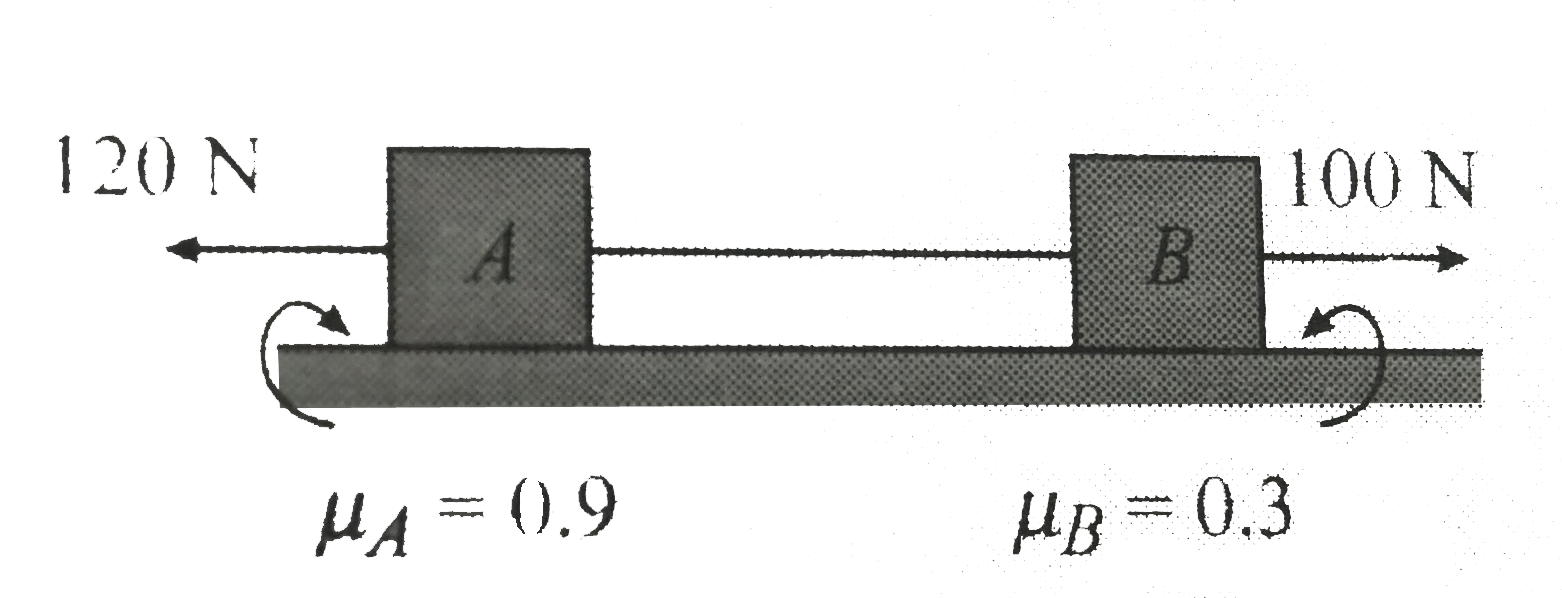
Let as assume that the system moves towards left .Then as it is clear from `FBD`
`F_("driving")= 120 - 100 20N`
`f_("resisting") = mu_(A)N_(A) + mu_(B)N_(B)`
`= 90 + 60 + 150 N`
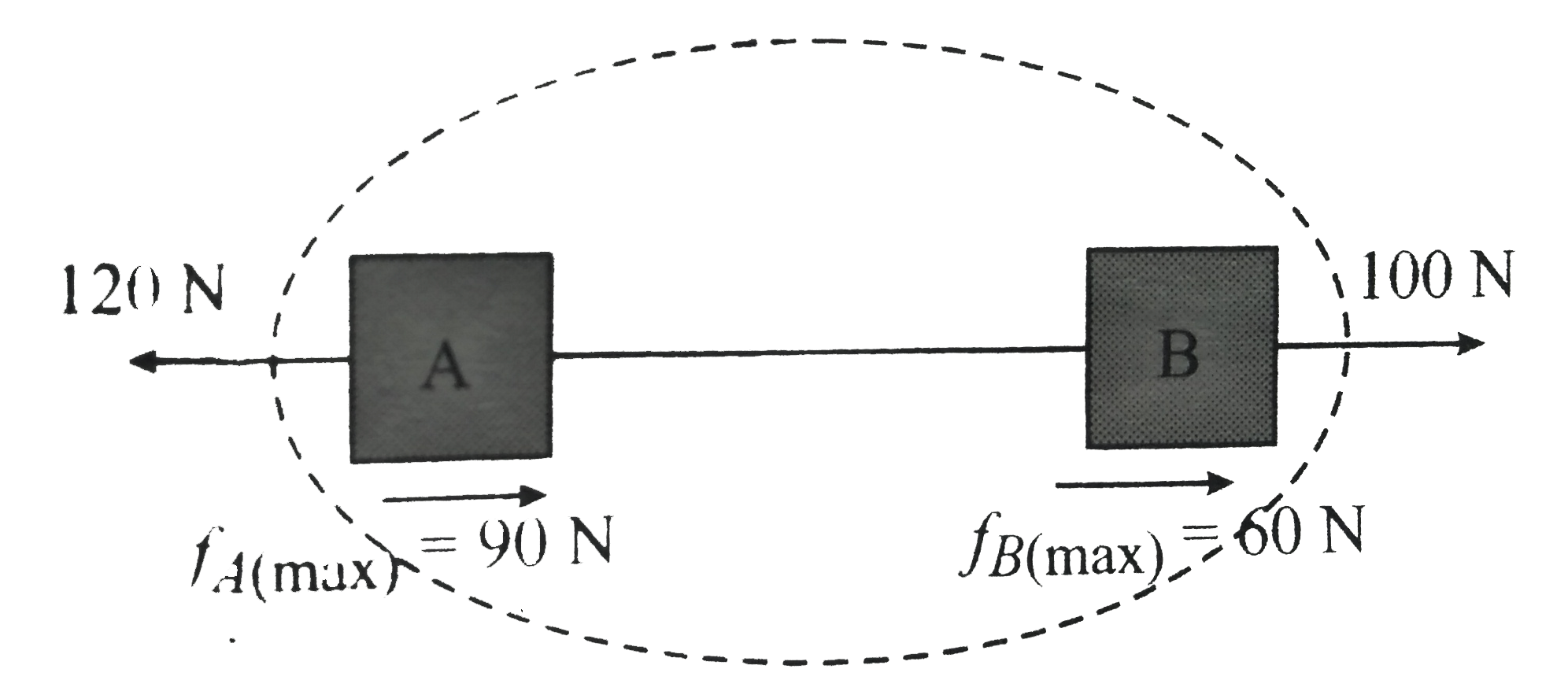
As `F_("resisting") gt F_("driving") ` therefore, it can be concuded that the system is stationary Now there may be two posibilities
The friction between both block and ground should be static
The friction between one block and between the after block and ground is limiting
If friction between both and ground static , the tension in string should be zero
The friction on block `A, f_(A) = 120N`
The friction on block `B, f_(B) = 100N`
But `(f_(A))_(max) = 90 N` and `(f_(B))_(max) = 60 N`
Hence the friction on both block cannot be static
Hence friction on one block is static and on block should be limiting
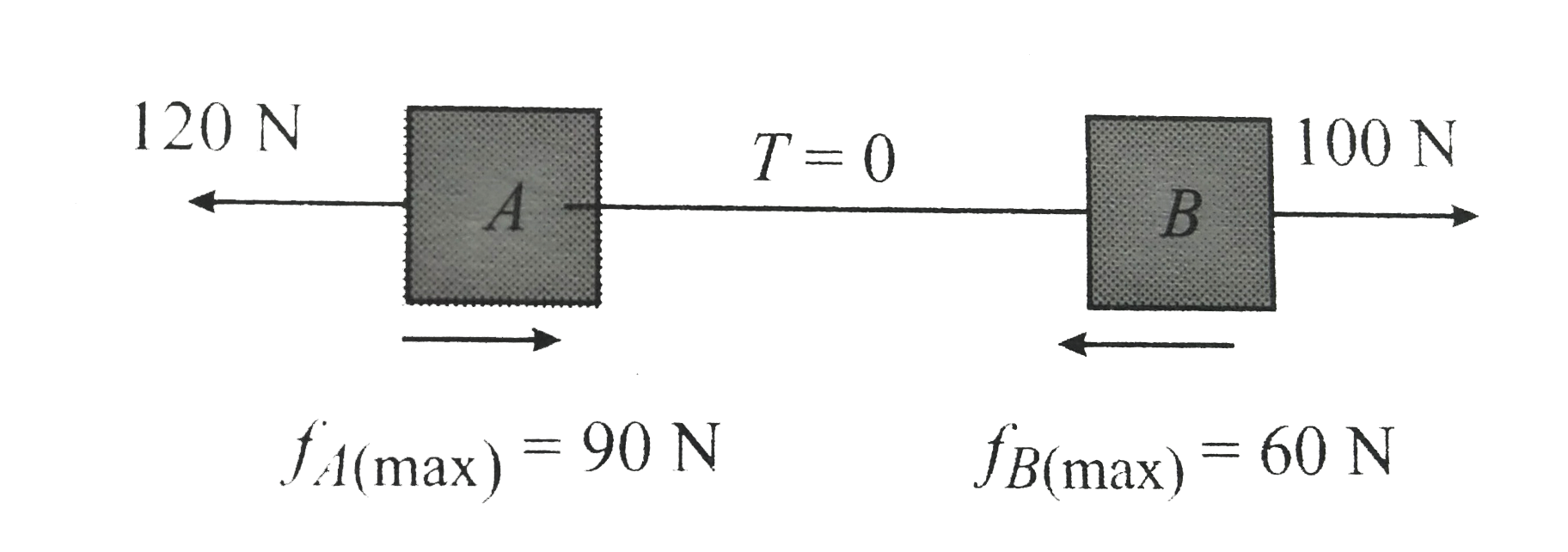
Assuming that the `10 kg` block reaches limiting friction first then using `FBD's`
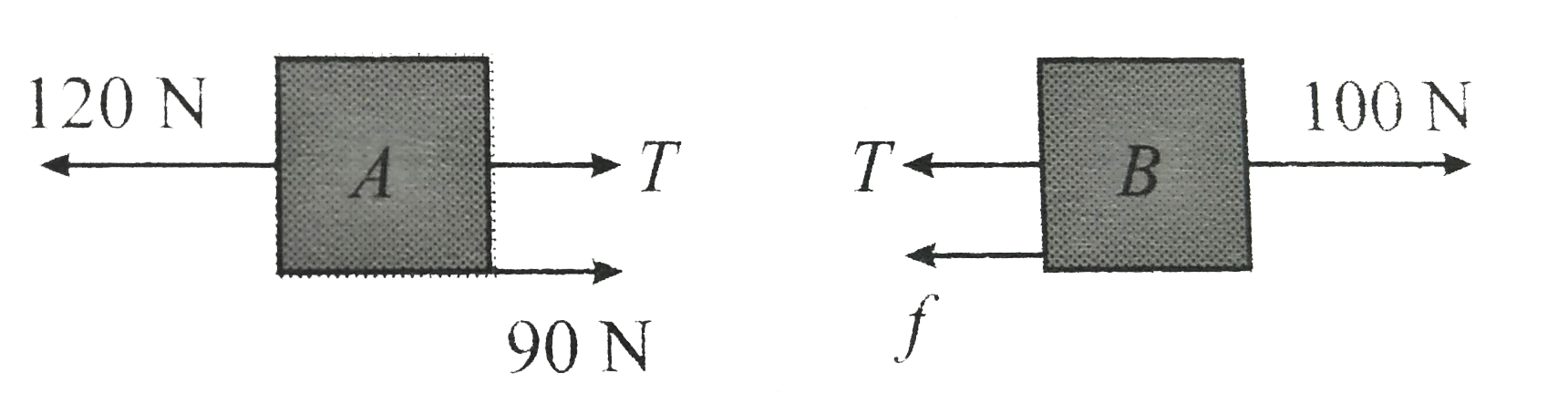
If block `A` is at rest
`120= T + 90 rArr T = 30N`
From `FBND` of `B` : ` T = f = 100`
` :. 30 + f = 100`
Then`f = 30N `which is not posible as the value is `60N` for this surface of block
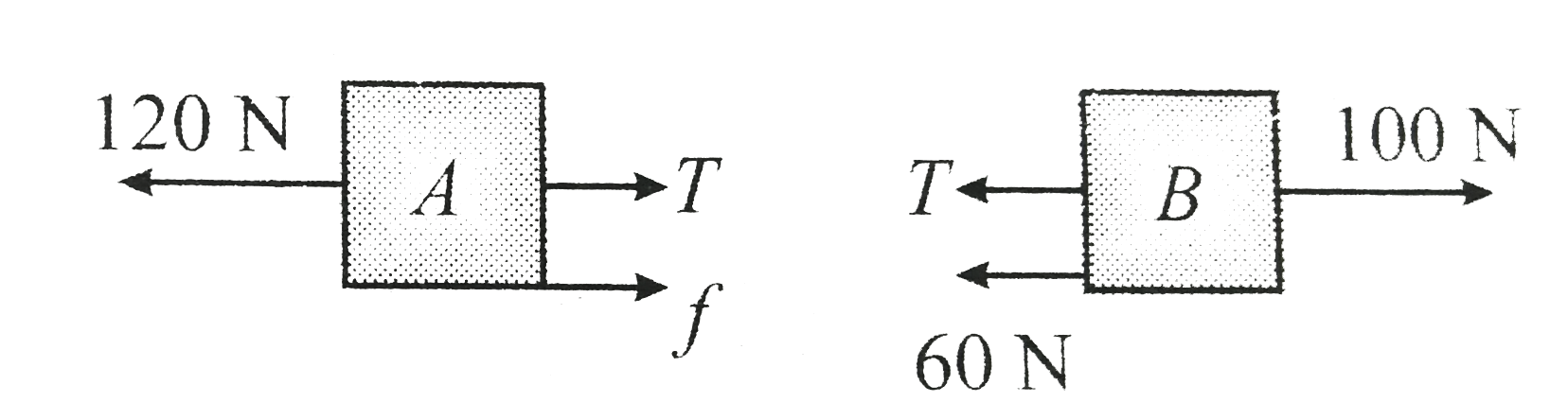
Therefore our assumption is wrong and now taking for `20 kg` surface to be limiting we have
from FBD of `B`
` T + 60 = 100 rArr T = 40 N`
From F`BD`of `A`
Also ` f + T = 120 rArr f = 80 N`
This is acceprable as the static friction at this should be less than `90 N`
Hence the tension in the string is `T = 40 N`