Home
Class 11
PHYSICS
There are two block as shown in the figu...

There are two block as shown in the figure of masses `1kg` and `4kg`. Friction coefficient between any two surfaces are `0.2` then find maximum value of horizontal force `F` so that both blocks moves together.

Text Solution

Verified by Experts

a. If both blocks move together, i,e no sliding between `M` and `m`, the friction between `m` and `M` will be static nature .Static friction force is a self - adjusting force `0 le f le mu_(s)N` .Acceleration of system in this case, `a = (F)/((M + m))` ....(i)
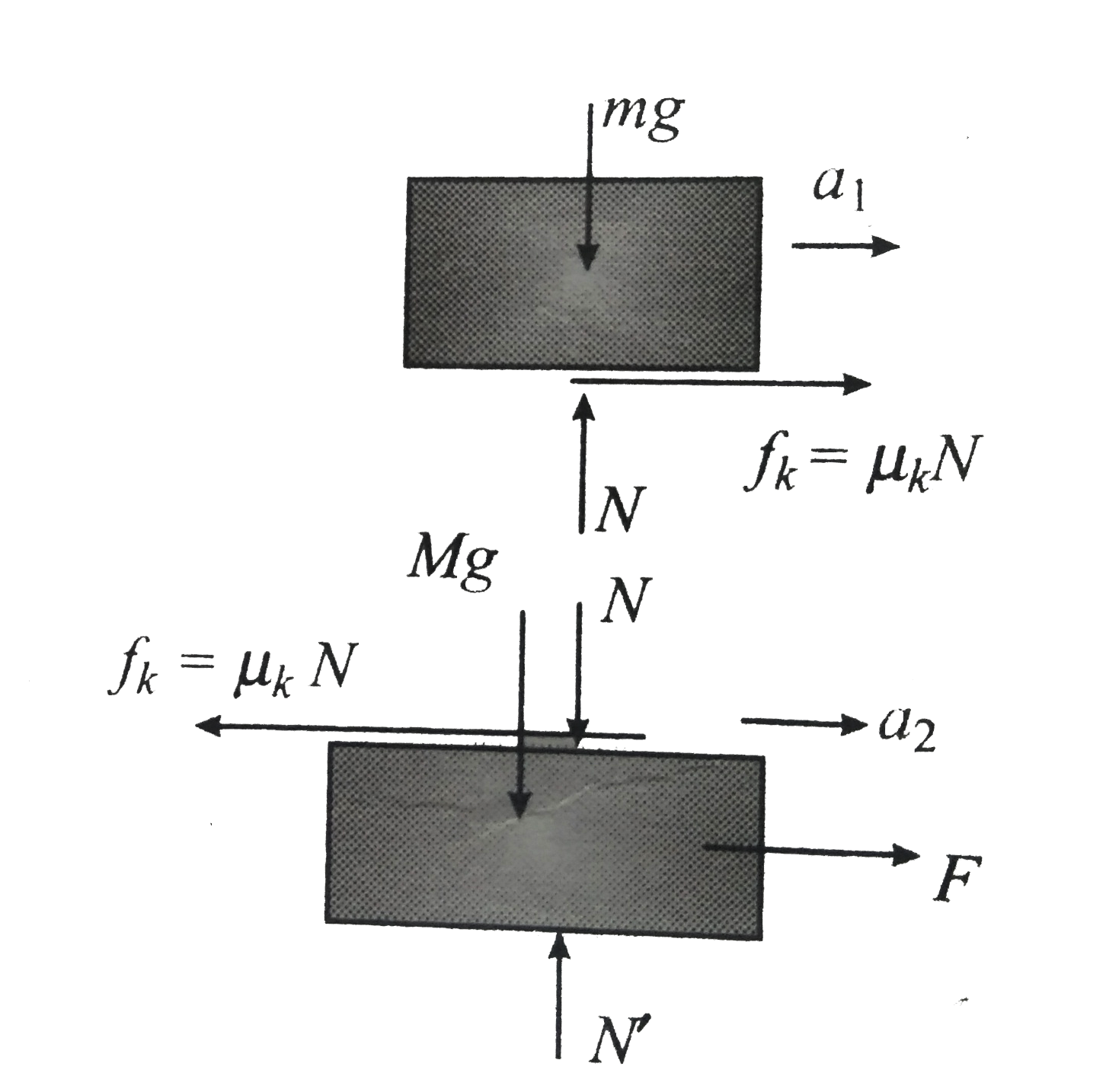
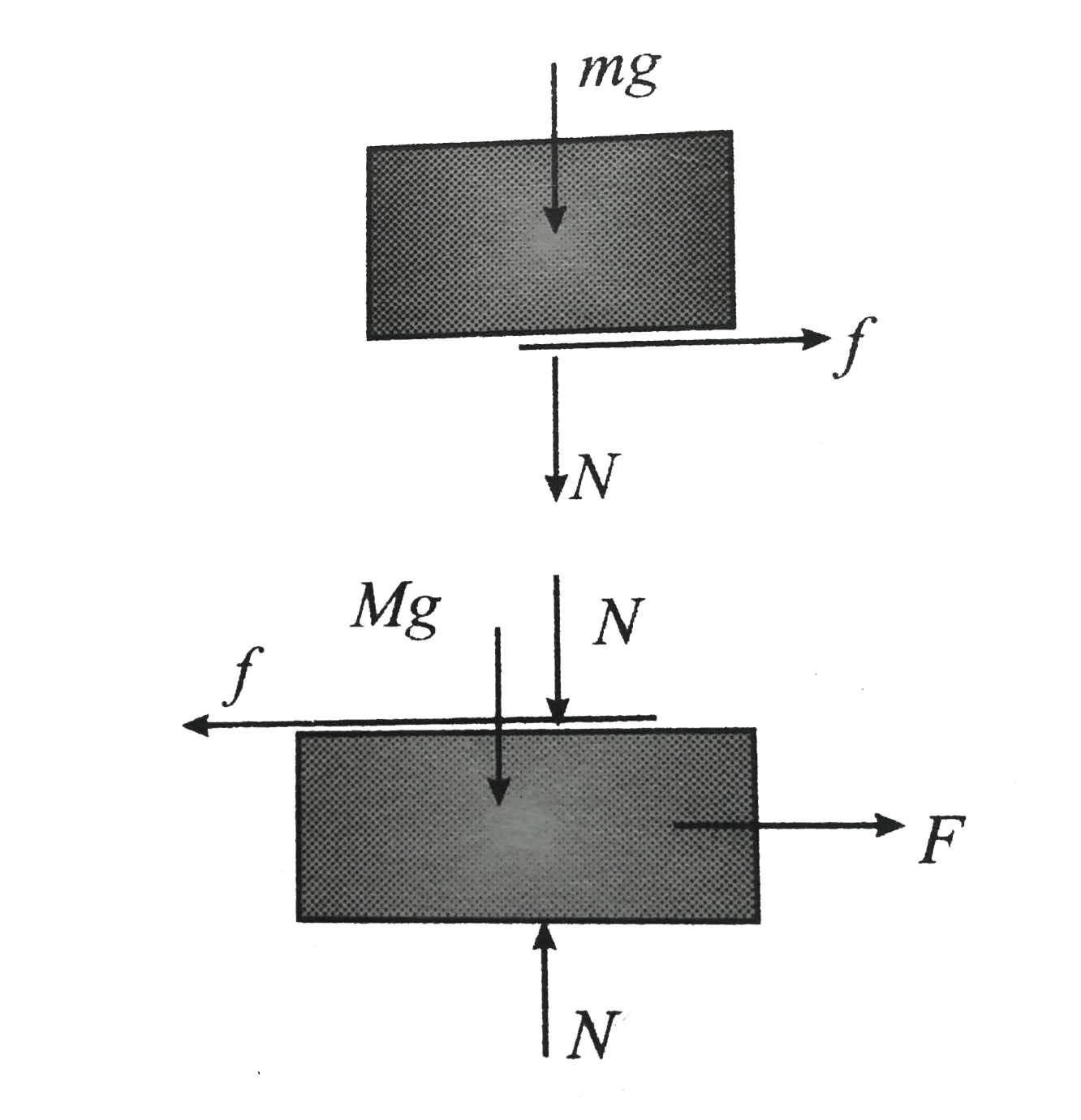
`FBD` of `m` and `M`
Equation of motion of `m`
` f = ma = m (F)/((M + m))` ...(ii)
If there is no sliding between `M` and `m` , then `f le f_(s - max)`
`rArr (mF)/((M + m)) le mu_(s)(mg)`
`rArr F le mu_(s)(m)g`
b. If `F gt mu_(s)(M + m)g`, then there will be relative sliding between `M` and `m` . when relative sliding between `M` and `m` static
The friction force reaches limiting value the friction for because `f_(k) = mu_(k)N`
Free - body diagrams of `m` and `M` .
Equation of motion of `m : mu_(k)(mg) = ma_(1)`
Acceleration of `m , a_(1) = mu_(k)g`
Equation of motion of `M: F - mu_(k) mg = Ma_(2)`
Acceleration of `M , a_(2) = (F - mu_(k) mg )/(M)`
Promotional Banner

Topper's Solved these Questions

  • NEWTON'S LAWS OF MOTION 2

    CENGAGE PHYSICS|Exercise Solved Examples|12 Videos
  • NEWTON'S LAWS OF MOTION 2

    CENGAGE PHYSICS|Exercise Exercise 7.1|25 Videos
  • NEWTON'S LAWS OF MOTION 1

    CENGAGE PHYSICS|Exercise Integer|5 Videos
  • PROPERTIES OF SOLIDS AND FLUIDS

    CENGAGE PHYSICS|Exercise INTEGER_TYPE|2 Videos

Similar Questions

Explore conceptually related problems

A bar of mass m is placed on a triangular block of mass M as shown in figure The friction coefficient between the two surface is mu and ground is smooth find the minimum and maximum horizontal force F required to be applied on block so that the bar will not slip on the inclined surface of block

Consider the situation shown in the figure . The coefficient of friction between the blocks is mu . Find the minimum and the maximum force F that can be applied so that two blocks move together.

A system of two blocks is shown in figure. Friction coefficient between 5 kg and 10 kg block is mu=0.6 and between 10 kg and ground is mu=0.4 What will be the maximum value of force F applied at the lower block so that 5 kg block does not slip w.r.t. 10 kg . (g=10m//sec^(2)). The force applied at the upper block is having fixed magnitude of 80 N (both forces start to act simultaneously)

A block of mass m is placed on another block of mass M lying on a smooth horizontal surface as shown in the figure. The co-efficient of friction between the blocks is mu . Find the maximum horizontal force F (in Newton) that can be applied to the block M so that the blocks together with same acceleration? (M=3kg, m=2kg, mu=0.1, g=10m//s^(2))

A block is kept on a rough horizontal surface as shown. Its mass is 2 kg and coefficient of friction between block and surface (mu)=0.5. A horizontal force F is acting on the block. When

In the arrangement shown in figure, m_A = m_B = 2kg. String is massless and pulley is frictionless. Block B is resting on a smooth horizontal surface, while friction coefficient beteen block A and B is mu=0.5 . the Maximum horizontal force F that can be applied so that block A does not slip over block B is.

Two blocks of mass 2kg and 1kg are at rest on a smooth surface as shown. There is friction between 2kg and 1kg block with mu = 0.5 . Find maximum force to be applied on 1 kg for the two blocks to move together.

Two blocks A and B of masses m_(A) = 1kg and m_(B) = 3kg are kept on the table as shown in figure. The coefficient of friction between A and B is 0.2 and between B and the surface of the table is also 0.2. The maximum force F that can be applied on B horizontally, so that the block A does not slide over the block B is ________ (in N): [Take g = 10 m//s^(2) ]

Three blocks of masses 5 kg, 3 kg and 2 kg are placed on a rough surface as shown in figure. Coefficient of friction between block and surface is same for all the blocks and is equal to mu = 0.2 . A horizontal force of 15 N is applied on 5 kg block. The force exerted by 3 kg block on 2 kg block is : (g = 10 m/ s^(2) )

The coefficient of static friction between the two blocks shown in figure is mu and the table is smooth. What maximum horizontal forced F can be applied to he block of mass M so that the block move together?

