Home
Class 11
PHYSICS
Let as consider the next case in the pre...

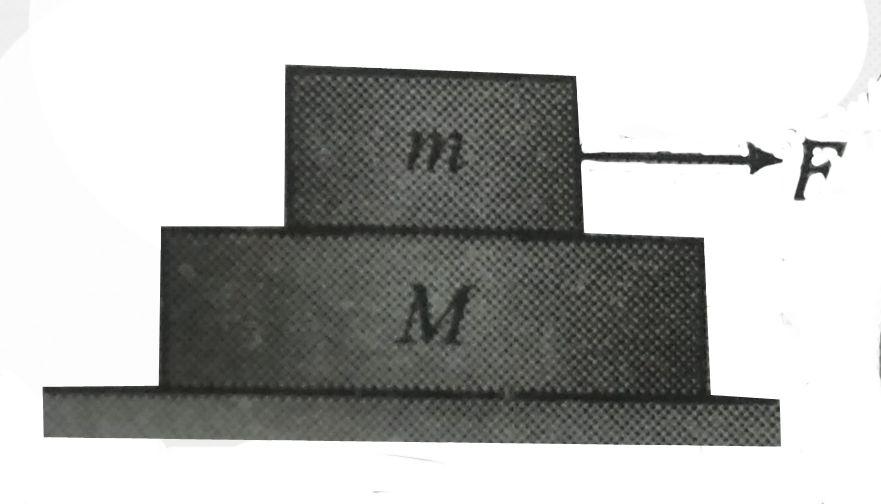
Let as consider the next case in the previous illustration when there is no friction between ground and `M` . The coefficient of static and kinetic friction are `mu_(2)` and `mu_(1)`, respectively, and force `F` acts upper block as shown in figure
a. What is the maximum possible value of `F` so that the system moves together ?
b . If there is releative sliding between `M` and `m` then calculate acceleration of `M` and `m`

Text Solution

Verified by Experts

Let the system move together , then `a = (F)/((M + m))`
`FBD` of `m` and `M`
From `FBD` of `M : f = ma = M((F)/(M + m))` ….(i)
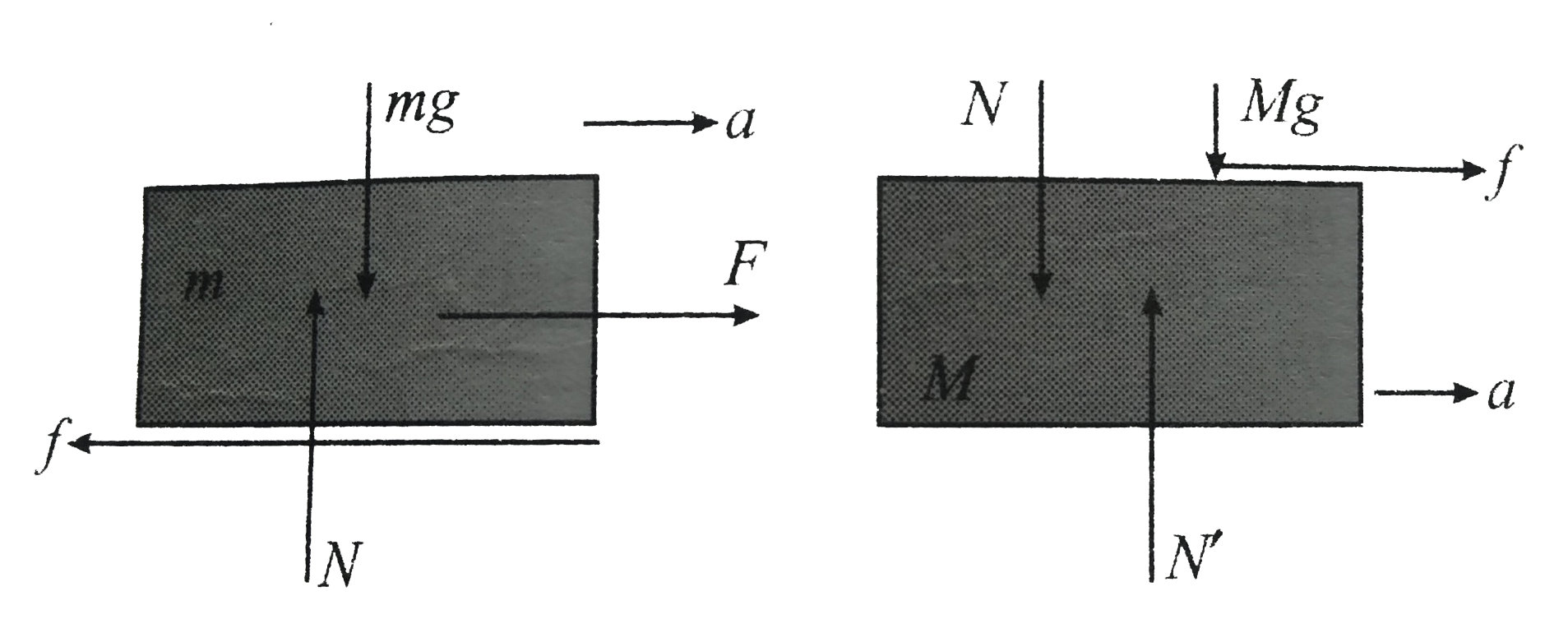
As there is no sliding between `M` and `m`
` M((F)/(M + m))le mu_(s) mg`
`rArr F le mu_(s)(m)/(M)(M + m)g`
If `F gt mu_(s)(m)/(M)(M + m)g` the relative sliding between the blocks starts . The friction force between the block will be of kinetic nature and both blocks will move with different accelerations.
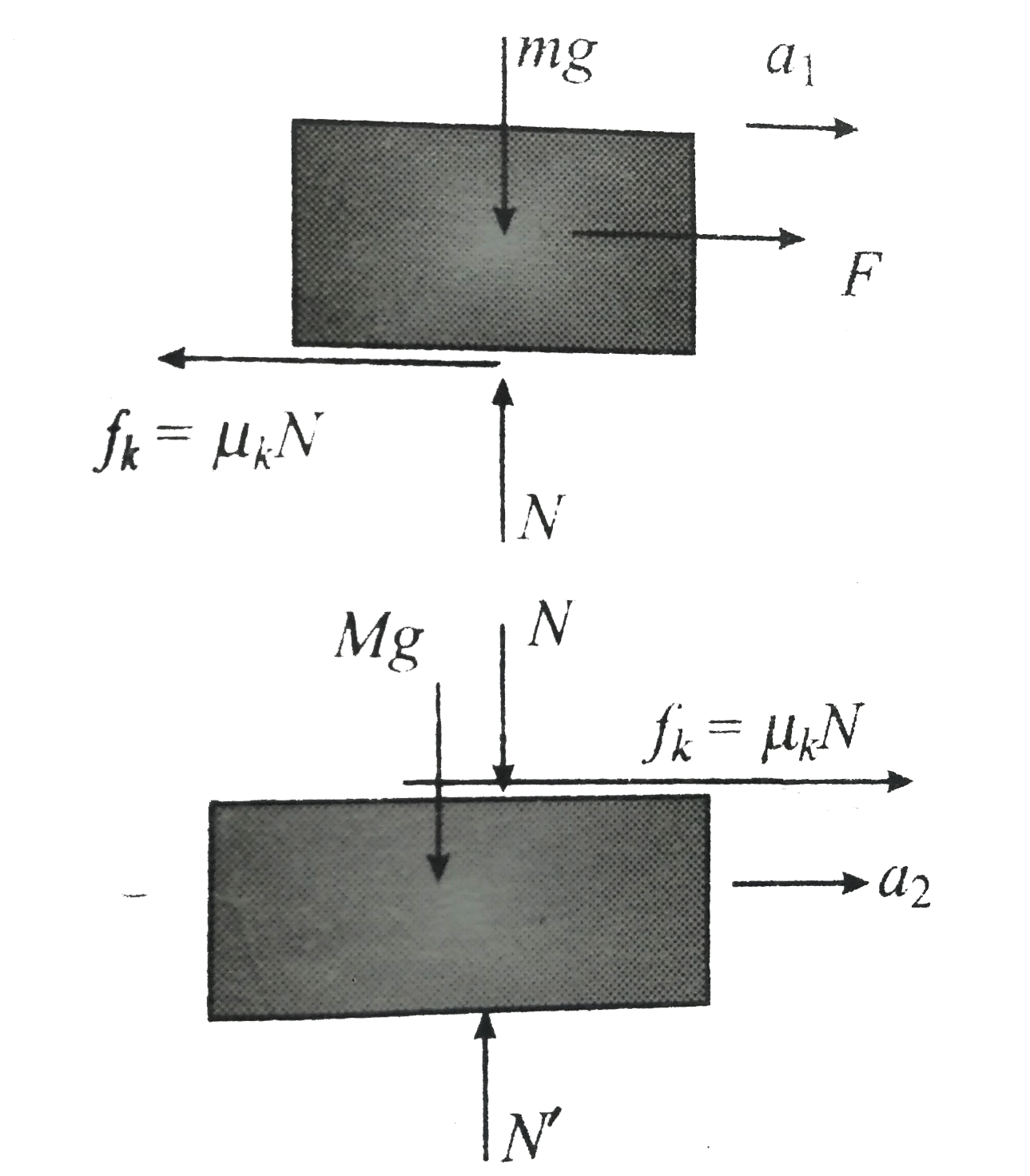
Acceleration of `m. a_(1) = (F - mu_(s) mg)/(m)`
Acceleration of `M, a_(2) = (mu_(s) mg)/(M)`
Promotional Banner

Topper's Solved these Questions

  • NEWTON'S LAWS OF MOTION 2

    CENGAGE PHYSICS|Exercise Solved Examples|12 Videos
  • NEWTON'S LAWS OF MOTION 2

    CENGAGE PHYSICS|Exercise Exercise 7.1|25 Videos
  • NEWTON'S LAWS OF MOTION 1

    CENGAGE PHYSICS|Exercise Integer|5 Videos
  • PROPERTIES OF SOLIDS AND FLUIDS

    CENGAGE PHYSICS|Exercise INTEGER_TYPE|2 Videos

Similar Questions

Explore conceptually related problems

Coefficient of kinetic friction and coefficient of static friction between two blocks is mu_(k) and mu_(s) respectively. In general

A block of mass M is sliding down the plane. Coefficient of static friction is mu_(s) and kinetic friction is mu_(k) . Then friction force acting on the block is :

The coefficient of static friction, mu_(s) between block A mass 2kg and the table as shown in the figure, is 0.2. What would be the maximum mass value of block B, so that the two blocks do not move ? The string and the pulley are asseumed to be smooth and massless ( g=10m//s^(2) )

The coefficient of static friction between the two blocks shown in figure is mu and the table is smooth. What maximum horizontal forced F can be applied to he block of mass M so that the block move together?

The coefficient of static friction between the block of 2 kg and the table shown in figurwe is mu_s=02. What should be the maximum value of m so tht the blocks do not move? Take g=10 m/s^2. The string and the pulley are light and smooth.

The coefficient of friction between the blocks are mu_(s) = 0.3 and mu_(k) = 0.2 . (a) Find the maximum value of F so that the blocks move together. (b) If force F is twice the value found in (a) , find the acceleration of each block.

The coefficient of static friction, mu_(s) between block A of mass 2 kg and the table as shown in the figure is 0.2. What would be the maximum mass value of block B so that the two blocks do not move? The string and the pulley are assumed to be smooth and massless. (g=10m//s^(2))

The coefficient of static friction mu_(s) between block A of mass 2kg and the table as shown in is 0.1 What would be the maximum mass value of blocks B so that the two bloks do not move ? The string and the pulley are assumed to be smooth and massless (g = 10m//s^(2)) .

