Home
Class 11
PHYSICS
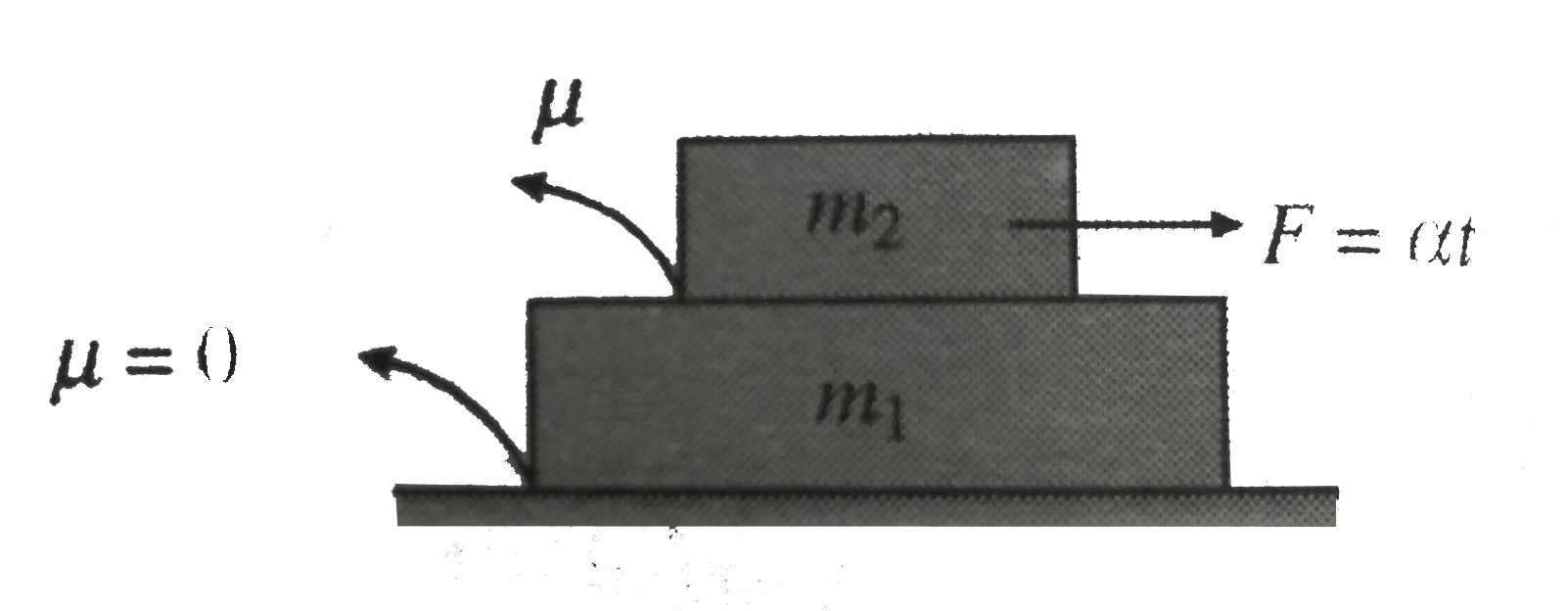
In the Fig force F = alpha t is applied...

In the Fig force `F = alpha t ` is applied on the block of mass `m_(2)`. Here `alpha` is a constant and `t` is the time .Find the acceleration of the block Also draw the acceleration time graph of both the block

Text Solution

Verified by Experts

If `F le mu (m_(2))/(m_(1))(m_(1) + m_(2)) g` , then both blocks will move togather (illustration 7.28)
Here , `1 le mu (m_(2))/(alpham_(1))(m_(1) + m_(2))g`
During this time, acceleration of both blocks
`a_(1) = a_(2) = (F)/((m_(1) + m_(2)))= (alpha t)/((m_(1) + m_(2)))`
If `t ge (mu m_(2))/(am_(1))(m_(1) + m_(2)) g` friction will be of kinetic nature

Free - body diagrams :
Acceleration of `m_(1) : a_(1) = (mu N)/(m_(1)) = (mu m_(2)g)/(m_(1))`
Acceleration of `m_(2) : a_(2) = (alpha t - mu m_(2)g)/(m_(2))`
Acceleration time graph for `m_(1)` :
`t_(0) =( mu m_(2))/(alpha m_(1))(m_(1) + (m_(2))g`
` a_(t_(0)) = (alpha t_(0))/(m_(1) + (m_(2)) = (mu m_(2) g)/(m_(2))`

Acceleration time graph for `m_(2)` Before time `t_(0)` . slope of the graph is `(alpha)/(m_(1) + (m_(2))` and after `t_(0)`slope of the graph becomes `alpha//m_(2)` .Slope increase after `t_(0)` hence the graph
Promotional Banner

Topper's Solved these Questions

  • NEWTON'S LAWS OF MOTION 2

    CENGAGE PHYSICS|Exercise Solved Examples|12 Videos
  • NEWTON'S LAWS OF MOTION 2

    CENGAGE PHYSICS|Exercise Exercise 7.1|25 Videos
  • NEWTON'S LAWS OF MOTION 1

    CENGAGE PHYSICS|Exercise Integer|5 Videos
  • PROPERTIES OF SOLIDS AND FLUIDS

    CENGAGE PHYSICS|Exercise INTEGER_TYPE|2 Videos

Similar Questions

Explore conceptually related problems

A constant force F = m_(2)g//2 is applied on the block of mass m_(1) as shown in fig. The string and the pulley are light and the surface of the table is smooth. The acceleration of m_(1) is :

Figure shows a block of mass 2m sliding on a block of mass m. Find the acceleration of each block . ( All surface are smooth )

A force F=75 N is applied on a block of mass 5 kg along the fixed smooth incline as as shown in the figure. Here gravitational acceleration g = 10 m s^(-2) . The acceleration of the block is

At t=0, a force F = kt is applied on a block of mass m making an angle alpha with the horizontal . Suppose surfaces to be smooth. Find the velocity of the body at the time of breaking off the plane.

A block is placed on a rough horizontal plane. A time dependent horizontal force F=K t acts on the block K is a postive constant. Accelration-time graph of the block is

In the arrangement shown in the fig. the block of mass m lies on the wedge. Wedge is moving with acceleration a = 5 m/sec Find the wedge acceleration of the block with respect to wedge.

In the arrangement shown in the fig. the block of mass m lies on the wedge. Wedge is moving with acceleration a = 5 m/sec . Find the wedge acceleration of the block with respect to wedge.

Three blocks with masses m , 2m and 3m are connected by strings, as shown in the figure. After an upward force F is applied on block m , the masses move upward at costant speed v . What is the net force on the block of mass 2m ? ( g is the acceleration due to gravity). ltBrgt

A block of unknown mass is at rest on a rough, horizontal surface. A horizontal force F is applied to the block. The graph in the figure shows the acceleration of the block with respect to the applied force. The mass of the block is

Two blocks are connected by a string that passes over a pulley of radius R and moment of inertia I . The block of mass m_(1) sides on a frictionless, horizontal surface, the block of mass m_(2) is suspended from the string. Find the acceleration a of the blocks and the tension T_(1) and T_(2) assuming that the string does not slip on the pulley.