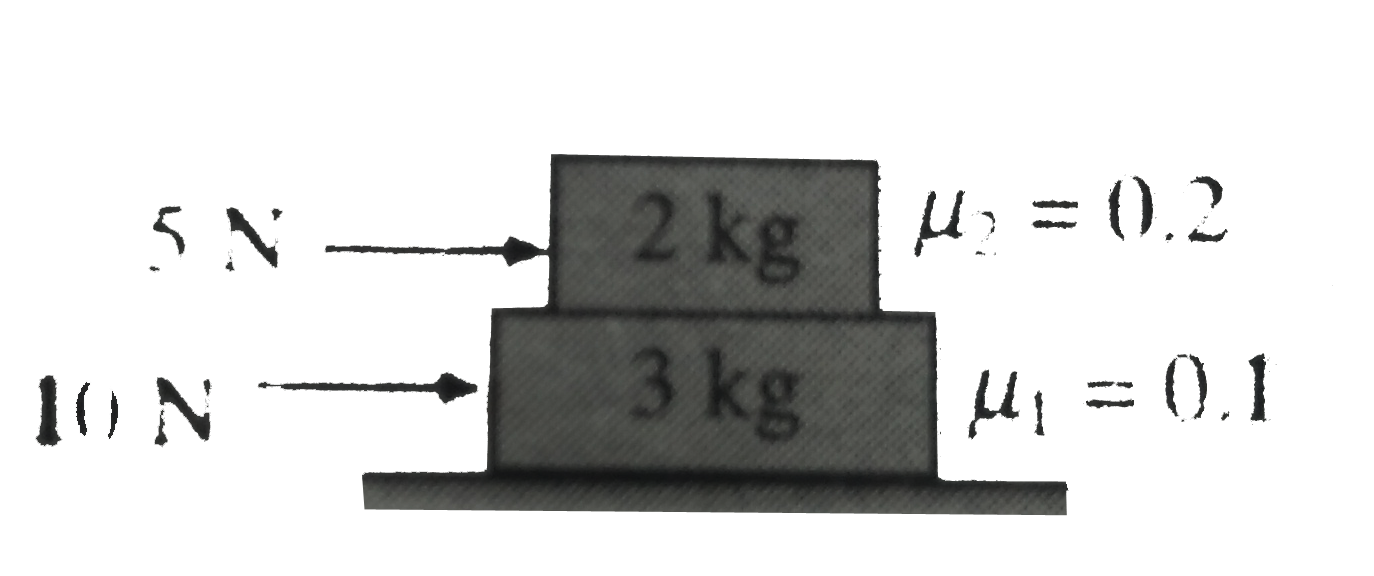
Let as first calculate the limiting and kinetic friction between varius surface between `3 kg` and ground
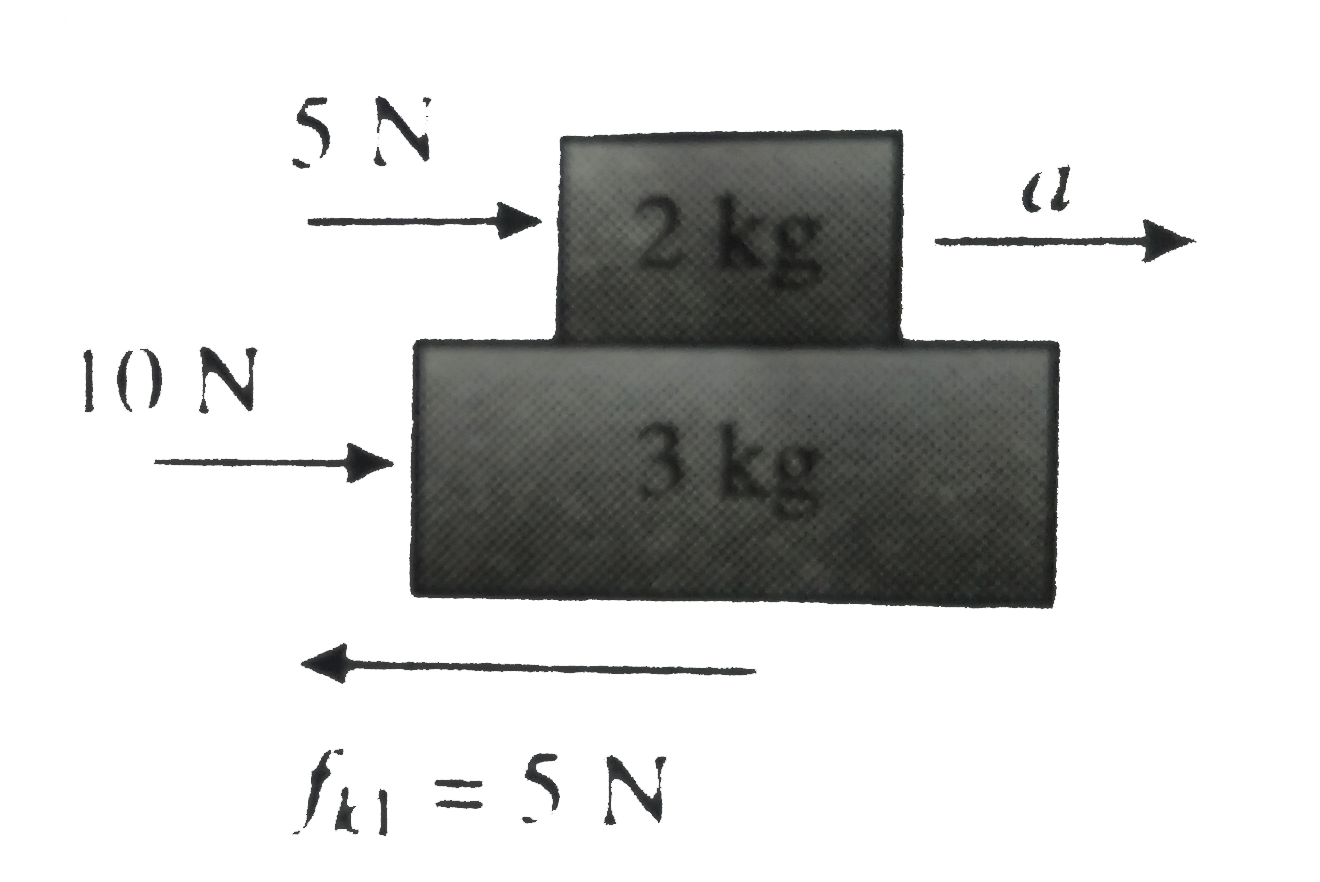
`f_(t_(1)) = f_(k_(1)) = mu_(1) (2 + 3) g = 0.1 xx 5 kg = 5 N`
Between `2 kg` and `3 kg`
` f_(t_(2)) = f_(k_(2)) = mu_(2)2g = 0.2 xx 2 kg = 4 N`
Let us first assume that both block move together with common acceleratia a.
`a = (5 + 10 - f_(k_(1)))/(2 + 3) rArr a = (15 - 5)/(5) = 2ms^(-2)`
Now let us see how much friction is required between 2 and `3 kg` for common acceleration a
`5 - f_(2) = 2a rArr 5 - f_(2) = 2 xx 2 rArr f_(2) = 1 N`
Since `f_(2) lt f_(t_(2))`
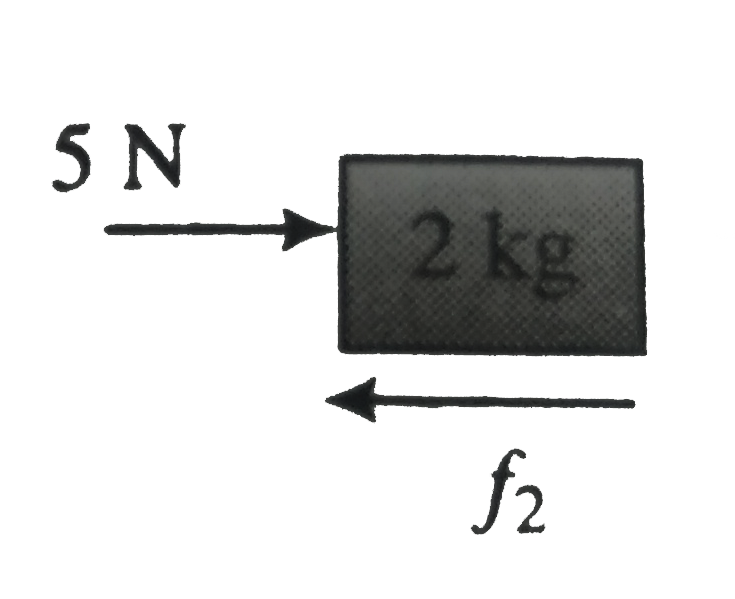
1. Both blocks will move together with common acceleration `a = 2 ms^(-2)`
Friction between `2 kg` and `3 kg = f_(2) = 1 N` friction between `3 kg` and ground `= f_(k_(1) = 5 N`