Home
Class 11
PHYSICS
The pulley of the system shown in Fig i...

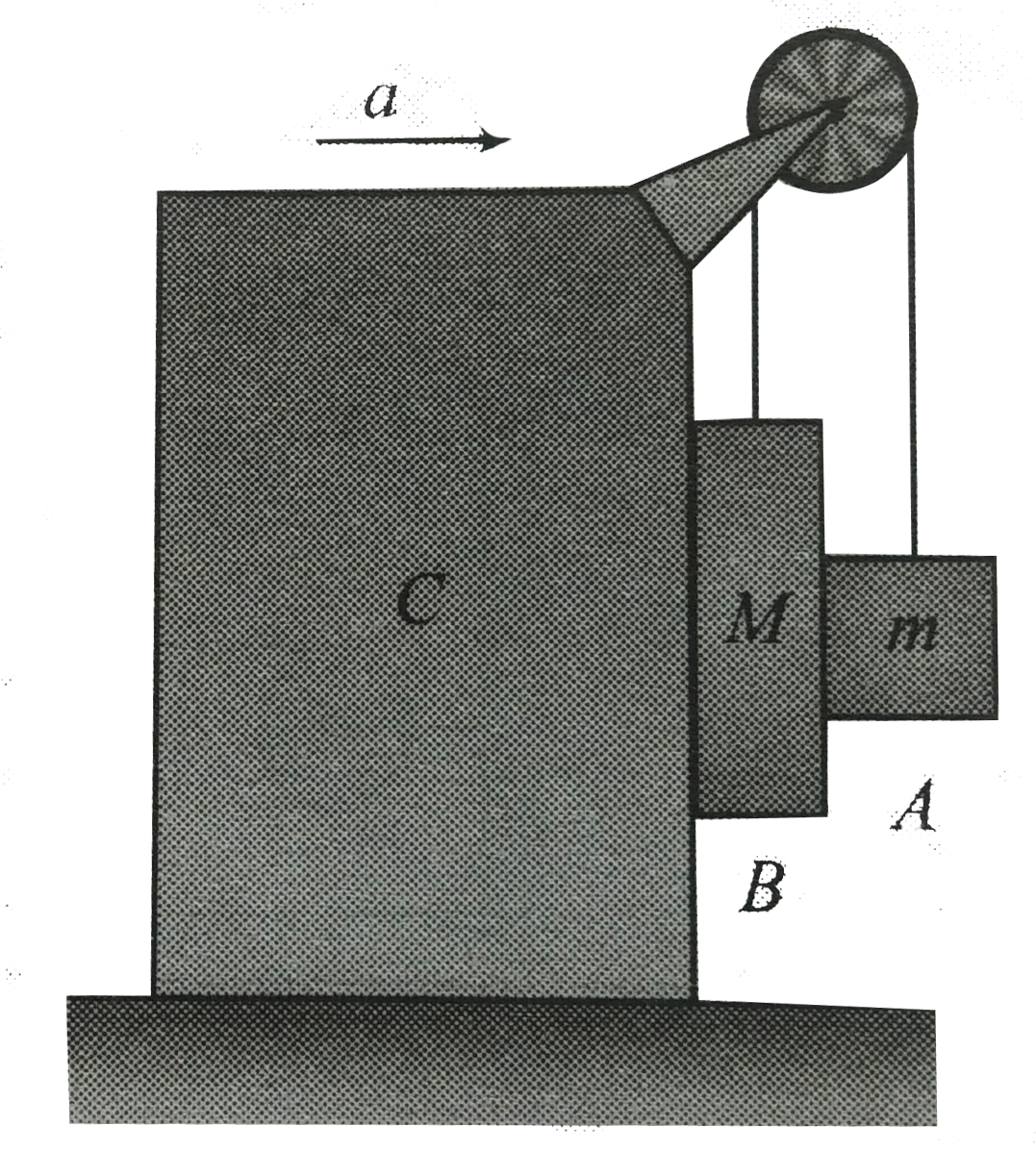
The pulley of the system shown in Fig is massless and frictionless and thread and thread is inextensible Then horizontal surface over which block `C` is smooth while for all the remaining surface is `mu`

Calculate minimum acceleration a with which the system should be moved to the right so that suspented block `A`(mass m ) and `B` (mass `M` and `M gt m )`can remain stationary relative to `C `

Text Solution

Verified by Experts

Since blocks `A and B` are stationary relative to `C` It means their acceleration will also be equal to a (rightward). Since mass `m` of block `A` is less than mass `M` of block `B` hence block `A` has tendency to slip upward while `B` has tendency to slip downward .
Since `A` has to slip upward therefore on its left surface will act downward and friction on both the surface of block `B` will act upward because it has tendency to slip downward hence , their free body diagram will be as shown in fig
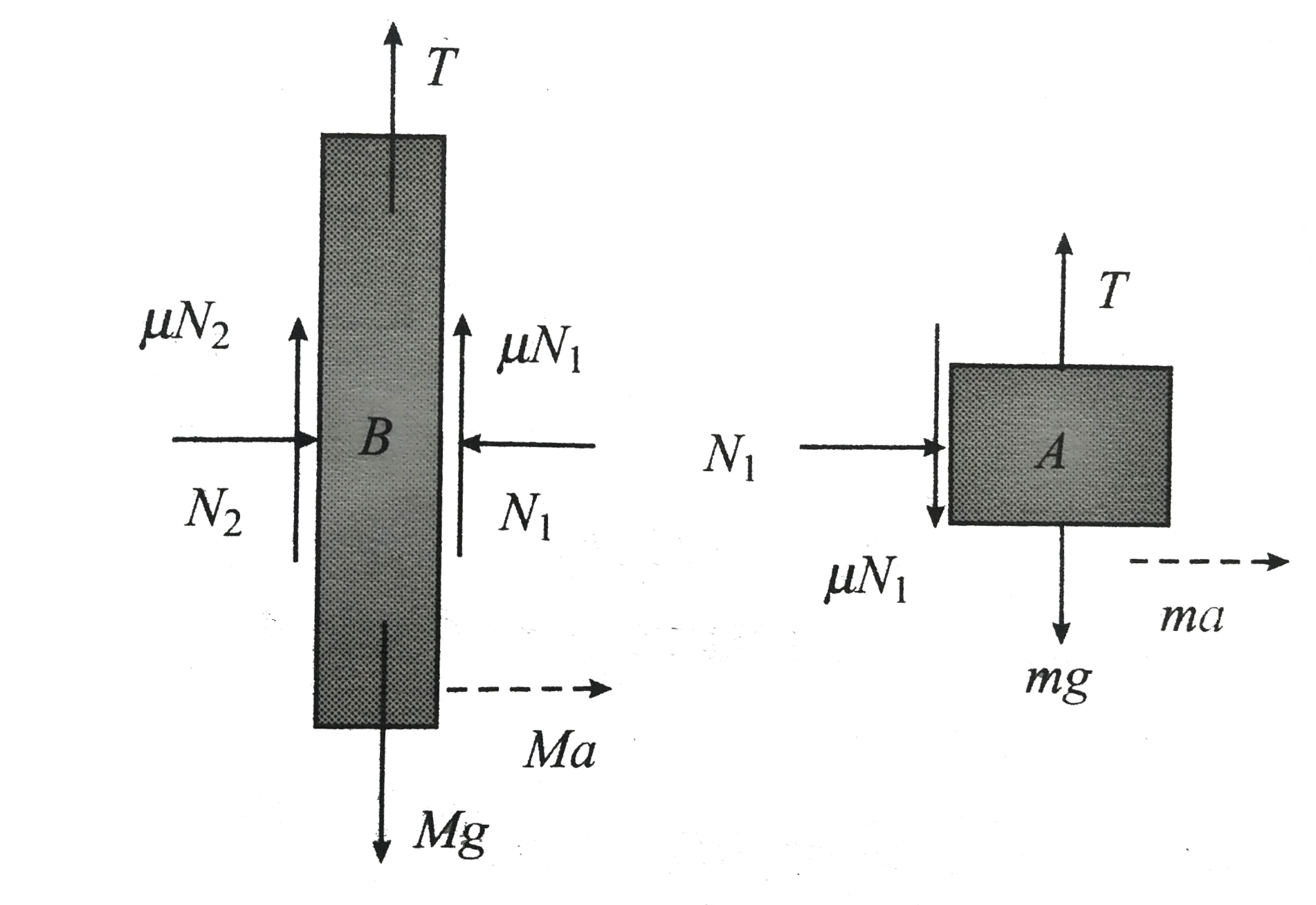
For horizontal forces on `A ,N_(1) = ma`
For verticle equillibruim of `A`,
`T = (mu N_(1) + mg ) = (mu ma + mg)` ....(i)
For horizontal forces on `B N_(2) - N_(1) = Ma`
or `N_(2)= (m + M)a`
For verticle equillibruim of `B`
`T + mu N_(1) + mu N_(2) = Mg`
`(mu ma + mg) + mu ma + mu(m + M)a= Mg`
`a = (M - m)/(mu(3m + M)).g`
Promotional Banner

Topper's Solved these Questions

  • NEWTON'S LAWS OF MOTION 2

    CENGAGE PHYSICS|Exercise Solved Examples|12 Videos
  • NEWTON'S LAWS OF MOTION 2

    CENGAGE PHYSICS|Exercise Exercise 7.1|25 Videos
  • NEWTON'S LAWS OF MOTION 1

    CENGAGE PHYSICS|Exercise Integer|5 Videos
  • PROPERTIES OF SOLIDS AND FLUIDS

    CENGAGE PHYSICS|Exercise INTEGER_TYPE|2 Videos

Similar Questions

Explore conceptually related problems

In the arrangement , shown below pulleys are massless and frictionless and threads are inextensible , block of mass m_(1) will remain at rest if

In the arrangement shown below pulleys are mass less and frictionless and threads are in responsible block of mass m_(1) will remain at rest if :

Pulleys shown in the system are massless and fricionless. Threads are inextensible. The mass of blocks A, B, and C are m_(1)=2kg, m_(2)=4kg , and (m_3)=2.75 kg , respectively. Calculate the acceleration of each block.

The upper surface of blokc C is horizontal and its right part is inclined to the horizontal at angle 37^(@) . The mass of blocks A and B are m_(1) = 1.4kg and m_(2)=5.5kg , respectively. Neglect friction and mass of the pulley. Calculate acceleration a with which block C should be moved to the right so that A and B can remain stationary relative to it.

Pulleys shown in the system of the figure are massless and friction less. Threads are inextensible. Mass of block A, B and C are m_(1) kg,m_(2) =4kg and m_(3) = 2.75kg , respectively .Calculate acceleration of A block

For the following system shown assume that pulley is frictionless, string is massless (m remains on M), Q. The acceleration of the block A is

In the arrangement shown in figure-2.124 pulley A and B are massless and the thread is inextensible. Mass of pulley C is equal to m. If friction in all the pulleys negligible, then :

