Home
Class 11
PHYSICS
A bar of mass m is placed on a triangula...

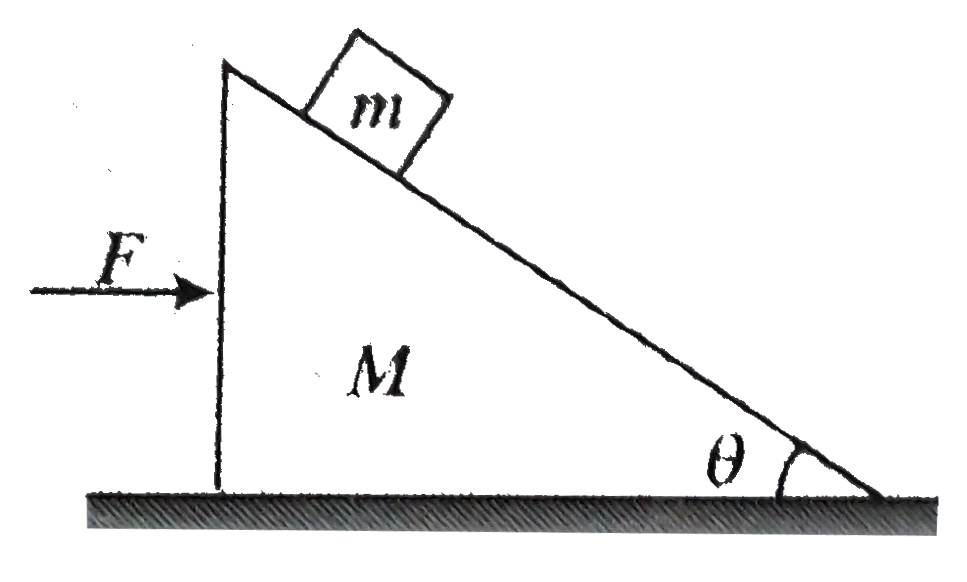
A bar of mass `m` is placed on a triangular block of mass `M` as shown in figure The friction coefficient between the two surface is `mu` and ground is smooth find the minimum and maximum horizontal force `F` required to be applied on block so that the bar will not slip on the inclined surface of block

Text Solution

Verified by Experts

Here if both the masses are moving together , accceleration of the system will be `a = F1 (M + m)` .If we observe the mass `m` relation to `M` . It experience a pseudo force out `ma` toward left . Along the incline it experience two forces `mg sin theta` downwards and `ma cos theta ` upward . If `mg sin theta `is morethen `ma cos theta `will act in upward direction here if block `m` is in equlibrium on inclined surface , we most have
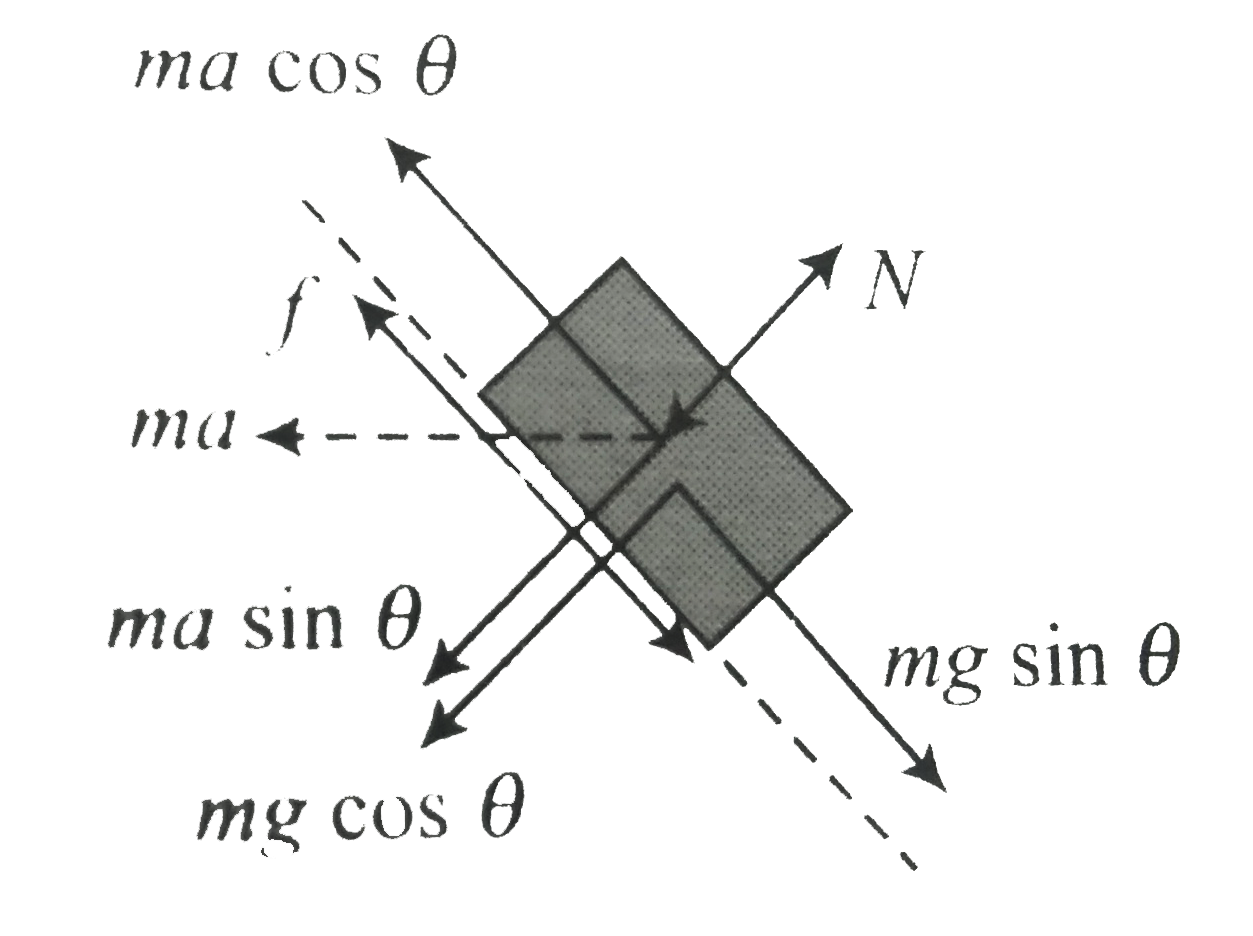
`f = mu N`,
Here `f = (mg sin theta - ma cos theta)`
and `N = (ma sin theta + mg cos theta)`
`f = mg sin theta - ma cos theta le mu (mg cos theta +ma sin theta)`
or `a ge (sin theta - mu cos theta )/(cos theta + mu sin theta )g`
or `(M + m) a ge (sin theta - mu cos theta )/(cos theta + mu sin theta )(M + m)g`
`F ge (sin theta - mu cos theta )/(cos theta + mu sin theta )(M + m)g`....(i)
If force is more than the value obtaional in Eq (i) `ma cos theta ` will increase on `m` and the static friction on it will derection At `a = g tan theta` (when `F = (M + m)g tan theta )` we know that the force `mg sin theta` will be balanced by `ma cos theta` at this acceleration no friction will act on it , if applied force will increase belond values , `ma cos theta ` will execed `mg sin theta ` and friction static in downward direction here if block `m` is in equation we must have `f = (ma cos theta - mg sin theta )N = (mg cos theta + ma sin theta )` and `f le mu N`
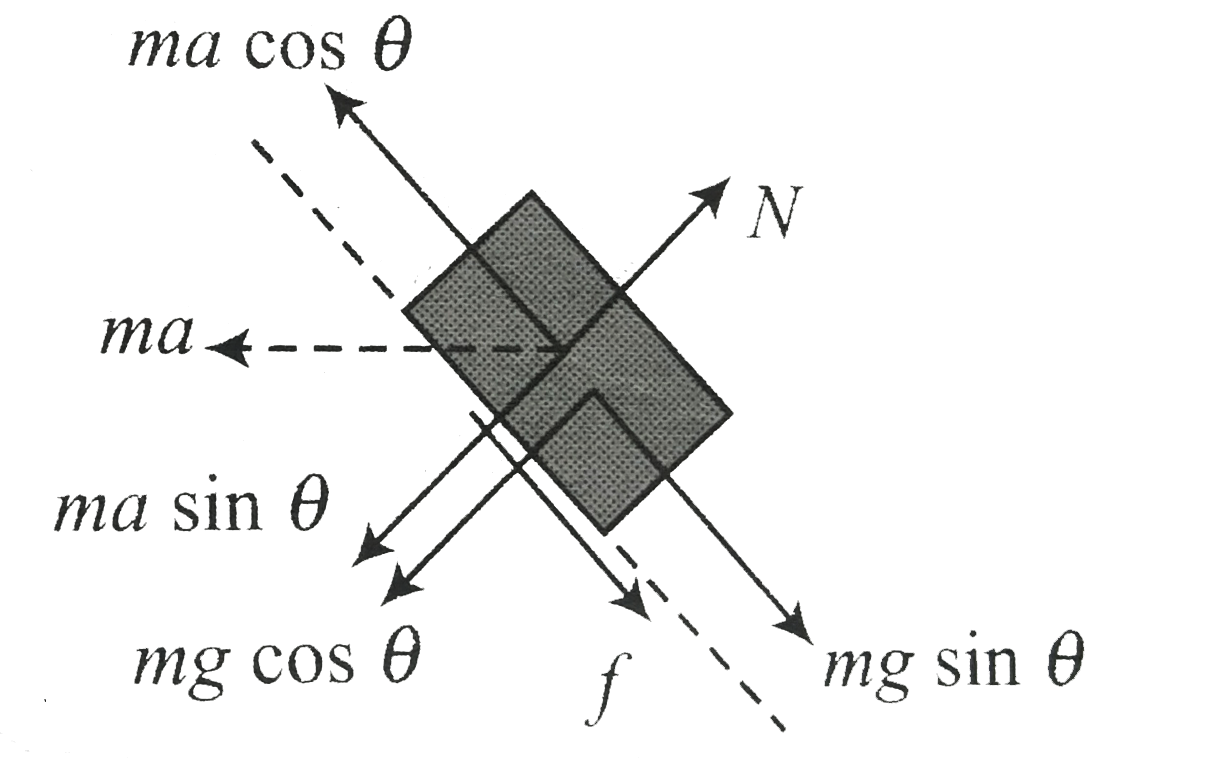
`ma cos theta - mg sin theta le mu(mg cos theta + ma sin theta )`
`rArr a le (sin theta + mu cos theta )/(cos theta - mu sin theta )g`
`rArr (M + m) a le (sin theta + mu cos theta )/(cos theta - mu sin theta) (M + m)g`
` rArr F le (sin theta + mu cos theta )/(cos theta - mu sin theta) (M + m)g`
Hence `F_(min) le (sin theta - mu cos theta )/(cos theta + mu sin theta) (M + m)g`
and `F_(max) le (sin theta + mu cos theta )/(cos theta - mu sin theta) (M + m)g`
Promotional Banner

Topper's Solved these Questions

  • NEWTON'S LAWS OF MOTION 2

    CENGAGE PHYSICS|Exercise Solved Examples|12 Videos
  • NEWTON'S LAWS OF MOTION 2

    CENGAGE PHYSICS|Exercise Exercise 7.1|25 Videos
  • NEWTON'S LAWS OF MOTION 1

    CENGAGE PHYSICS|Exercise Integer|5 Videos
  • PROPERTIES OF SOLIDS AND FLUIDS

    CENGAGE PHYSICS|Exercise INTEGER_TYPE|2 Videos

Similar Questions

Explore conceptually related problems

A block of mass m is placed on another block of mass M lying on a smooth horizontal surface as shown in the figure. The co-efficient of friction between the blocks is mu . Find the maximum horizontal force F (in Newton) that can be applied to the block M so that the blocks together with same acceleration? (M=3kg, m=2kg, mu=0.1, g=10m//s^(2))

The coefficient of static friction between the two blocks shown in figure is mu and the table is smooth. What maximum horizontal forced F can be applied to he block of mass M so that the block move together?

In the adjoining figure, the coefficient of friction between wedge (of mass M ) and block (of mass m ) is mu . Find the minimum horizontal force F required to keep the block stationary with respect to wedge.

There are two block as shown in the figure of masses 1kg and 4kg . Friction coefficient between any two surfaces are 0.2 then find maximum value of horizontal force F so that both blocks moves together.

In the adjoining figure, the coefficient of friction between wedge ( of mass M) and block ( of mass m) is mu . Find the minimum horizontal force F rquired to keep the block stationary with respect to wedge

A block of mass m is pulled by a force of constant power P placed on a rough horizontal plane. The friction coefficient between the block and the surface is mu . Then

Find the magnitude of the horizontal force F required to keep the block of mass m stationary on the smooth inclined plane as shown in the figure.

A block of mass m lies on wedge of mass Mas shown in figure. Find the minimum friction coeffcient required between wedge Mand ground so that it does not move while block m slips down on it.

Two blocks of Masses M and 2M are connected by a spring of stiffness k .The coefficient of friction between the blocks and the surface is mu Find the minimum constant force F to be applied to 2m in order to slide the mass M .

