Home
Class 11
PHYSICS
A block of mass m is kept on the edge of...

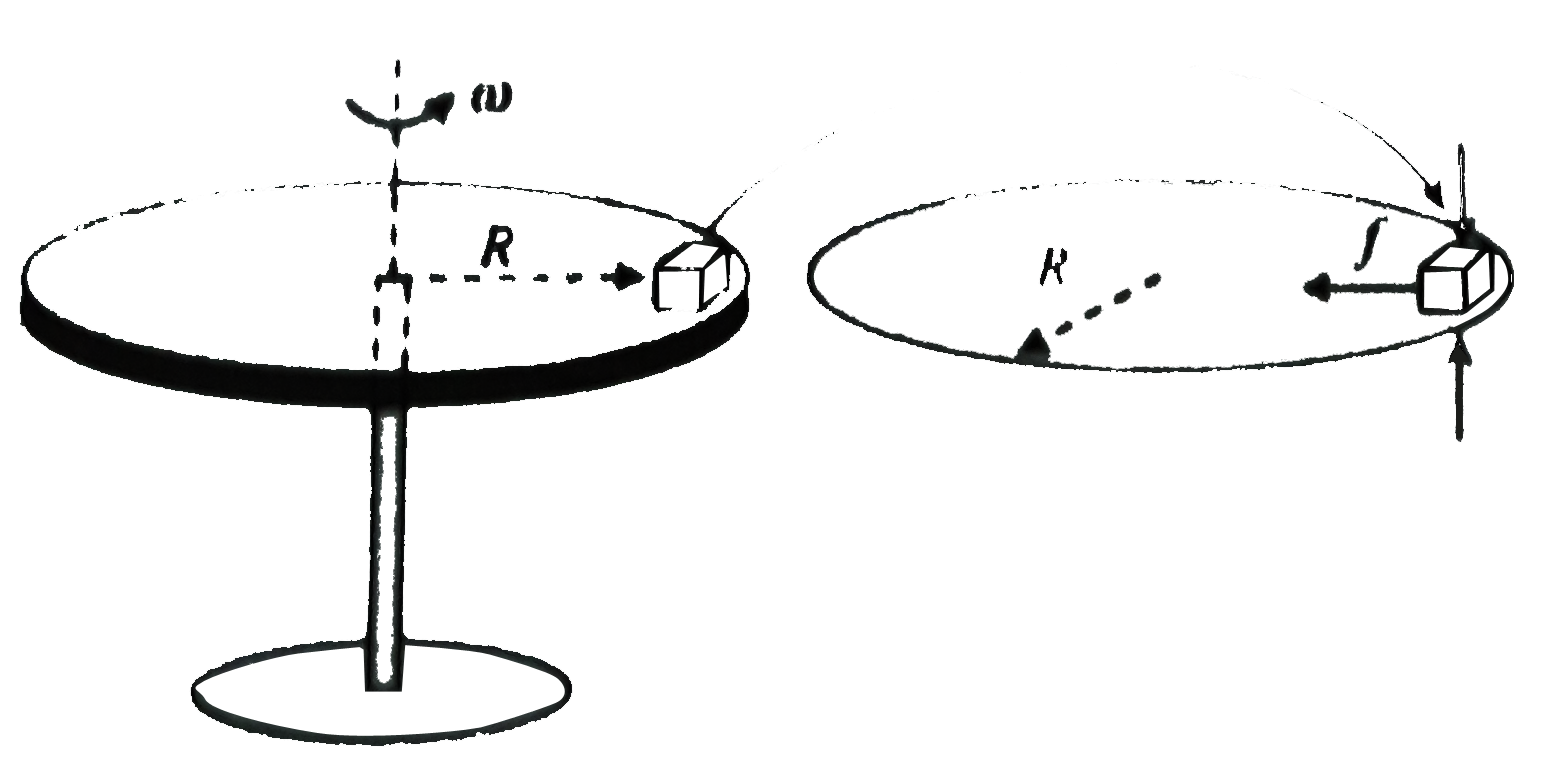
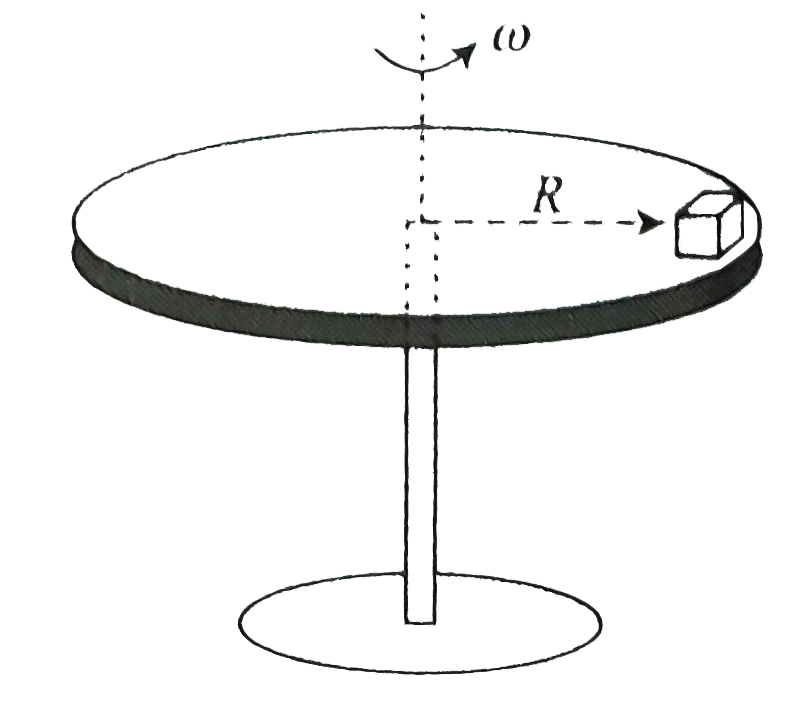
A block of mass `m` is kept on the edge of a horizontal turn table of radius `R` which is rotating with constant angular verticle `omega` (along with the block ) about its axis . If coefficient of friction is `mu`, find the friction force between block and table.

Text Solution

Verified by Experts

The block in Fig does not accelerate vertically. Therefore , we model it as a particle in equilibrum in the verticle direction if centripetal acceleration in the horizontal direction in this case centriprted is proveded by friction.
` sum F_(y) = N - mg = 0`...(i)
`N = mg`....(ii)
`sum F_(x) = f = ma_(c) = m omega^(2) R`
Friction force = centripental force ` = m omega^(2) R`
Promotional Banner

Topper's Solved these Questions

  • NEWTON'S LAWS OF MOTION 2

    CENGAGE PHYSICS|Exercise Solved Examples|12 Videos
  • NEWTON'S LAWS OF MOTION 2

    CENGAGE PHYSICS|Exercise Exercise 7.1|25 Videos
  • NEWTON'S LAWS OF MOTION 1

    CENGAGE PHYSICS|Exercise Integer|5 Videos
  • PROPERTIES OF SOLIDS AND FLUIDS

    CENGAGE PHYSICS|Exercise INTEGER_TYPE|2 Videos

Similar Questions

Explore conceptually related problems

If coefficient of friction between both the block is mu- (1)/(2) . Find friction force acting between both block.

A block of mass m is kept on a horizontal table. If the static friction coefficient is mu ., find the frictional force acting on the block.

There are two blocks of masses m_(1) and m_(2) , m_(1) is placed on m_(2) on a table which is rotating with an angular velocity omega about the vertical axis . The coefficent of friction between the block is mu_(1) and between m_(2) and table is mu_(2) (mu_(1) lt mu_(2)) if block are placed at distance R from the axis of ratation , for relative sliding between the surface in contact , find the a. friction force at the contacting surface b. maximum angular speed omega

A ring of radius R is rotating with an angular speed omega_0 about a horizontal axis. It is placed on a rough horizontal table. The coefficient of kinetic friction is mu_k . The time after it starts rolling is.

A block on table shown in is just on the edge of slipping Find the coefficient of static friction between the blocks and table .

A horizontal force of 20 N i sapplied to a block of mass 4 kg resting on a rough horiozontal table. If the blcok does not move on the table, how much fricrtional force the table is applying on the blockgt What can be said about the coefficient of static friction between the block and the table? Take g=m/s^2 .

A block 'A' of mass 2m is placed on another block 'B' of mass 4m which in turn is placed on a fixed table. The two blocks have a same length 4d and they are placed as shown in fig The coefficient of friction (both static and kinetic) between the block 'B' and table is mu . There is no friction between the two blocks. A small object of mass m moving horizontally along a line passing through the centre of mass (cm.) of the block B and perpendicular to its face with a speed v collides elastically with the block B at a height d above the table. (a) What is the minimum value of v(call it v_0 ) required to make the block A topple? (b) If v=2v_0 ,find the distance (from the point P in the figure ) at which the mass m falls on the table after collision. (Ignore the role of friction during the collision).

A block rests on a horizontal table which is executing SHM in the horizontal plane with an amplitude A. What will be the frequency of oscillation, the block will just start to slip? Coefficient of friction =mu .

