Home
Class 11
PHYSICS
A particle of mass m is moving with a co...

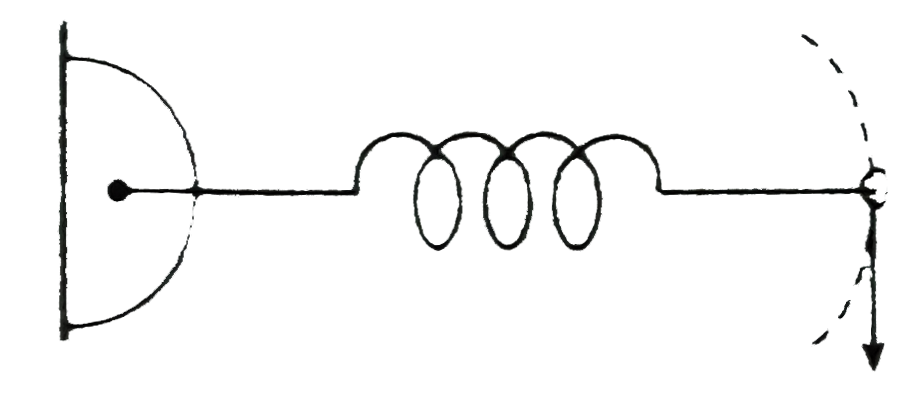
A particle of mass `m` is moving with a constant speed `v` in a circular path in a smooth horizontal plate (plan of the paper ) by a spring force as shown in figure If the natural length of the spring is `l_(0)` and stiffeness of the spring is `k` find the elongation of the spring

Text Solution

Verified by Experts

If the particle executes uniform circular motion , its speeds must be uniform because there is no tangential force to speed it up . Here the spring force `kt` acting on the particlein the centripetal force caused by the elongation `x` of the spring
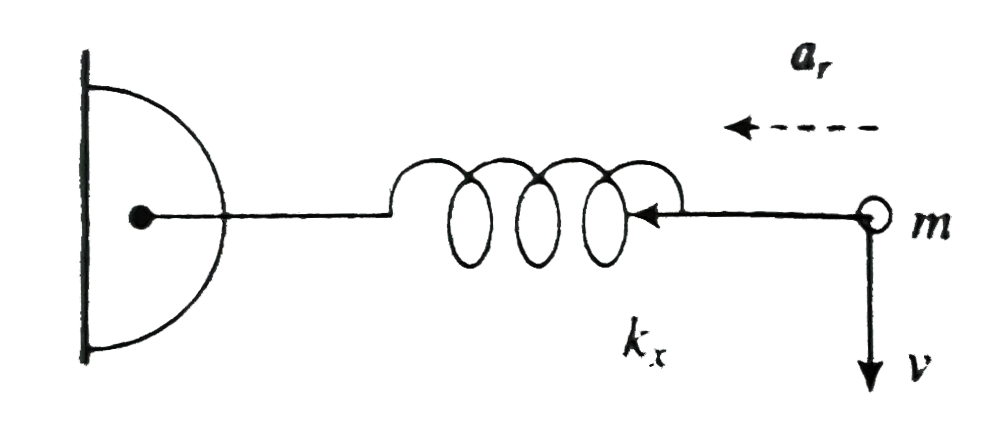
Equation of motion
`sum F_(r) = F_(SP) = ma_(r)`
But centripental acceleration
`a_(r) = (v^(2))/(R)` (where `R =` radius of circular path)
Radius os rotation `R = 1_(0) + x`
`|F_(SP)| = kx`
Put in (i)` kx = (mv^(2))/((1_(0) + x)) rArr kx^(2) + kl_(0) x - mv^(2) = 0`
This given `x = (sqrt(k^(2)1_(0)^(2) + 4 mv^(2) k - kl_(0)))/(2k)`
Promotional Banner

Topper's Solved these Questions

  • NEWTON'S LAWS OF MOTION 2

    CENGAGE PHYSICS|Exercise Solved Examples|12 Videos
  • NEWTON'S LAWS OF MOTION 2

    CENGAGE PHYSICS|Exercise Exercise 7.1|25 Videos
  • NEWTON'S LAWS OF MOTION 1

    CENGAGE PHYSICS|Exercise Integer|5 Videos
  • PROPERTIES OF SOLIDS AND FLUIDS

    CENGAGE PHYSICS|Exercise INTEGER_TYPE|2 Videos

Similar Questions

Explore conceptually related problems

Block of mass 2 m is given v_(0) towards the right. If L is the natural length of spring constant k , find the maximum elongation of the spring.

The block of mass m is released when the spring was in its natrual length. Spring constant is k. Find the maximum elongation of the spring.

A block of mass m is moving with a speed v on a horizontal rought surface and collides with a horizontal monted spring of spring constant k as shown in the figure .The coefficient of friction between the block and the floor is mu The maximum cobnpression of the spring is

If the system is suspended by the mass m the length of the spring is l_(1) . If it is inverted and hung by mass M, the length of the spring is l_(2) . Find the natural length of the spring.

A body of mass m hangs by an inextensible string that passes over a smooth mass less pulley that is fitted with a light spring of stiffness k as shown in figure. If the body is released from rest and the spring is released, calculate the maximum elongation of the spring.

A rod mass (M) hinged at (O) is kept in equilibrium with a spring of stiffness (k) as shown in figure. The potential energy stored in the spring is .

A system of wedge and block as shown in figure, is released with the spring in its natural length. All surfaces are frictionless. Maximum elongation in the spring will be .

The system of the wedge and the block connected by a massless spring as shown in the figure is released with the spring in its natural length. Friction is absent. Maximum elongation in the spring will be

A block of mass m held touching the upper end of a light spring of force constant K as shown in figure. Find the maximum potential energy stored in the spring if the block is released suddenly on the spring.

