a. `theta = ("Arc length")/("Radius") = (L)/(R )`

From free body diagram at top position equation of motion is `mg - N = (mv^(2))/(R )`
` rArr N = mg - (mv^(2))/(r )`
If the constant at highest point does not loose .
` N gt 0, mg gt (mv^(2))/(R )`
`v^(2) lt g R rArr v lt sqrt(g R)`
b. If the velocity of motorcyclist `v'^(1) = (1)/(sqrt2) v sqrt(gR)/(sqrt(2))`
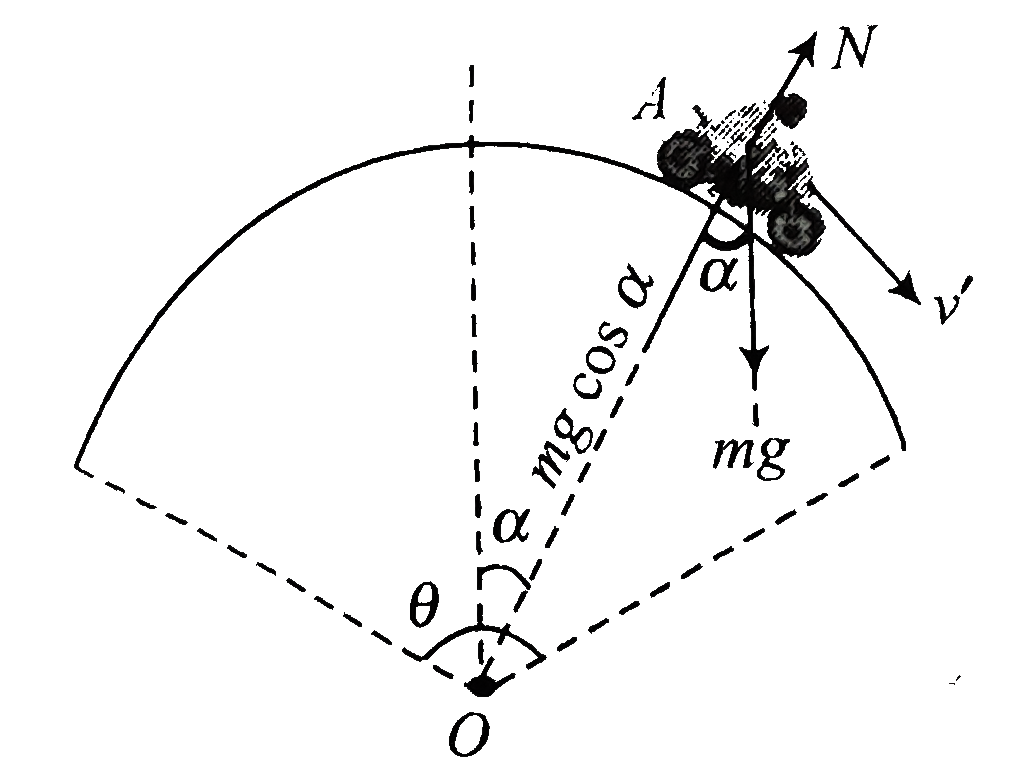
At position `A`
`mg cos alpha- N' = (mv'^(2))/(R )`
` rArr = mg cos alpha - (mg)/(2) (sqrt((gR)/(2)))^(2)`
`N' = mg cos alpha - (mgR)/(2R) = mg cos alpha - (mg)/(2)`
If he does not loose contact with road `N'gt 0`
`mg cos alpha - (mg)/(2) gt 0 rArr cos alpha gt (1)/(2) rArr alpha lt (pi)/(3)`
Hence are length `l' = (R pi)/(3)` from top.
c. The equation of motion of motorcyclist in the function of `alpha` measured from verticle,
`mg cos alpha - N^(")= (mv^(''2))/(R )`
The normal reaction will be minimum at the end of are Hence, critical position is at the end are , where
`alpha = (theta)/(2) = (L)/(2R)`
`mg cos ((L)/(2R)) - N^('') = (mv^('' 2))/(R )`
`rArr N^('') = mg cos ((OL)/(2R)) -(mv''^(2))/(R)`
If the motorcycle does not loose contact even at the end of are `N^('') gt 0`
`mg cos ((L)/(2R)) - (mv^(''2))/(R ) gt 0 `
`rArr g cos ((L)/(2R)) gt (v^(''2))/(R )`
`rArr v^('') lt sqrt( gR cos((L)/(2R)))`


