Home
Class 11
PHYSICS
Block B rests on a smooth surface . If t...

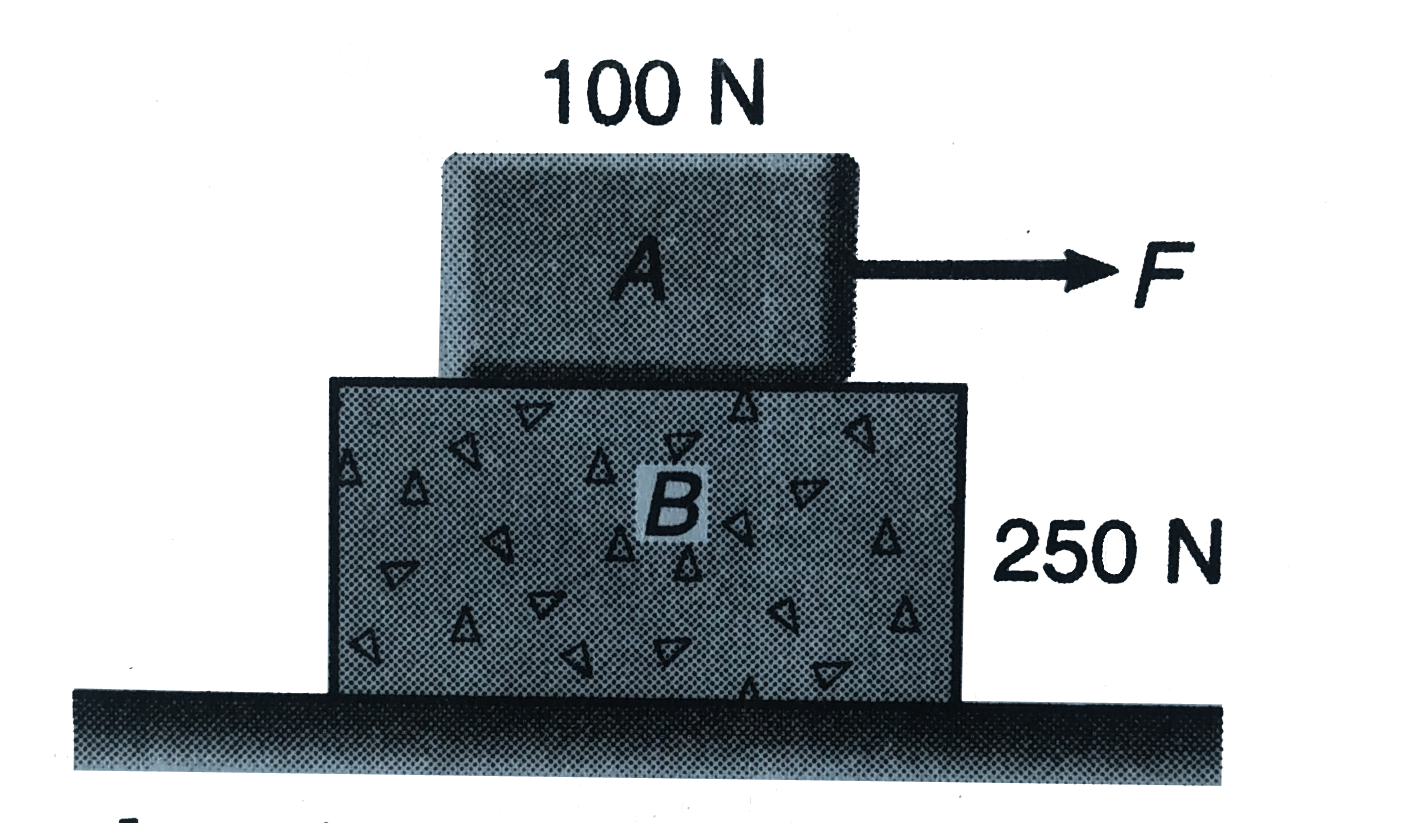
Block `B` rests on a smooth surface . If the coefficient of static friction between `A` and `B` is `mu = 0.4`. Determine the acceleration of each , if
(a) `F = 30 N` and
(b) `F = 250 N (g = 10 m//s^(2))`

A

`4//5 ms^(-2)`

B

`3//2 ms^(-2)`

C

`3//5 ms^(-2)`

D

`8//5 ms^(-2)`

Text Solution

Verified by Experts

The correct Answer is:

d

For upper block
`a_(max)= mg = 4ms^(-2)` and `f_(max) = 40 N`
a. when `F = 30N`,as `F ltf_(max)`
so both blocks will move togather
`:. A = (F)/(M +m) = (30)/(15)= (6)/(7)ms^(-2)`
b. when `F = 250 N`
For upper block: `250 - 40 = 10a_(1)`
`210 = 10a_(1) rArr a_(1) = 21ms^(-2)`
For block
`a_(2) = (40)/(25)= (8)/(5)ms^(-2)`
Promotional Banner

Topper's Solved these Questions

  • NEWTON'S LAWS OF MOTION 2

    CENGAGE PHYSICS|Exercise Linked Comprehension|52 Videos
  • NEWTON'S LAWS OF MOTION 2

    CENGAGE PHYSICS|Exercise Integer|6 Videos
  • NEWTON'S LAWS OF MOTION 2

    CENGAGE PHYSICS|Exercise Single Correct|87 Videos
  • NEWTON'S LAWS OF MOTION 1

    CENGAGE PHYSICS|Exercise Integer|5 Videos
  • PROPERTIES OF SOLIDS AND FLUIDS

    CENGAGE PHYSICS|Exercise INTEGER_TYPE|2 Videos

Similar Questions

Explore conceptually related problems

Block B rests on surface . If the coefficient of static friction between A and B is mu = 0.4 . Determine the acceleration of each , if (a) F = 30 N and (b) F = 250 N (g = 10 m//s^(2))

Block B rests on a smooth surface .The coefficient of static friction between A and B is mu = 0.4 where F = 30 N then Acceleration of lower block is

Block B rests on a smooth surface .The coefficient of static friction between A and B is mu = 0.4 where F = 30 N then Acceleration of upper block is

The coefficient of friction between the blocks is 0.5 . Find the acceleration of each block if F is (a) 21 N ,(b) 35 N and (c ) 40 N .

The friction coefficient between the blocks is 0.5 . Find the acceleration of each block if F is equal to (a) 5 N and (b) 20 N .

A block of mass 5 kg is (i) pushed in case (A) and (ii) pulled in case (B), by a force F = 20 N, making an angle of 30^(@) with the horizontal, as shown in the figures. The coefficient of friction between the block and floor is mu=0.2 . The difference between the accelerations of the block, in case (B) and case (A) will be: (g=10ms^(-2))

A force F accelerates a block of mass m on horizontal surface. The coefficient of friction between the contact surface is . The acceleration of m will be -

A block of mass 1 kg lies on a horizontal surface in a truck. The coefficient of static friction between the block and the surface is 0.6. If the acceleration of the truck is 5m//s^2 , the frictional force acting on the block is…………newtons.

A block of mass m = 1 kg is at rest on a rough horizontal surface having coefficient of static friction 0.2 and kinetic friction 0.15. Find the frictional forces if a horizontal force (a) F = 1 N, (b) F = 1.96 N and (c) F = 2.5 N are applied on a block which is at rest on the surface.

A block of mass m_(1) = 20 kg as placed on a wedge of mass m_(2)= 30 kg rest on a smooth flooras shpwn in Fig (a) . Friction exists between block and wedge. a. Find the acceleration of each block if (i) F = 180 N and (ii) F = 400 N b. Solve the problem if force F = 180 N is direction upwards as shown in Fig (b)
