Home
Class 11
PHYSICS
A block A of mass m is placed over a pla...

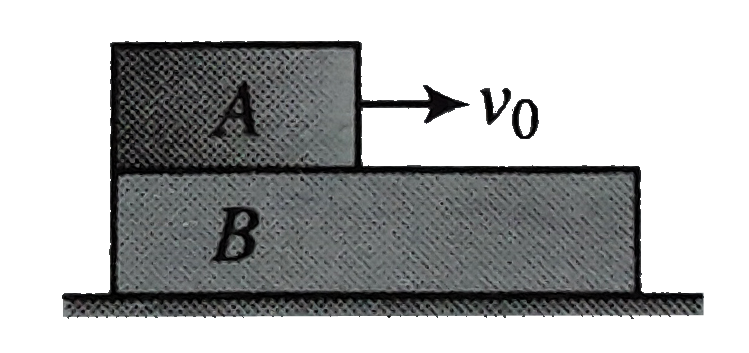
A block `A` of mass m is placed over a plank` B` of mass `2m` plank B is placed over a smooth horizontal surface .The coefficient of friction between `A` and B is `0.4` Block A is given a velocity `v_(0)` toward right Find acceleration (in `ms^(-2)` of `B` relative to `A`

Text Solution

Verified by Experts

The correct Answer is:

6

Force of friction between the two will be maximum i.e. `mu mg`
Retandation of A : `a_(A) = (mu mg)/(m)= mu g`M
and acceleration of B is `(mu mg)/(2m)= (mu g)/(2)`
Acceleration of B relative to A is `a_(BA) = a_(A) + a_(B) = (3mu g)/(2)`
Substitating `mu = (1)/(2) , a_(BA)= (3g)/(4)`
Promotional Banner

Topper's Solved these Questions

  • NEWTON'S LAWS OF MOTION 2

    CENGAGE PHYSICS|Exercise True And False|4 Videos
  • NEWTON'S LAWS OF MOTION 2

    CENGAGE PHYSICS|Exercise Single correct answer type|13 Videos
  • NEWTON'S LAWS OF MOTION 2

    CENGAGE PHYSICS|Exercise Linked Comprehension|52 Videos
  • NEWTON'S LAWS OF MOTION 1

    CENGAGE PHYSICS|Exercise Integer|5 Videos
  • PROPERTIES OF SOLIDS AND FLUIDS

    CENGAGE PHYSICS|Exercise INTEGER_TYPE|2 Videos

Similar Questions

Explore conceptually related problems

A block A of mass m is over a plank B of mass 2m . Plank B si placed over a smooth horizontal surface. The coefficient of friction between A and B is (1)/(2) . Blocks A is given a velocity V_(0) towards right. Then

A block A of mass m is placed over a plank B of mass 2m. Plank B is placed over a smooth horizontal surface. The coefficient of friction between A and B is (1)/(2) block A is given a velocity v_(0) towards right. Accelration of B relative to A is

A block A of mass 2 kg is placed over smooth block B of mass 4 kg which is placed over a smooth horizontal floor The coefficient of friction between A and B is 0.4 when a horizontal forces of magnitude 10 N is applied on A the acceleration of block of A and B are

A block of mass m is placed gently onto a long plank of mass M moving with a velocity v_(0) on a smooth horizontal floor. If friction is present between M and m :

A block of mass m = 1 kg is placed over a plank Q of mass M = 6 kg, placed over a smooth horizontal surface as shown in figure. Block P is given a velocity v = 2 m//s^(2) to the right. If the coefficient of friction between P and Q is mu = 0.3 . Find the acceleration of Q relative to P.

Block of mass m rests on the plank B of mass 3m which is free to slide on a frictionless horizontal surface. The coefficient of friction between the block and plank is 0.2. If a horizontal force of magnitude 2 mg is applied to the plank B, the acceleration of A relative to the plank and relative to the ground respectively, are

A block A is placed over a long rough plank B same mass as shown below. The plank is placed over a smooth horizontal surface. At time t = 0 , block A is given a velocity v_(0) in horizontal direction. Let v_(1) and v_(2) be the velocity of A & B at time 't'. Then choose the correct graph between v_(1) or v_(2) and t.

A block A is placed over a long rough plank B of same mass shown below. The plank is placed over a smooth horizontal surface. At time t=0 , block A is given a velocity v_(o) in horizontal direction. Let v_(1) and v_(2) be the velocity of A & B at time 't' . Then choose the correct graph between v_(1) or v_(2) and t :

Block A of mass 2kg is placed over a block B of mass 8kg . The combination is placed on a rough horizontal surface. If g=10ms^(-2) , coefficient of friction between B and floor =0.5 , coefficient of friction between B and floor =0.5 , coefficient of friction between A and B=0.4 and a horizontal force of 10N is applied on 8kg block, then the force of friction between A and B is.
