Home
Class 11
PHYSICS
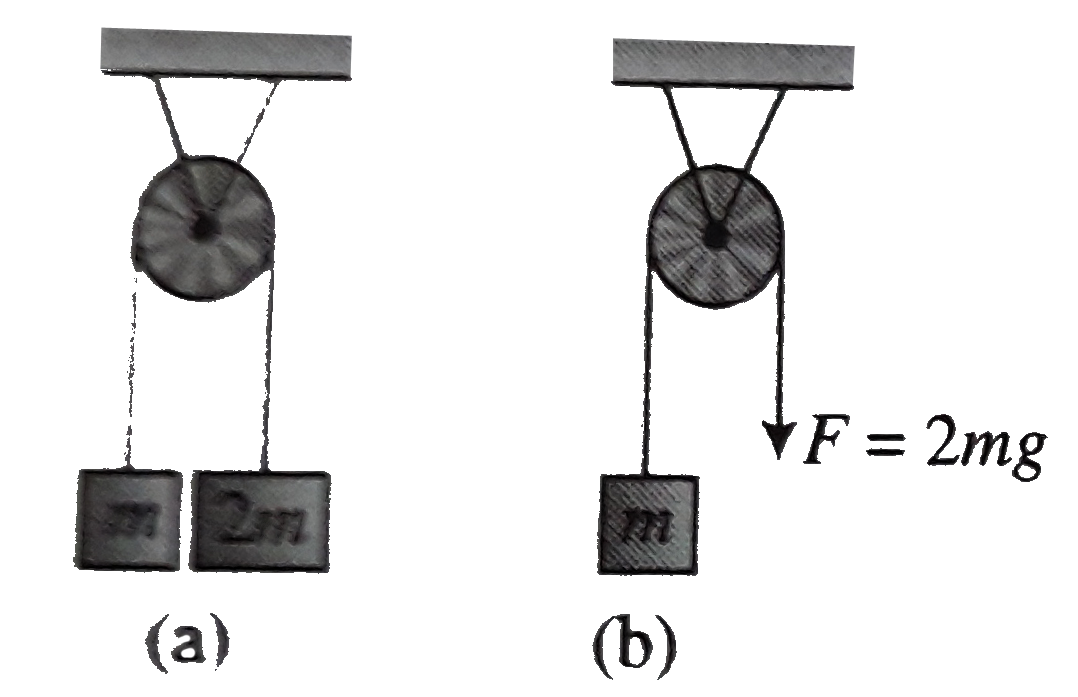
The pulley arrangement in Fig are identi...

The pulley arrangement in Fig are identical .The mass of the rope is negligble in figure the mass m is lifted up by atteched a mass `2m` to the other end of the rope . In (b), `m` is lifed up by pulley the other end of the rope with a constant in both cases

Text Solution

Verified by Experts

The correct Answer is:
False

For mass `m`
`T - mg = ma`….(i)
For mass `2m`
`2 mg - T - 2ma`….(ii)
From(i) and (ii) `a = g//3`
In second case` T- mg = ma'`
`2mg - mg = ma'`
`a' = g`
Promotional Banner

Topper's Solved these Questions

  • NEWTON'S LAWS OF MOTION 2

    CENGAGE PHYSICS|Exercise Single correct answer type|13 Videos
  • NEWTON'S LAWS OF MOTION 2

    CENGAGE PHYSICS|Exercise Multiple correct answer type|3 Videos
  • NEWTON'S LAWS OF MOTION 2

    CENGAGE PHYSICS|Exercise Integer|6 Videos
  • NEWTON'S LAWS OF MOTION 1

    CENGAGE PHYSICS|Exercise Integer|5 Videos
  • PROPERTIES OF SOLIDS AND FLUIDS

    CENGAGE PHYSICS|Exercise INTEGER_TYPE|2 Videos

Similar Questions

Explore conceptually related problems

The pulley arrangements of Figs. (a) and (b) are identical. The mass of the rope is negligible. In (a) the mass m is lifted up by attaching a mass 2m to the other end of the rope. In (b), m is lifted up by pulling the other end of the rope with a constant downward force F=2mg . The acceleration of m is the same in both cases

The pulley arrangements of fig (a) and (b) are identical. The mass of the rope is negligible. In (a) the mass m is lifted up by attaching a mass 2 m to the other end of the rope. In (b) m is lifted up by pulling the other end of the rope with a constant downward force F = 2 mg. Which of the following is correct?

In fig mass m is lifted up by attaching a mass 2m to the other end of the string while in fig (b) m is lifted by pulling the other end of the string with a constant force F=2mg then:

The pulley arrangements shown in figure are identical, the mass of the rope being negligible. In case I the mass m is lifted by attaching a mass 2m to the other end of rope with a constant downward force F =2mg , where g is acceleration due to gravity The acceleration of mass m in case I is .

Figure shown two pulley arrangments for lifting a mass m . In case-1, the mass is lifting by attaching a mass 2m while in case-2 the mass is lifted by pulling the other end with a downward force F=2mg . If a_(a) and a_(b) are the accelerations of the two masses then (Assumme string is massless and pulley is ideal).

A uniform rope of linear mass density lambda (kg/m) passes over a smooth pulley of negligible dimension. At one end B of the rope there is a small particle having mass one fifty of the rope. Initially the system is held at rest with length L of the rope on one side and length L/4 on the other side of the pulley (see fig). The external agent begins to pull the end A downward. Find the minimum work that the agent must perform so that the small particle will definitely reach the pulley.

A pulley-rope-mass arrangement is shown in fig. Find the acceleration of block m_(1) when the masses are set free to move. Assume that the pulley and the ropes are ideal.

A block of mass M is attached to the lower end of a vertical rope of mass m. An upward force P acts on the upper end of the rope. The system is free to move. The force exerted by the rope on the block is (PM)/(M+m)

