Home
Class 11
PHYSICS
A block of mass m height 2h and width 2...

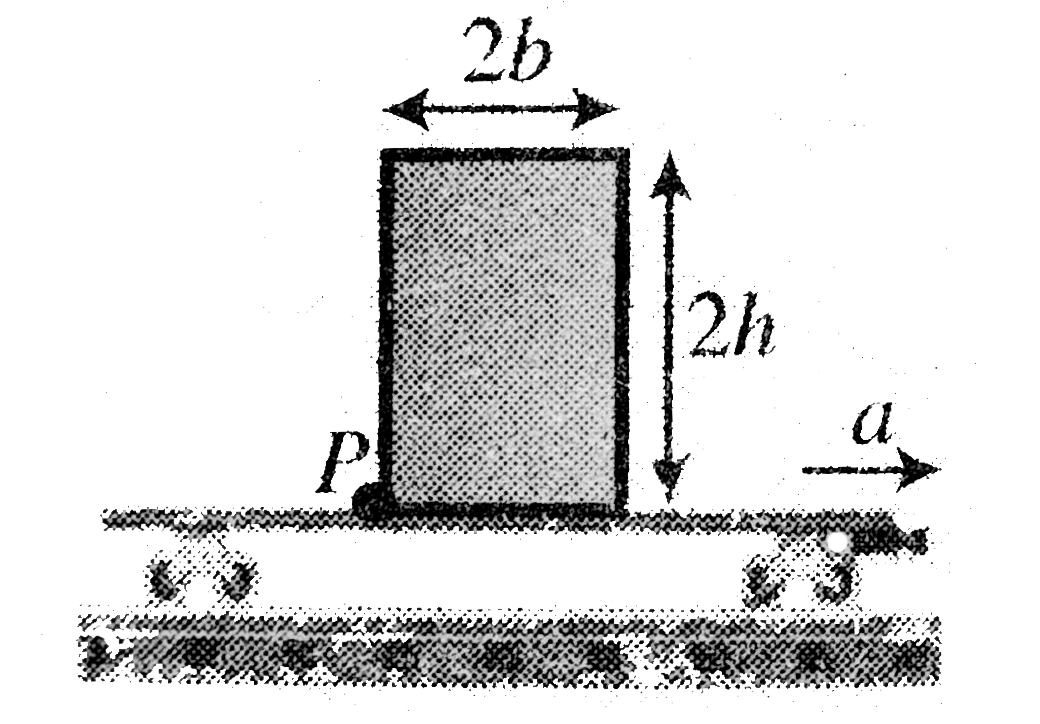
A block of mass `m` height `2h` and width `2b` rests on a flat car which moves horizontally with constant acceleration a as shown in figure. Determine

a. the value of the acceleration at which slipping of the block on the car starts, if the coefficient of friction is `mu`.
b. the value of the acceleration at which block topples about `A`, assuming sufficient friction to prevet slipping and
c. the shortest distance in which it can be stopped from a speed of `20 ms^(-1)` with constant deceleration so that the block is not disturbed. The following data are given `b=0.6 m, h=0.9 mu=0.5` and `g=10ms^(-2)`

Text Solution

Verified by Experts
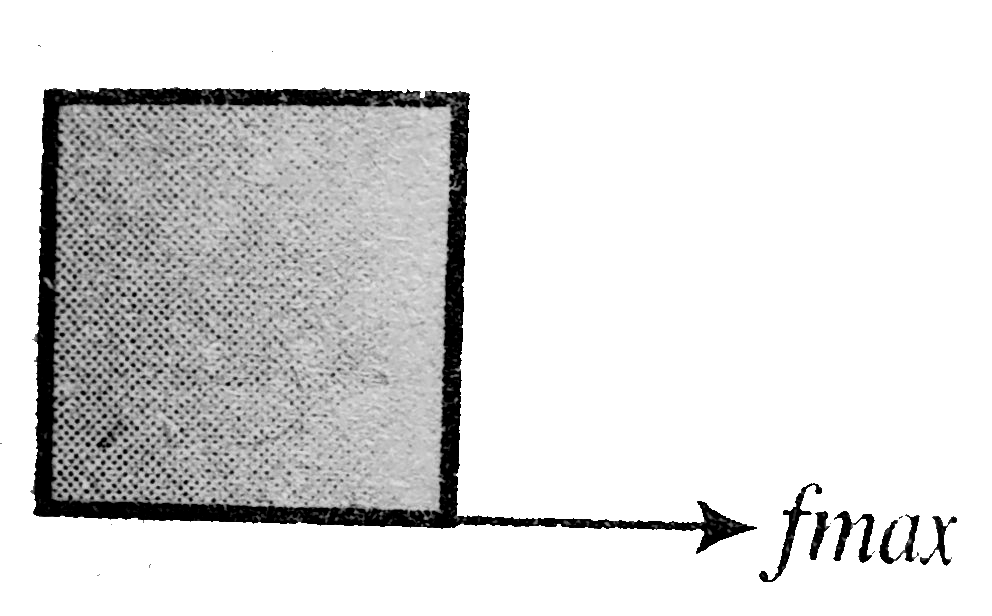
a. Maximum frictionnal force between block and car will be limiting force.

`implies f_("max")=mumg`
The maximum possible acceleration of block can be
`a_(max)=f_("max")/m=(mumg)/m=mug=(0.5)(10)=5ms^(-2)`
if acceleration of car, exceeds this value slipping will start between the block and the car.
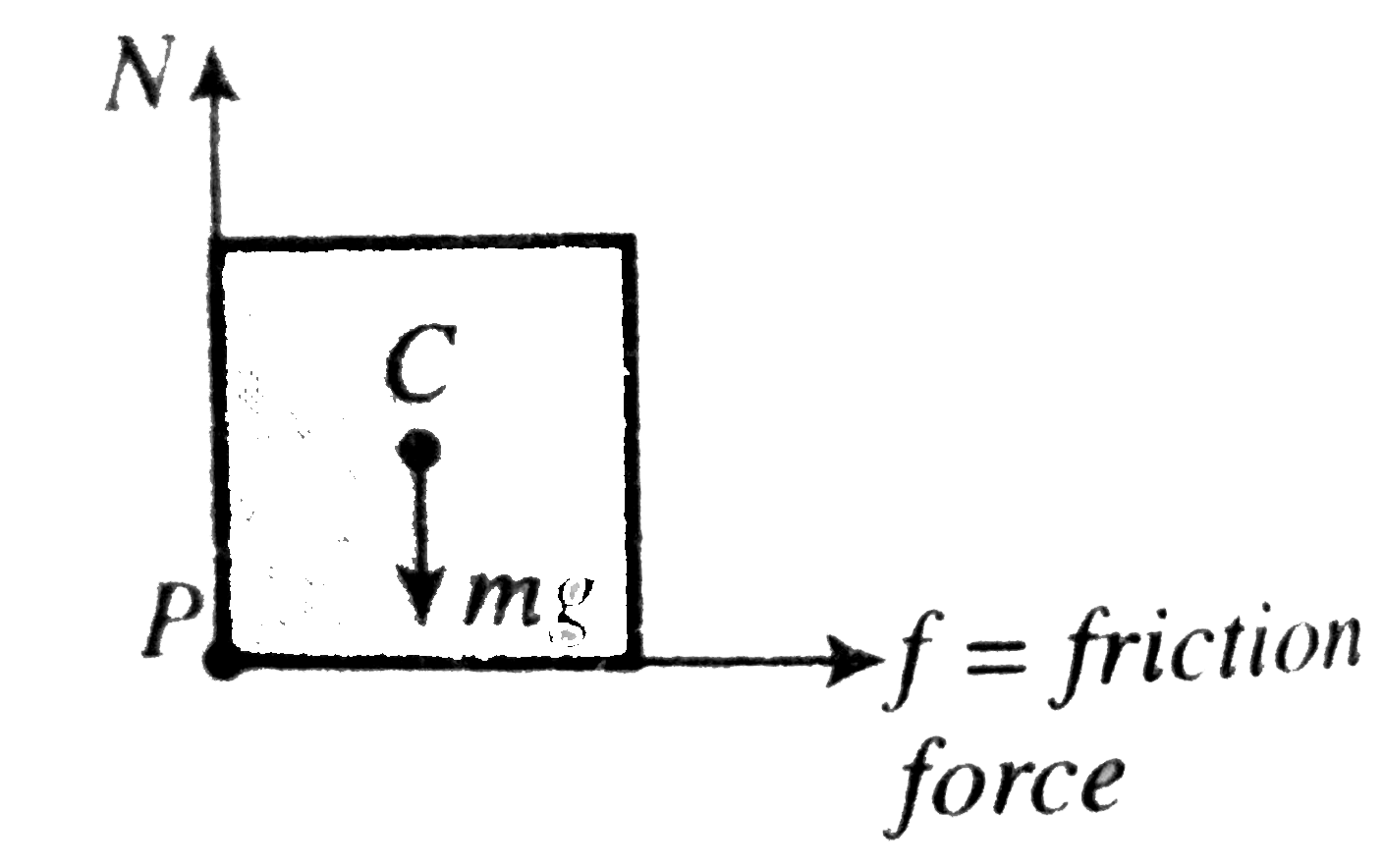
b. In the case when the block is about to topple about `P`, normal reaction will pass through `P`. The friction will be static nature.
`f=ma` ............i
`N=mg`.......ii
the block topples when torque of f about `CM` exceeds the torque of `N`.
The block topples when torqe of f about `CM` exceeds the torque of `N`.
In case of the limiting value` tau_(f)=tau_(N)`

or `(f)(h)=(N)(b)`
`(ma)(h)=(mg)(b)`
or `a=(b/h)g=(0.6/0.9)(10)=60/9ms^(-2)`
so, if the acceleration of car exceeds this value the block will topple about `A`.
c. the maximum acceleration /retardation at which the block is not disturbed, is the smaller of the two values, obtained above i.e, `5ms^(-2)`
Hence the maximum retardation can be `5ms^(-2)`
Now using `v^(2)=u^(2)-2as`
Initial velocity `u=0`
`s=u^(2)/(2a)(a=5ms^(-2))=((20)^(2))/((2)(5))` or `s=40 m`
Promotional Banner

Topper's Solved these Questions

  • RIGID BODY DYNAMICS 1

    CENGAGE PHYSICS|Exercise Exercise 2.1|6 Videos
  • RIGID BODY DYNAMICS 1

    CENGAGE PHYSICS|Exercise Exercise 2.2|17 Videos
  • RIGID BODY DYNAMICS 1

    CENGAGE PHYSICS|Exercise Integer|11 Videos
  • PROPERTIES OF SOLIDS AND FLUIDS

    CENGAGE PHYSICS|Exercise INTEGER_TYPE|2 Videos
  • RIGID BODY DYNAMICS 2

    CENGAGE PHYSICS|Exercise Interger|2 Videos

Similar Questions

Explore conceptually related problems

A force F accelerates a block of mass m on horizontal surface. The coefficient of friction between the contact surface is . The acceleration of m will be -

Acceleration of block A varies with time as shown in figure the value of coefficient of kinetic friction between block A and B is

Two block of masses m1 and m2 are connected with a massless unstretched spring and placed over a plank moving with an acceleration 'a' as shown in figure. The coefficient of friction between the blocks and platform is mu

A block of mass 4 kg is pressed againest the wall by a force of 80N as shown in figure Determine the value of the friction force and block's acceleration (Take mu_(s) = 0.2 , mu_(s) = 0.15)

The block B starts from rest and slides on the wedge A which can move on a horizontal surface, Neglecting friction, determine (a) the acceleration of wedge, (b) the acceleration of the block relative to the wedge.

Block B rests on a smooth surface .The coefficient of static friction between A and B is mu = 0.4 where F = 30 N then Acceleration of upper block is

Block B rests on a smooth surface .The coefficient of static friction between A and B is mu = 0.4 where F = 30 N then Acceleration of lower block is