Home
Class 11
PHYSICS
Determine the minimum coefficient of fri...

Determine the minimum coefficient of friction between a thin rod and a floor at which a person can slowly lift the rod from the floor, without slipping, to the vertical position applying at its end a force always perpendicular to its length.

Text Solution

Verified by Experts
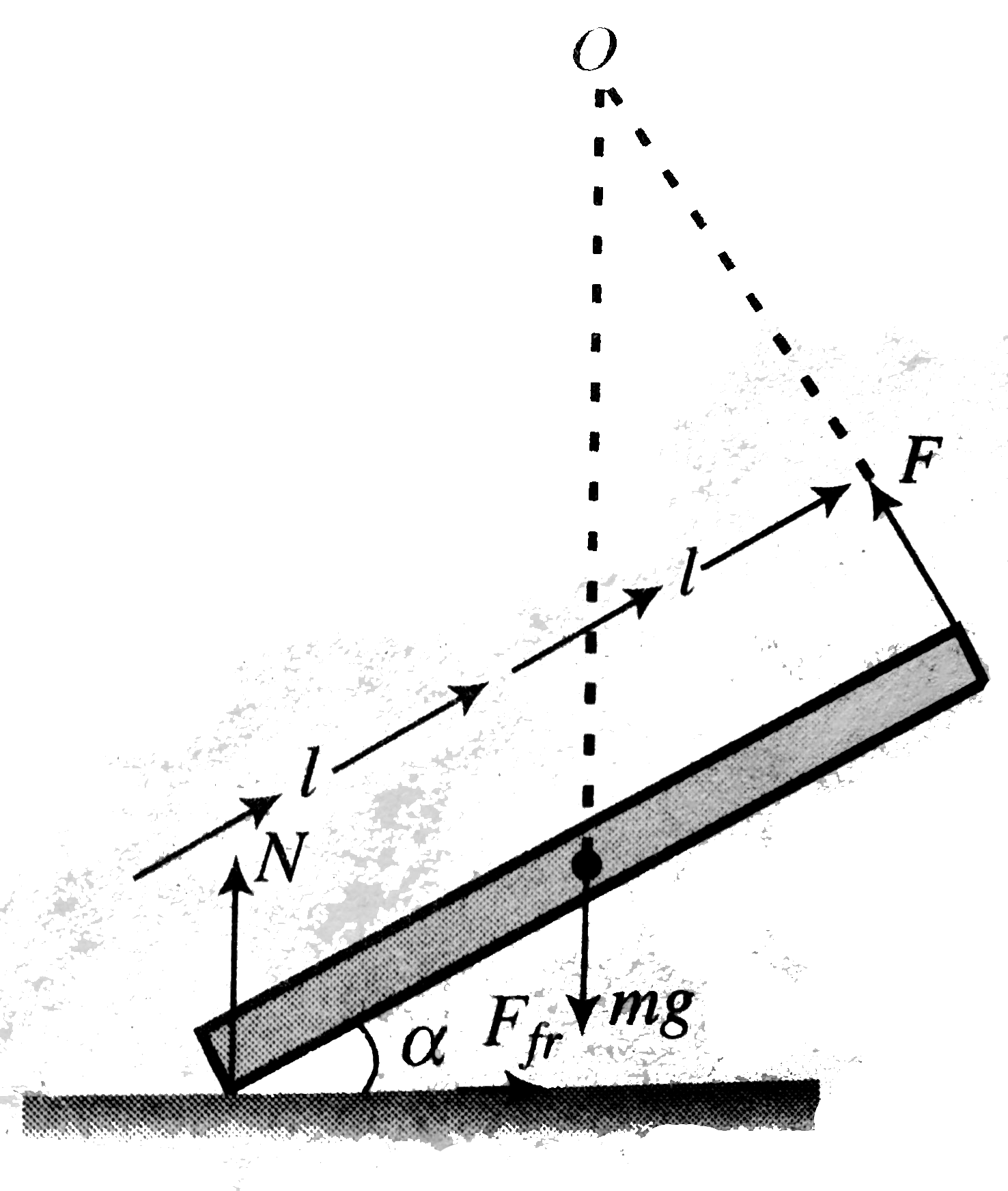
We consider the equilibrium of the rod when it is inclined at an angle `alpha` with the horizontal. The forces acting on the rod are shown in figure.

We consider torque about the point of intersection of the force of gravity, `mg`, and the force `F` applied by the person perpendicular to the rod. Since the torque of thee fores about this point is zero, it eliminates the unknown force `F`.
`sumtau=Nlcosalpha-F_("fr")l(1/(sinalpha)+sinalpha)=0`.......i
moment arm for `N` is `l cosalpha,` while for friction is
`l/(sinalpha)+lsinalpha`
From equation i we get
`F_("fr")=N(cosalphasinalpha)/(1+sin^(2)alpha)=N(cosalphasinalpha)/(2sin^(2)alpha+cos^(2)alpha)`
`=N1/(2tanalpha cotalpha)`
As the force on friction cannot exceed `muN`, we have `muge1/(2tanalpha+cotalpha)`
`mu` is minimum when `2tanalpha+cotalpha` is maximum,
`d/(dalpha)(2tanalpha+cotalpha)=0implies2sec^(2)alpha-cosec^(2)alpha=0`
`tanalpha=1/(sqrt(2))`
Thus the required coefficient of friction is `mu_("min")=1/(2sqrt(2))`
Promotional Banner

Topper's Solved these Questions

  • RIGID BODY DYNAMICS 1

    CENGAGE PHYSICS|Exercise Exercise 2.1|6 Videos
  • RIGID BODY DYNAMICS 1

    CENGAGE PHYSICS|Exercise Exercise 2.2|17 Videos
  • RIGID BODY DYNAMICS 1

    CENGAGE PHYSICS|Exercise Integer|11 Videos
  • PROPERTIES OF SOLIDS AND FLUIDS

    CENGAGE PHYSICS|Exercise INTEGER_TYPE|2 Videos
  • RIGID BODY DYNAMICS 2

    CENGAGE PHYSICS|Exercise Interger|2 Videos

Similar Questions

Explore conceptually related problems

Determine the minimum coefficient of friction mu_(min) between a thin homogeneous rod and a floor at which a person can slowly lift the rod from the floor without slippage to the vertical position, applying to its end a force perpendicualr to it.

The moment of inertia of thin rod of linear density lambda and length l about an axis passing through one end and perpendicular to its length is

A block of mass m slips on a rough horizontal table under the action of horiozontal force applied to it. The coefficient of friction between the block and the table is mu . The table does not move on the floor. Find the total frictional force aplied by the floor on the legs of the table. Do you need the friction coefficient between the table and the floor or the mass of the table ?

Consider a thin uniform rod having length 'L' and mass 'M'. Its moment of inertia about an axis passing through mid-point between centre point and one end and perpendicular to its length is

The friction coefficient between the board and the floor shown in figure is mu Find the maximum force that the man can exert on the rope so that the board does not slip on the floor

The moment of inertia of a thin uniform rod of mass M and length L about an axis perpendicular to the rod, through its centre is I . The moment of inertia of the rod about an axis perpendicular to rod through its end point is

A thin rod of length L is vertically straight on horizontal floor. This rod falls freely to one side without slipping of its bottom. The linear velocity of centre of rod when its top end touches floor is

A uniform ladder of length 3.25 m and weight 250 N is placed against a smooth vertical wall with its lower end 1.25 m from the wall. If coefficient of friction between the ladder and the floor is 0.3, then, find the frictional force acting on the ladder at the point of contact between ladder and floor.

M.I. of a thin uniform rod about the axis passing through its centre and perpendicular to its length is ML^(2)//12 . The rod is cut transversely into two halves, which are then riveted end to end.M.I. of the composite rod about the axis passing through its centre and perpendicular to its length will be

