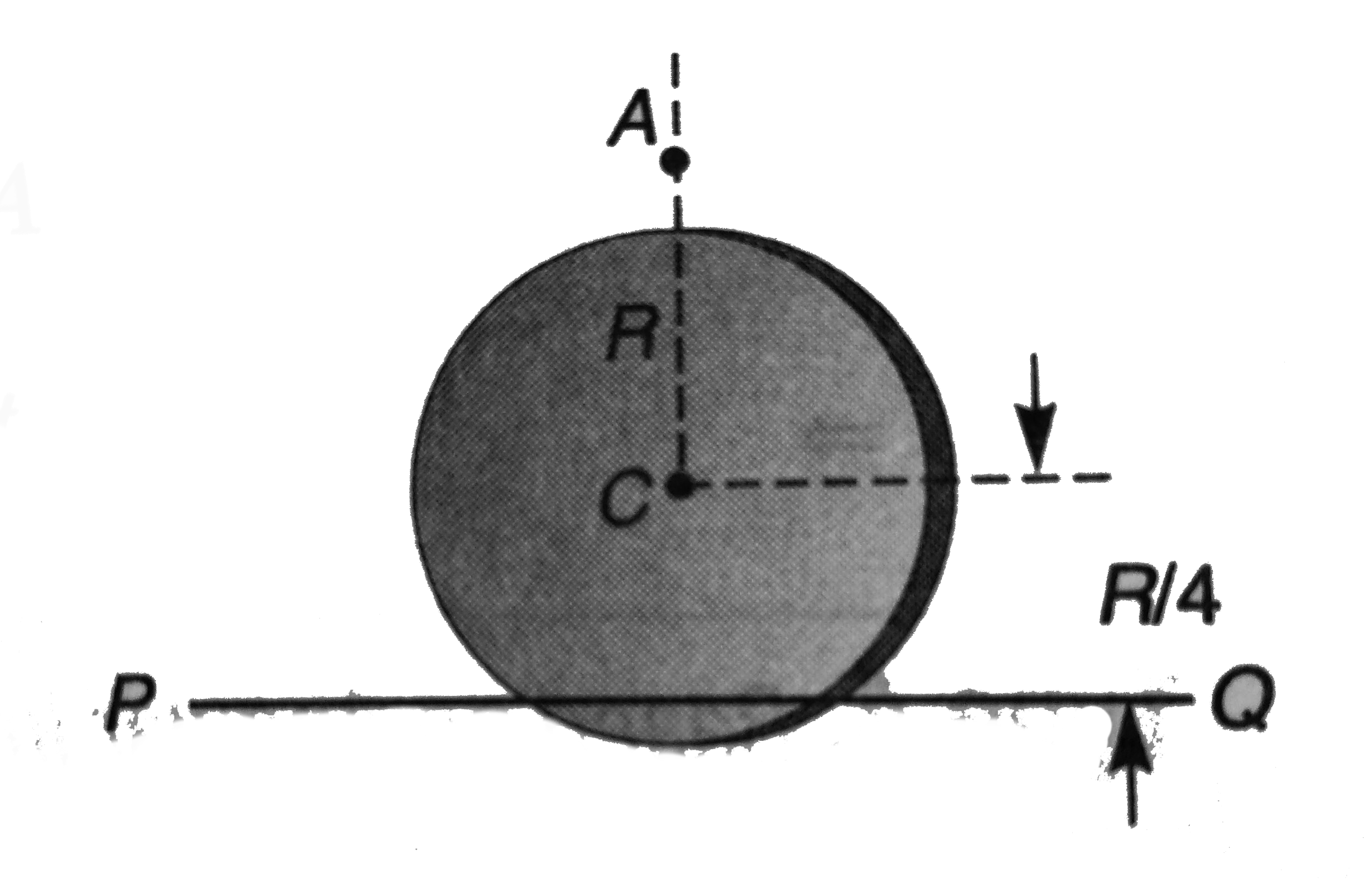
During the fall the disc mas system gains rotational kinetic energy. This is the expense of potential energy.
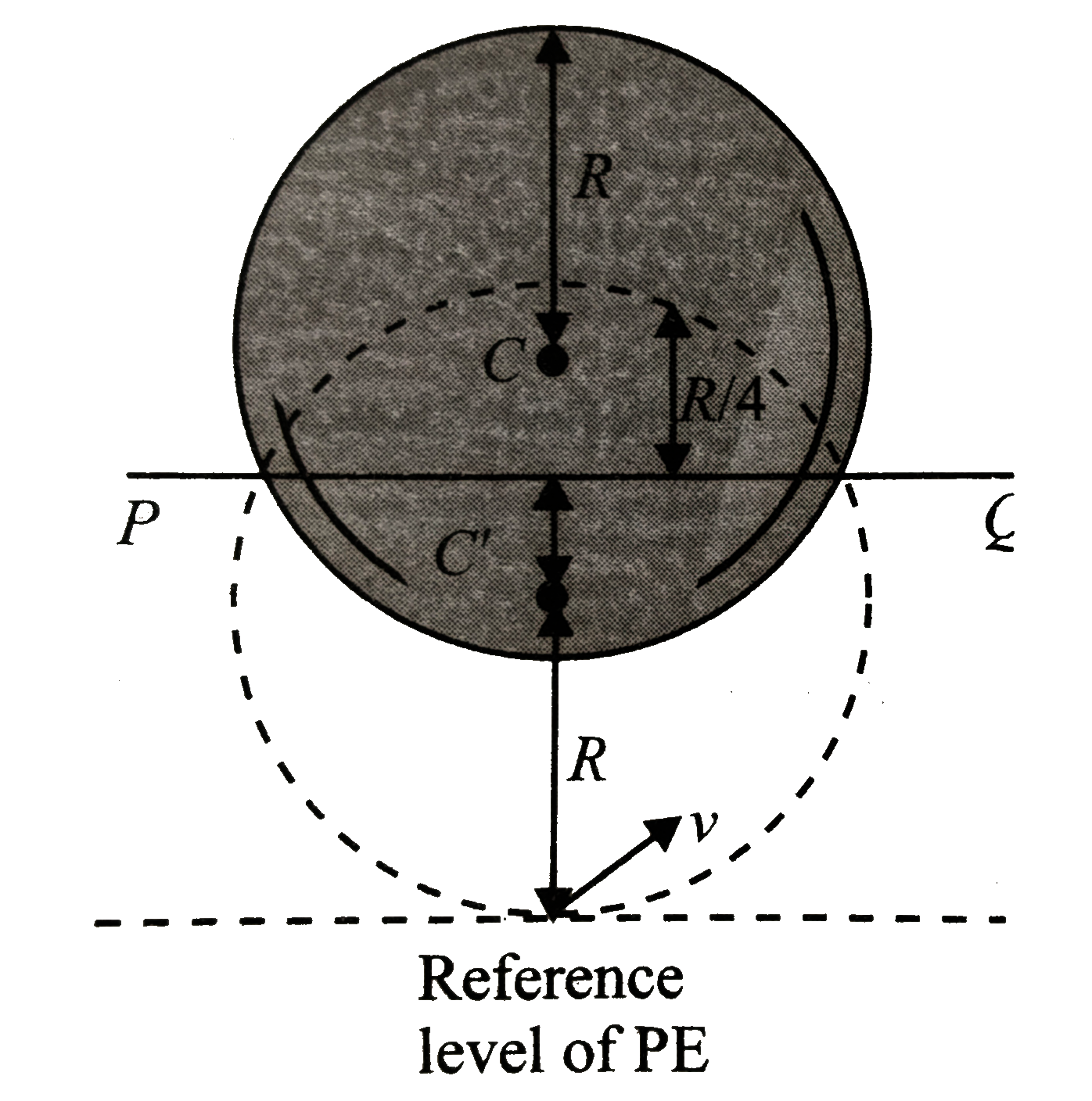
Applying conservation of mechanical energy, we get
Initial total energy `=` Final total energy
`mg(2R+(2R)/4)+mg(R+(2R)/4)=mgR+1/2Iomega^(2)`
where `I=MI` of the disc mass system about `PQ`
`=mg+(10R)/4+mg(6R)/4=mgR+1/2omega^(2)`
`implies 3mgR=1/2IOmega^(2)`
`implies w=(sqrt(6mgR)/1)`...........i
`(I)_(PQ)=(I_("disc"))_(PQ)+(I_("mass"))_(PQ)`
`=[(mR^(2))/4+M(R/4)2]+m((5R)/4)^(2)`
[Therfore `MI` of disc about the diameter `=(1/4)MR^(2)`]
`=(mR^(2)[4+1+25])(15mR^(2))/8`...........ii
Form eqn i and ii `omega=sqrt((6mgRxx8)/(15mR^(2)))=sqrt((16g)/(5R))`
Let `v` be velocity of mass `m` at the lowest point of rotation
`v=omega(R+R/4)`
`=sqrt((16g)/5g)xx(5R)/4=sqrt(5gR)`