Let us take the origin at `P,x`-axis along the horizonntal and `y`-axis along the vertically upward direction as shown in figure.
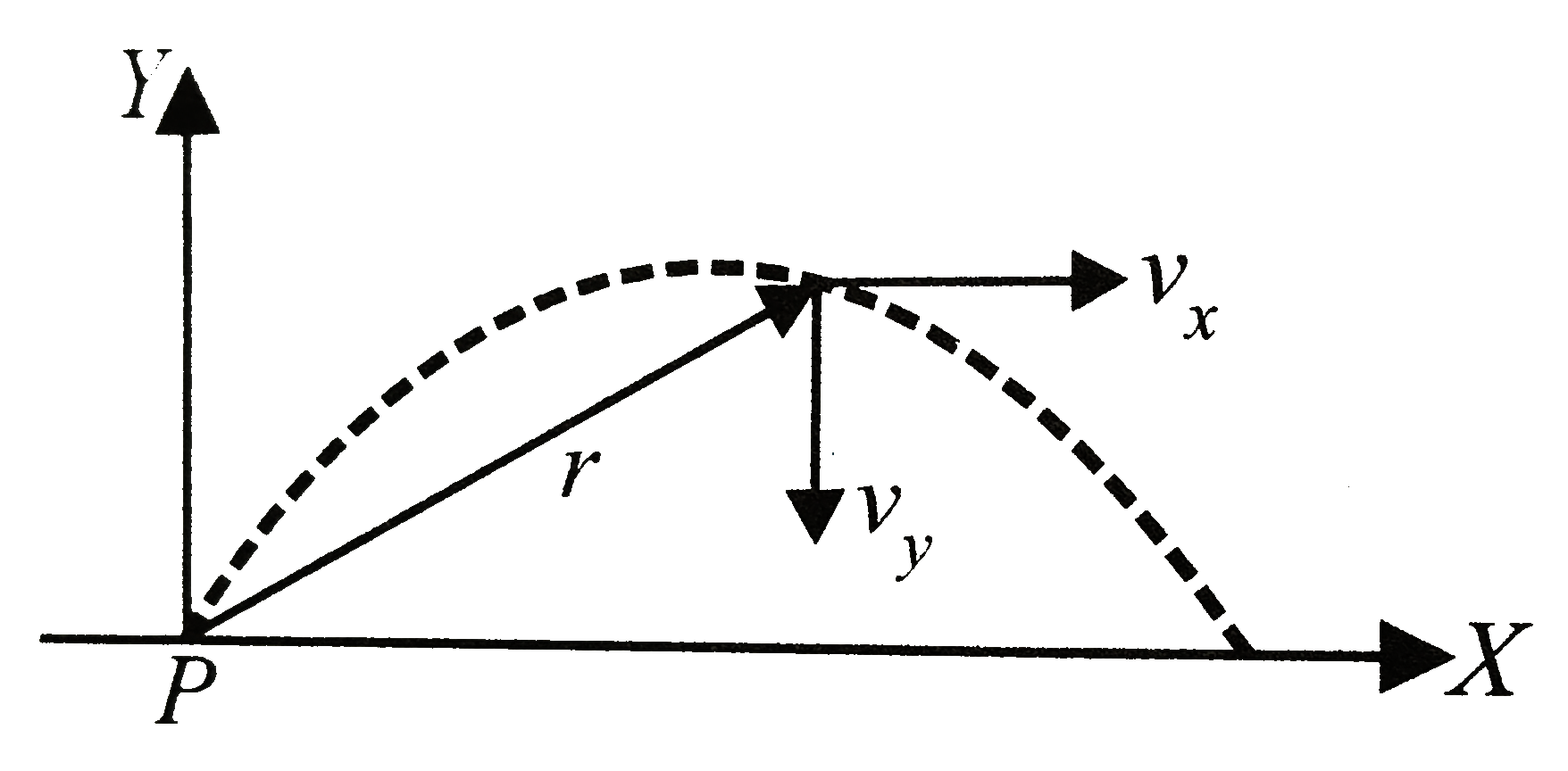
For horizontal motion during the thime `0` to `t`,
`v_(x)=v_0cos45^@=(v_(0))/(sqrt(2))`
and `x=v_(x)t=(v_(0))/(sqrt(2)) (v_(0))/g=(v_(0)^(2))/(sqrt(2)g)`
For vertical motion using `v_(y)=v_(sigmay)-"gt"`
`v_(y)=v_(0)sin45^@-g((v_(0))/g)=((1-sqrt(2)))/sqrt(2)v_(0)`
and `y=(v_(0)sin45^@)t-1/2"gt"^(2)`
`implies y=(v_(0))/(sqrt(2))(v_(0))/g)-1/2g((v_(0))/g)^(2)=(v_(0)^(2))/(2g) sqrt(2-1)`
The angular momentum of the particle at time `t` about the origin is
`L=vecrxxvecp=m(vecrxxvecv)`
`=(vecix +vecjy)xx(v_(x)veci+v_(y)vecj)=m(veckxv_(y)-veckyv_(x))`
`=mveck[((v_(0)^(2))/(sqrt(2)g))(v_(0))/sqrt(2)(1-sqrt(2))-(v_(0)^(2))/(2g)(sqrt(2)-1)(v_(0))/(sqrt(2))]`
`=-veck(mv_(0)^(3))//(2sqrt2g)`
Thus, the angular momentum of the particle is `mv_(0)^(3)//(2sqrt(2)g)` in the negative `Z`-direction, i.e., perpendicular to the plane of motion going into the plane.


