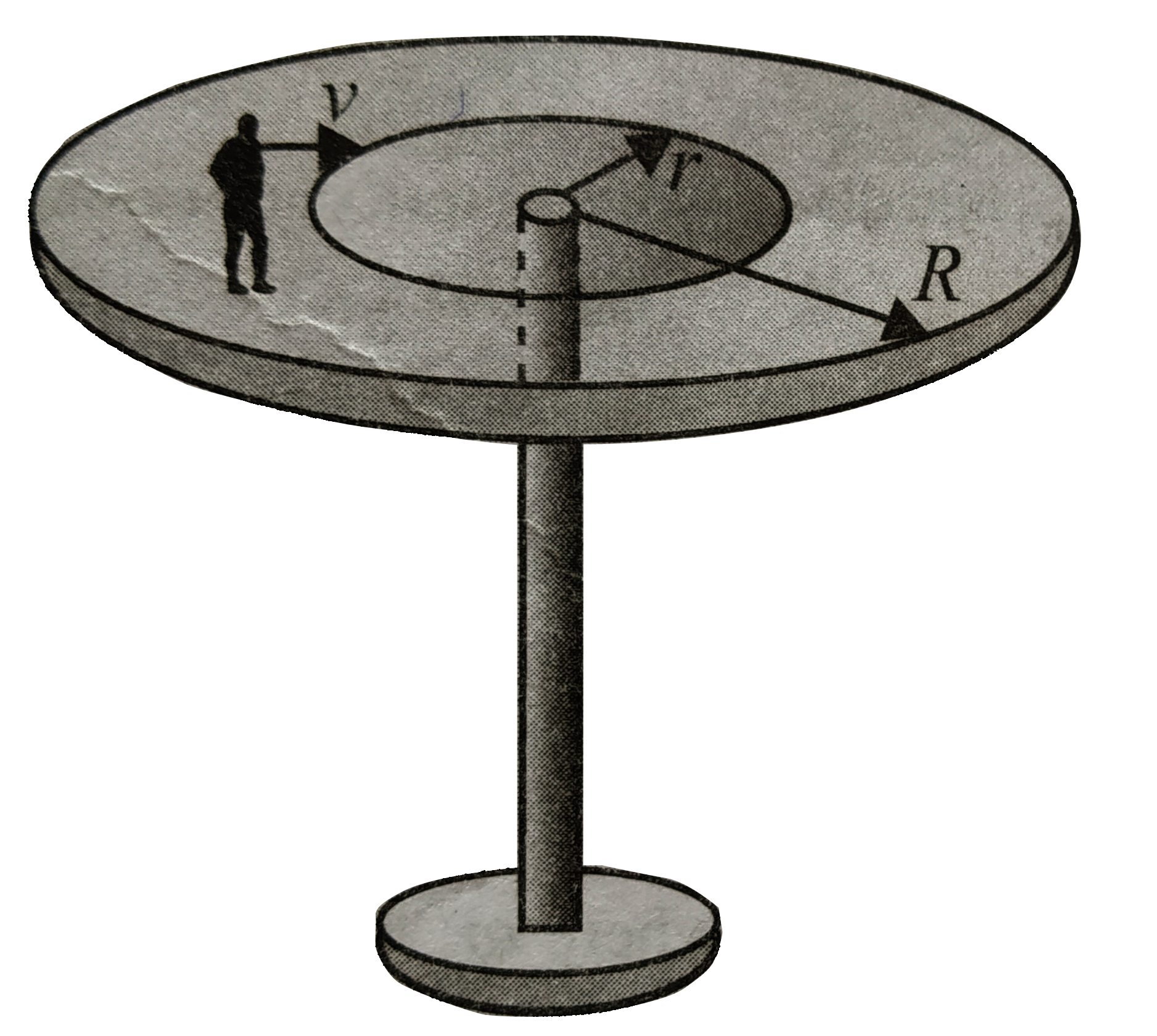
A man of mass `m` stands on a horizontal platform in the shape of a disc of mass `m` and radius `R`, pivoted on a vertical axis through its centre about which it can freely rotate. The man starts to move around the centre of the disc in a circle of radius `r` with a velocity `v` relative to the disc. Calculate the angular velocity of the disc.
Text Solution
Verified by Experts
Since there is no torque acting about the axis of rotation of the disc, so the angular momentum of the system (disc`+`man) remains constant. Initially it is zero. Suppose `omega` is the angular velocity of the disc (take positive in the sense of motion of the man). The velocity of the man with respect to the ground observer will be: `vecv_("man, disc")=vecv_("man")-vecv("disc")` `impliesvecv_("man")=vecv("man,disc")-vecv_("disc")` or `vecv_("man")=v-omegar` Thus, angular momentum of the man `=m(v-omegar)r` And angular momentum of the disc is `I_("disc") omega=(MR^(2))/2omega` By conservation of angular momentum, we have `m(v-omegar)=(MR^(2))/2omega` After solving, we get `omega=(mvr)/((mvr^(2)+(MR^(2))/2)`
A man of mass m_1 stands on the edge of a horizontal uniform disc of mass m_2 and radius R which is capable of rotating freely about a stationary vertical axis passing through its centre. At a certain moment the man starts moving along the edge of the disc, he shifts over an angle varphi^' relative to the disc and then stops. In the process of motion the velocity of the man varies with time as v^'(t) . Assuming the dimensions of the man to be negligible, find: (a) the angle through which the disc had turned by the moment the man stopped, (b) the force moment (relative to the rotation axis) with which the man acted on the disc in the process of motion.
A man of mass m stands on the edge of a horizontal unifom disc of mass M and radius R whichis capable of rotating freely about a stationary vertical axis passing through its center. At a certain moment the man starts moving along the edge of the disc, he shifts over angle theta relative to the disc and then stops. Find the angle through which the disc rotates.
A man of mass m_(1) stands on the edge of a horizontal uniform disc of mass m_(2) and radius R which is capable of rotating freely about a stationary vertical axis passing through its centre . The man walks along the edge of the disc through angle theta relative to the disc and then stops . find the angle through which the disc turned the time the man stopped . [(2m_(1)theta)/(2m_(1) + m_(2))]
A disc of radius r is removed from the centre of a disc of mass M and radius R. The M.I. About the axis through the centre and normal to the plane will be:
A insect of mass m stands on a horizontal disc platform of moment of inertia 1 which is at rest. What is the angular velocity of the disc platform when the insect goes along a circle of radius r, concentric with the disc, with velocity v relative to the disc.
A uniform disc of mass M and radius R is pivoted about the horizontal axis through its centre C A point mass m is glued to the disc at its rim, as shown in figure. If the system is released from rest, find the angular velocity of the disc when m reaches the bottom point B.
Calculate the moment of Inertia of a semicircular disc of mass M and radius R about an axis passing through its centre and perpendicular to its plane.
A uniform disc of mass M and radius R is rotating about a horizontal axis passing through its centre with angular velocity omega . A piece of mass m breaks from the disc and flies off vertically upwards. The angular speed of the disc will be