A small block of mass `4kg` is attached to a cord passing through a hole in a horizontal frictionless surface. The block is originally revolving in a circle of radius `0.5 m` about the hole with a tangential velocity of `4m//s`. The cord is then pulled slowly from below, shorting the radius of the circle in which the block revolves. The breaking strength of the cord is `600 N`. What will be radius of the circle when the cord breaks?
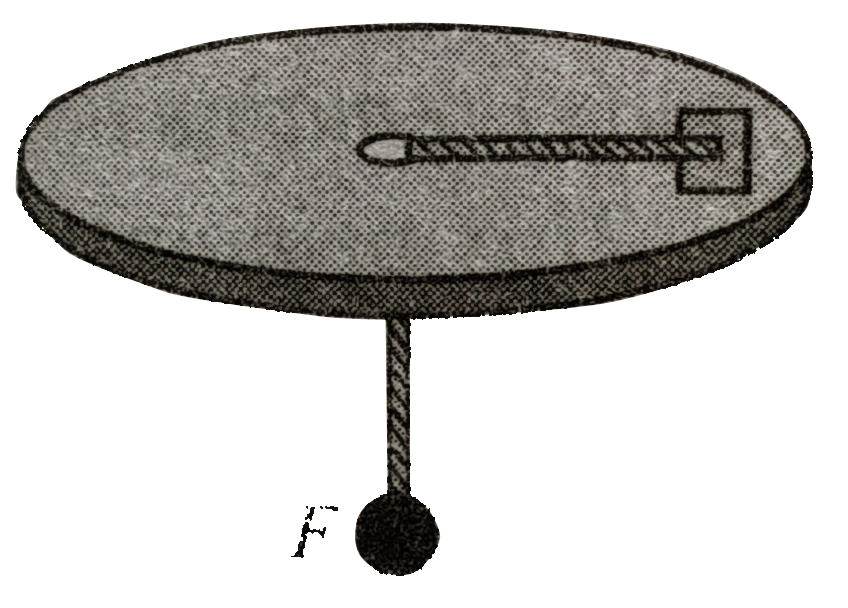
A small block of mass `4kg` is attached to a cord passing through a hole in a horizontal frictionless surface. The block is originally revolving in a circle of radius `0.5 m` about the hole with a tangential velocity of `4m//s`. The cord is then pulled slowly from below, shorting the radius of the circle in which the block revolves. The breaking strength of the cord is `600 N`. What will be radius of the circle when the cord breaks?
Text Solution
Verified by Experts
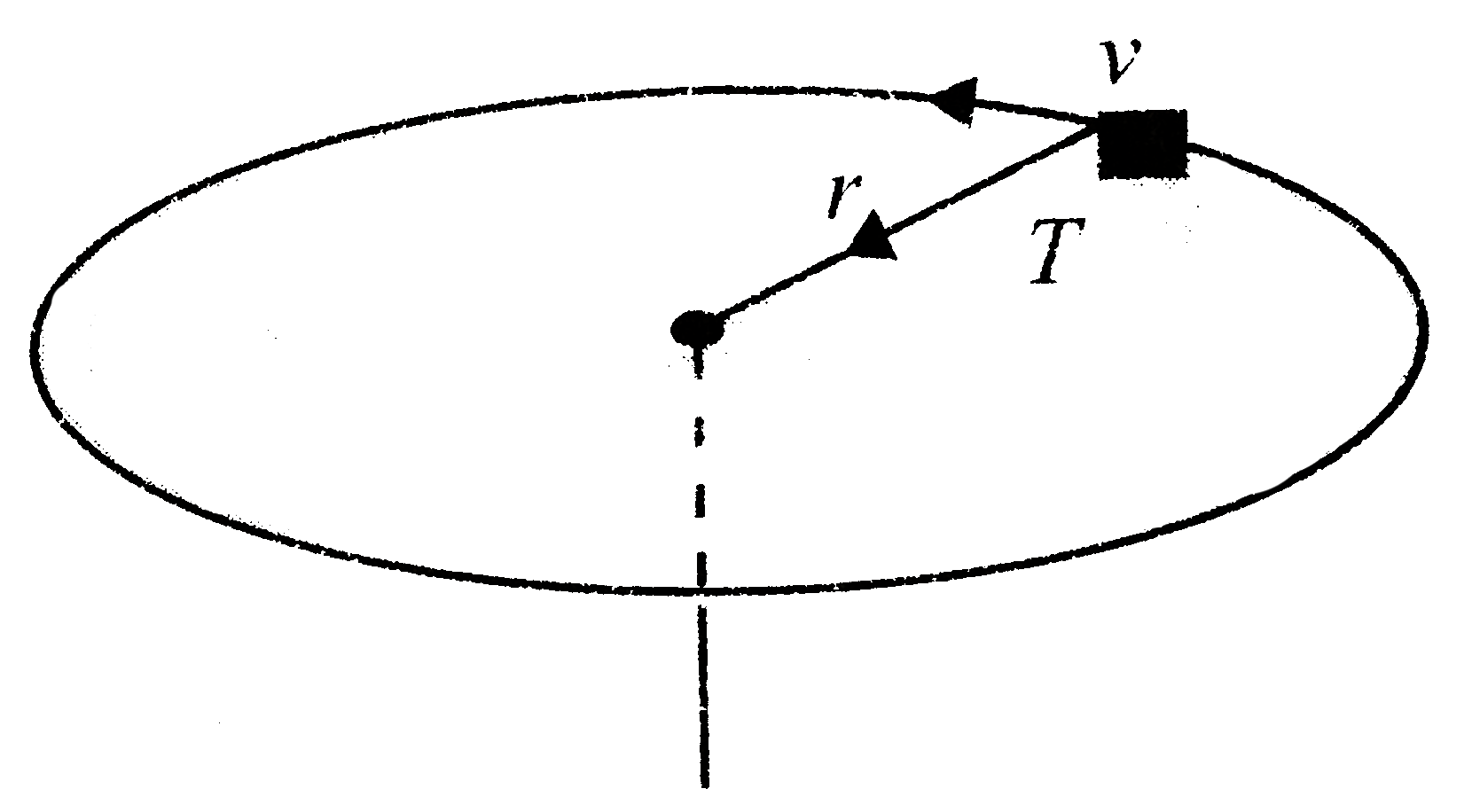
The tension of the rope is the only net force on the block and it does not exert any torque about the axis of rotation. Hence the angular momentum of the block about the axis should remain conserved.
`implies mvr=`constant
Let `r_(1)=0.5 m` and `v_(1)=4m//s`
Let `r_(2),v_(2),T_(2)` be the radius velocity of and tensio, respectively. when the string breaks
`impliesT_(2)=600N`
`mv_(1)r_(1)=mv_(2)r_(2)=` and `T_(2)=mv_(2)^(2)//r_(2)`
`implies mv_(1)r_(1)=msqrt((r_(2)T_(2))/m)r_(2)`
`r_(2)=((v_(1)^(2)r_(1)^(2))/(T_(2))^(1/3)=(4xx16xx0.25)/600)^(1/3)=(16/600)^(1/3)=3.0m`
`implies mvr=`constant
Let `r_(1)=0.5 m` and `v_(1)=4m//s`
Let `r_(2),v_(2),T_(2)` be the radius velocity of and tensio, respectively. when the string breaks
`impliesT_(2)=600N`
`mv_(1)r_(1)=mv_(2)r_(2)=` and `T_(2)=mv_(2)^(2)//r_(2)`
`implies mv_(1)r_(1)=msqrt((r_(2)T_(2))/m)r_(2)`
`r_(2)=((v_(1)^(2)r_(1)^(2))/(T_(2))^(1/3)=(4xx16xx0.25)/600)^(1/3)=(16/600)^(1/3)=3.0m`



Topper's Solved these Questions
Similar Questions
Explore conceptually related problems
A small block of mass 4 kg is attached to a cord passing through a hole in a horizontal frictionless surface. The block is originally revolving in a circle of radius of 5 m about the hole, with a tangential velocity of 4 m//s . The cord is then pulled slowly from below, shortening the radius of the circle in which the block revolves. The breaking strength of the cord is 200 N . What will be the radius of the circle when the cord breaks?
A small block of mass 4 kg is attached to a cord passing through a hole in a horizontal frictionless syurface . The block is originally revolving in a circle of radius 0.5 m about the hole , with a tangential velocity of 4 m/s . The cord is then pulled slowly from below , shortening the radius of the circle in which the block revolves . The breaking strength of the cord is 600 N . What will be the radius of the circle when the cord breaks ?
A small block of mass 4 kg is attached to a cord passing through a hole in a horizontal frictionless surface. The block is originally revolving in a circle of radius of 5 m about the hole, with a tangential velocity of 4 m//s . The cord is then pulled slowly from below, shortening the radius of the circle in which the block revolves. The breaking strength of the cord is 200 N . Velocity of the block at the time of breaking of the string
A block of mass 0.1 kg is attached to a cord passing through a hole in a horizontal frictionless horizontal surface as shown in the figure. The block is originally revolving at a distance of 0.4 m from the hole, with an angular velocity of "2 rad s"^(-1) . The cord is then pulled from below, shortening the radius of the circle in which the block revolves to 0.2 m. Considering the block to be point mass, calculate the new angular velocity ("in rad s"^(-1))
A puck of mass m = 50.0 g is attached to a taut cord passing through a small hole in a frictionless, horizontal surface (Fig.) The puck is initially orbiting with speed v_i = 1.50 m//s in a circle of radius r_i = 0.30 m . The cord is then slowly pulled from below, decreasing the radius of the circle to r = 0.10 m . The puck's speed at the smaller radius is. .
A small block of mass m on a horizontal smooth table is attached to a light string passing through a hole as shown in the figure. Initially, the block moves in a circle of radius r with speed v and the string is held by a person. The person pulls the strin slowly to decrease the radius of circle to r//2 . (a) Find the tension in the string when the block moves in a circle of radius r//2 . (b) Calculate the change in the kinetic energy of the block.
A point mass is tied to one end of a cord whose other end passes through a vertical hollow tube , caught in one hand. The point mass is being rotated in a horizontal circle ofradius 2 m with speed of 4m/sec.The cord is then pulled down so that the radius of the circle reduces to 1m . Compute the new linear and angular velocities of the point mass and compute the kinetic energies under the initial and final states.
Figure shows a mass m placed on a frictionless horizontal table and attached toa string passing through a mall hole in the surface. Initially, themas movesin a circle of radius r_0 with a speed v_0 and the ree end of the string is held by a person. The person pulls on the string slowly to decrease the radius of th circle of r. a. Find the tension in the string when the mass moves in the circle of radius r. b. Calculate the chasnge in the kinetic energy of the mass
A small block is rotating in a horizontal circle at the end of a thread which passes down through a hole at the centre of table top. If the system is rotating at 2.5 rps in a circle of 30 cm radius, what will be the speed of rotation when the thread is pulled inwards to decrease the radius to 10 cm ? Neglect friction.